Workshops und Tagungen

Erste und zweite Technik: Workshop zur zweiten Fassung von Benjamins Kunstwerkaufsatz
Workshop | 23./24. Januar 2026
Grama-Lounge, Universitätsbibliothek (Steubenstraße 6, 99423 Weimar)
Veranstaltet vom Graduiertenkolleg Medienanthropologie (GRAMA)
Wenig Aufmerksamkeit hat bisher die zweite Fassung von Walter Benjamins Aufsatz „Das Kunstwerk im Zeitalter seiner technischen Reproduzierbarkeit“ in der deutschsprachigen philosophischen Debatte erhalten.
Dabei trifft Benjamin dort eine Unterscheidung von zwei Formen der Technik, die für gegenwärtige Debatten um das Verhältnis von Autonomie und Automatisierung besonders instruktiv scheint. Während es die erste Technik Benjamin zufolge „auf Beherrschung der Natur abgesehen“ hat, ist das „Zusammenspiel zwischen der Natur und der Menschheit“ Ziel der zweiten Technik. Anders als zahlreiche entfremdungskritische Analysen, betont Benjamin die mit der Automatisierung der Technik verbundenen Freiheitspotentiale, die zugleich unausgeschöpft bleiben müssen, solange die zweite Technik „der heutigen Gesellschaft als eine zweite Natur gegenüber“ steht. Dieser Ambivalenz der zweiten Technik und den historischen, ökonomischen, genealogischen sowie ästhetischen Dimensionen der Unterscheidung möchten wir in einem zweitägigen close-reading-Workshop nachgehen.
Wie lässt sich die „emanzipierte Technik“ von ihrer Gestalt als „zweiter Natur“ trennen? Welcher Rolle kommt dabei reproduktiver Kunst und insbesondere dem Film zu, die Benjamin als Formen der „Einübung in dieses Zusammenspiel“ begreift? Mit der Unterscheidung von erster und zweiter Technik verbindet Benjamin zugleich eine genealogische Perspektive auf den Zusammenhang von Befreiung und Disziplinierung. So heißt es in der zweiten Fassung des Kunstwerkaufsatzes: „Der Ursprung der zweiten Technik ist da zu suchen, wo der Mensch zum ersten Mal und mit unbewußter List daran ging, Abstand von der Natur zu nehmen“. Nicht nur begreift Benjamin die Abstandnahme von der Natur als einen prä-reflexiven Prozess, der noch aller bewussten Formen vorausgeht, mit denen sich die menschlichen Subjekte die Natur zum Gegenstand theoretischer Erkenntnis und praktischem Wollen machen. Darüber hinaus bringt Benjamin diese Art der prä-reflexiven Abstandnahme zur Natur, im Gegensatz etwa zu neohegelianischen Ansätzen, nicht mit Prozessen der Gewöhnung und Disziplinierung in Verbindung, sondern mit Spiel und Experiment. Inwiefern ermöglicht Benjamins Unterscheidung ein neues Verständnis des Zusammenhangs von Spiel und Befähigung?
Diesen und vielen weiteren Fragen werden wir in einem kollektiven close-reading der „zweiten Fassung“ (Gesammelte Schriften, Suhrkamp, Band VII 1) des Kunstwerkaufsatzes gemeinsam nachgehen.
Die von Benjamin unveröffentlichte Version des Kunstwerkaufsatzes ist eine von mittlerweile fünf in der kritischen Gesamtausgabe (Suhrkamp, Band 16, 2013) vorliegenden Fassungen. Während diese Version in der deutschsprachigen Diskussion um Benjamins Medienästhetik bisher nur eine geringe Rolle spielt, verhält sich dies, wie aktuelle Publikationen zeigen (vgl. Hansen 2012, Friedlander 2024), im englischsprachigen Raum anders, was nicht zuletzt durch die Übersetzung der zweiten Fassung im Jahr 2008 (Harvard University Press) angeregt wurde. Insofern soll der Workshop auch einen Beitrag zu einer Diskussion leisten, die in der internationalen Benjamin-Forschung bereits vorangeschritten ist. Mit der zweiten Fassung werden wir auch jene Textfassung diskutieren, die im Umfeld des Frankfurter Instituts für Sozialforschung der zentrale Gegenstand der Kontroverse um die Frage nach den Emanzipationsmöglichkeiten von Massenkultur und neuer technischer Medien gewesen ist. Im Workshop werden wir daher auch der verästelten Entstehungs- und Rezeptionsgeschichte des Kunstwerkaufsatzes nachgehen.
In insgesamt 7 Panels werden wir den Kunstwerkaufsatz von Anfang bis Ende diskutieren. Nach kurzen Impulsen verschiedener Wissenschaftler*innen wird dabei ausreichend Zeit für die gemeinsame Textdiskussion vorhanden sein.
Eine genaue Textkenntnis ist Voraussetzung des Workshops.
Da die Teilnahmemöglichkeiten vor Ort in Weimar begrenzt sind, wird es auch die Möglichkeit einer Online-Teilnahme geben. Sowohl für die Teilnahme in Präsenz vor Ort als auch online ist eine Anmeldung bis zum 12. Januar 2026 an folgende Mail-Adresse erforderlich: laurien.simon.wuest[at]uni.weimar.de
Teilnehmer*innen: Astrid-Deuber-Mankowsky, Maria Muhle, Eli Friedlander, Thomas Khurana, Eva Krivanec, Gertrud Koch, Sulgi Lie, Francesca Raimondi, Christiane Voss, Laurien Wüst
Programm
Freitag, 23. Januar 2026
13:00-13:30
Christiane Voss & Laurien Wüst (Weimar): Begrüßung
13:30-14:30
Maria Muhle (München): Zur Entstehungs- und Rezeptionsgeschichte
14:30-15:45
Eli Friedlander (Tel Aviv): Abschnitte I-V, Input
– 15 Minuten Kaffeepause –
16:00-17:30
Thomas Khurana (Potsdam): Abschnitt VI
17:30-18:45
Eva Krivanec (Weimar): Abschnitt VII-XI
Samstag, 24. Januar 2026
09:30-11:00
Gertrud Koch (Berlin) & Sulgi Lie (Weimar): Abschnitt XII-XV
11:00-12:15
Astrid Deuber-Mankowsky (Bochum): Abschnitt XVI-XVIII
– 30 Minuten Kaffeepause –
12:45-14:00
Francesca Raimondi (Berlin): Abschnitt XIX

The Augmented Body: Affectivity, Perception, and Life in the Digital Age
Workshop | 18. Dezember 2025
Grama-Lounge, University Library (Steubenstraße 6, 99423 Weimar)
Organized by Ekaterina Odé (Bauhaus-University Weimar)
Online participation is possible via the following link: https://meeting.uni-weimar.de/b/rooms/4m4-zu8-zqj-my6/join
In the digital age, the human body is no longer merely extended by tools—it is reconfigured through its media-technical environments, the body is mediated, co-constituted by dispositifs that reshape its relation to the world, reconfigure its capacity to feel, and transform the very structures of affectivity. This workshop departs from the premise that the augmented body is not simply a body-plus-technology, but rather a site of individuation and exteriorization—a space where action, perception, and affectivity are continuously redistributed. The question is no longer whether the human body is transformed by technology, but how profoundly such transformations affect the conditions of embodiment, sensibility, and ontological structure. What we used to understand as the human body now encompasses a different dimension—comprising extra-human living and non-living matter, cultural, political, and economic layers, etc. On one hand, it seems that the body (corps propre) has, in many ways, been replaced by configurations such as the political body, the digital body, or interface bodies—or perhaps more radically, the anthropomedial body. On the other hand, the extended body constitutes a new locus of being-in-the-world—a new opening to action, identification, relationality, and nature. How we exist is no longer tied to the physical body per se (corps propre), but to a whole set of configurations constituted through lived experience (vécu)—almost in an algorithmic manner. In this context, the notion of the augmented/digital body must be rethought.
Schedule
10:00-10:30
Ekaterina Odé: Welcome & Opening Remarks
10:30-12:30 | Panel I: Affective Infrastructures & Networked Selves
Chair: Nathalie Schäfer
- Ulrike Wirth: Engaged and Dispersed: Hyperreactivity (Kohout) in Homophilic (Chun) Digital Neighborhoods
- Jens Kraushaar: On Mirror Dwelling in VRChat
– 12:30-13:30 | Lunch Break –
13:30-15:30 | Panel II: Fiction as Affective Environment
Chair: Vanessa Franke
- Sebastian Lederle: Recollecting the Lost Environment of Cinema: Immersion and Dislocation in Sam Mendes’ Empire of Light
- Katja Hettich: Readers as Augmented Bodies: Affective Entanglements through Literary Fiction
– 15:30-16:00 | Coffee Break –
16:00-17:30 | Panel III: Interfaces and Immersion
Chair: Ekaterina Odé
- Niklas Fabian Becker: Augmenting the Body, Augmenting Reality? Body-Technology-Relations (co-)constituting a ‘Virtually’ Augmented Reality
- Ekaterina Odé: Sharing the real: from anesthesia to a new body
– 18:00 | Conference Dinner –

Nature Thinking
Bauhaus-Hopkins Summer Lab on Comparative Thought
June 18th – 21st 2025
There are so many ways to hear the word “nature.” An incomplete list:
Nature, some say, is what appears, as a given world of entities and potentials; it encompasses all organic, inorganic and non-organic things, as well as the more elusive currents, atmospheres, virtualities, intensities.
Nature, some say, is a primordial or mythical unity, or an expression of God(s) or Gaia.
Nature, some say, indexes the sites of relentless exploitation and ecological collapse produced by global capitalism.
Nature, some say, shows itself to be profoundly relationally and accessible only through mediations; we can encounter it only through perception, intuition, imagination, and various kinds of aesthetic and techno-scientific entanglements.
Nature, some say, is an illusionary projection of representational systems or a useful/violent fiction.
Nature, some say, is no more than a term of contrast – the other to humanity, culture, technology, civilization, meaning.
Some say we have reached the end of “nature,” the final erosion of the value of the concept.
The Bauhaus-Hopkins Summer Lab on Comparative Thought for its inaugural year of 2025, wonders whether the “nature” can or should be dispensed with. Is there something valuable about the chronically over- or under-determined figure of nature? Can it teach us anew about ourselves and our existential entanglements? What concepts and images and narratives and performances can today mark and illuminate contemporary experiences of the vitalities, necessities, creativity, violence, beauty, porosity, and inexactitude of the more-than-human world? What do and could we want to know about “nature” on an intuitive, imaginative, and experiential level? Can processes of naturalization and denaturalisation be engaged in ways that lead beyond the logics of capitalism, colonialism, anthropocentrism?
Our hypothesis is that thinking “nature” is everything but outdated. The 2025 Bauhaus–Hopkins Summer Lab on Comparative Thought will convene faculty and doctoral students who seek affirmative, idiosyncratic, and yet non-naïve, speculative approaches that might help us respond to the political, theoretical, aesthetic, pragmatic, and epistemic challenges facing the interdisciplinary humanities today
Conveners:
Jane Bennett (Johns Hopkins University); Christiane Voss (Bauhaus University Weimar); Lorenz Engell (Bauhaus University Weimar)
Unfortunately, the event is not open to the public. In individual cases, participation can be made possible on request. Please contact: christiane.lewe@uni-weimar.de.
Speakers:
Jane Bennett, Andrew W. Mellon Professor of the Humanities and a member of the Departments of Comparative Thought and Literature and Political Science, Johns Hopkins University
Héctor Canal Pardo, research assistant at the Saxon Academy of Sciences and Humanities, PROPYLÄEN. Research platform on Goethe's biographica, Goethe and Schiller Archive Weimar
Rhiannon Clarke, PhD candidate in the Spanish & Portuguese program of the Department of Modern Languages and Literatures, Johns Hopkins University
William E. Connolly, Krieger-Eisenhower Professor Emeritus of Political Theory, Johns Hopkins University
Jennifer Culbert, associate professor with a joint appointment in the departments of Political Science and Comparative Thought and Literature, Johns Hopkins University
Jessica Croteau, Mellon Post-Doctoral Fellow in the John B. Hurford ‘60 Center for the Arts and Humanities (HCAH) at Haverford College after receiving her PhD in political theory from Johns Hopkins University
David DeBole, PhD candidate in the Political Science Department, Johns Hopkins University
Astrid Deuber-Mankowsky, Professor Emerita of Media Studies and Gender Studies, Ruhr-Universität Bochum
Lorenz Engell, Professor of Media Philosophy and Dean of the Faculty of Media, Bauhaus-Universität Weimar
Vanessa Franke, PhD candidate in the Research Training Group Media Anthropology, Bauhaus-Universität Weimar
Jennifer Gosetti-Ferencei, Professor and William Kurrelmeyer Chair in German, with a secondary appointment as Professor of Philosophy and a joint appointment in Comparative Thought and Literature, Johns Hopkins University
Brahim El Guabli, Associate Professor of Arabic Studies and Comparative Literature, Johns Hopkins University
Diego León-Villagrá, PhD candidate in the Research Training Group Media Anthropology, Bauhaus-Universität Weimar
Anne Merrill, PhD candidate in the Department of Comparative Thought and Literature, Johns Hopkins University
Katrin Pahl, Professor of German and for many years co-director of the Program for the Study of Women, Gender and Sexuality, Johns Hopkins University
Jörg Paulus, Professor of Archival and Literary Studies, Bauhaus-Universität Weimar
Martin Siegler, post-doctoral research assistant at the Chair of Media Philosophy, Bauhaus-Universität Weimar
Christiane Voss, Professor of Philosophy and Aesthetics, Spokeswoman of the Research Training Group Media Anthropology, Bauhaus-Universität Weimar
Mats Werchohlad, PhD candidate in the doctoral program Epistemologies of Aesthetic Practices at Collegium Helveticum Zurich.
Laurien Wüst, PhD candidate in the Research Training Group Media Anthropology, Bauhaus-Universität Weimar
Siyu Xie, PhD candidate at the Department of Comparative Thought and Literature, Johns Hopkins University
Schedule
--> Go to the abstracts (also as download)
Wednesday, June 18, 2025:
Venue: Goethe and Schiller Archive, Jenaer Straße 1, 99423 Weimar
- 9:30-9:45: University President Peter Benz & Christiane Voss: Welcome address
- Chair: Ekkehard Coenen
9:45-10:30: Christiane Voss: Anti-Kitsch or: An Attempt to Resonate with Motifs from Schelling's Natural Philosophy Today
10:30-11:15: Jane Bennett: Nature as Process and Sweeping as Acting
--Coffee break--
- Chair: Ulrike Wirth
11:30-12:15: Vanessa Franke: The Earth on the Horizon. On (Extra)Terrestrial Perspective with Samantha Harvey’s Novel "Orbital" (2024)
12:15-1:00: Rhiannon Clarke: (Un)natural Landscapes, Feral Archive: Lorca’s Legacy, on and off the Page
--Lunch break--
Thursday, June 19, 2025:
Venue: Goethe and Schiller Archive, Jenaer Straße 1, 99423 Weimar
- Chair: Jens Kraushaar
9:30-10:15: Charlotte Bolwin: Towards a Digital Aesthetics of Nature: Artistic Transformation of the Natural World in the Scope of Technological Transformation10:15-11:00: Brahim El Guabli: Rethinking Nature through Arid Lands: Saharanism and its Impacts
--Coffee break--
- Chair: Isabelle Castera
11:15-12:00: Laurien Wüst: The Second Nature of Technology: On Benjamin’s Distinction between First and Second Technology
12:00-12:45: Astrid Deuber-Mankowsky: Acting into Nature versus Play and Experimentation: Arendt and Benjamin on the Relationship between Nature, History and Technique
--Lunch break--
- Chair: Niklas Becker
2:00-2:45: Diego León-Villagrá: Figurations of ‘Malignant Nature’ in 20th and 21st Century Illness-Thinking
2:45-3:30: Jennifer Gosetti-Ferencei: Thirteen Ways of Thinking About a Blackbird: The Meaning(s) of ‘Nature’
--Coffee break--
3:45-4:45: Héctor Canal Pardo: Presentation of original handwritings from the Goethe and Schiller Archive
8:00: Filmscreening: TAMING THE GARDEN (Salomé Jashi, CH/GE/DE 2021), Lichthaus Cinema, Am Kirschberg 4, 99423 Weimar
Friday, June 20, 2025:
Venue: Lounge in the University Library, Steubenstraße 6, 99423 Weimar
- Chair: Lorenzo Gineprini
9:30-10:15: Jessica Croteau: For a Fermented, Fugitive, and Earthborn(e) Myth of Democracy
10:15-11:00: Martin Siegler: The Porous Media of Nature
--Coffee break--
- Chair: Christof Windgätter
11:15-12:00: David DeBole: Ogallala Dreams: On the Value of Other-than-Conscious Thought in Political Resistance
12:00-12:45: William E. Connolly: An Ecology of Nonhuman Modes of Production
--Lunch break--
3:15-6:15: Guided tour of the Buchenwald Memorial
Saturday, June 21, 2025:
Venue: Lounge in the University Library, Steubenstraße 6, 99423 Weimar
- Chair: Jasmin Degeling
9:30-10:15: Siyu Xie: Nature’s Orientalism versus Productive Ambiguity
10:15-11:00: Katrin Pahl: Auntie Earth: With Thomas Köck toward a Pedologic of Mutual Agency
--Coffee break--
- Chair: Katharina Otto
11:15-12:00: Jennifer Culbert: Still Life: Natural Law and the Art of Man
12:00-12:45: Lorenz Engell: Nature as Trans-D(io)ramatic Experience
--Lunch break--
- Chair: Sebastian Lederle
2:00-2:45: Anne Merrill: Tracing Tor House, “Tor House,” and Torrid Zone
2:45-3:30: Jörg Paulus: Nature’s Paperwork
--Coffee break--
- 3:45-4:45: Concluding discussion
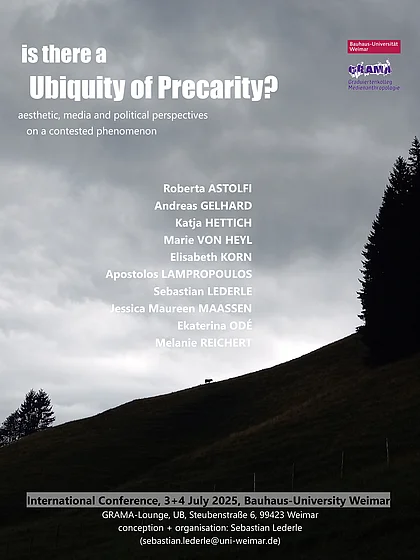
Is there a Ubiquity of Precarity? Media, aesthetic and political perspectives on a contested phenomenon
International Conference | 3-4. July 2025
Grama-Lounge, University Library (Steubenstraße 6, 99423 Weimar)
Curated and organized by Sebastian Lederle (Bauhaus-University Weimar, sebastian.lederle[at]uni-weimar.de)
The workshop departs from the assumption that precariousness is first experienced by those who are placed under uncertain, media, political and aesthetic conditions of becoming a subject and relating to the world as a world of becoming. The question of what it means to live in a world in which precarity has become ubiquitous cannot be answered without considering its medial, infrastructural forms of presentation and its modes of appearance, which are tangibly reflected in the field of aesthetics and make it appear as being contested in itself – and thus political. There is no demarcation between the medial, the aesthetic and the political that is not open to negotiation, contingent and contested. What it means to be precarious is challenged by other perspectives on it, so that one’s own perspective on precarity is always already called into question and lacking standards and last foundations to refer to in order to answer the question what it means to be and call something or someone precarious.
What can be termed the aesthetics of the precarious becomes evident not least with regard to the question of the extent to which aesthetic practices, techniques and the associated processes of attribution and evaluation not only thematically engage with precarity, but have also become precarious in an operative sense: How can knowledge of the aesthetic – in contrast to the medial and the political – be justified, if the previous criteria, standards and routines themselves exhibit a precarious status and must be repeatedly renegotiated? Can aesthetic knowledge only be asserted and maintained if it already proves to be permeated or marked by mediality and the political, that is, only has something to say if it keeps an eye on its own precarity as the precarity of the others (and vice versa)? Isn’t this exactly the point being made by saying the political is already at play and incorporated in aesthetic practices and experiences, because it blures the lines from within the realm of aesthetics? Doesn’t this also mean, that the relation of aesthetics and the political point at the way media operate? Media are the agents, milieus and operations by which aesthetics and the political call each other into question and contest each others. Media allow to contest the meaning of precarity, its attribution and how it informs structures as well as subjects in the first place, because they are already in play and doing their work, when someone or something becomes precarious. Media collaborate in making precarity and being made precarious.
Connected to this is the question of what role the arts (or the knowledge of the arts) play in how precarity is re-presented, and who is considered and perceived as precarious. Not least, what it means to be precarious, to whom one is to be counted as precarious, and to be able to articulate one's own precarity at all as such, is itself contested in a non-trivial sense. Is there a potentia precaria or does the conditio precaria consist precisely in the fact that it is only indirectly noticeable in its effects and in what and whom it destabilizes and undermines? If this is the case, however, it must be considered how it can be grasped and put onto display at all. This would then be a question of the specific mediality and aesthetics of the precarious: One is never just precarious and insists on it, as it were – and yet precariousness lacks direct visibility, in which it manifests itself directly and tangibly when normalized frames of reference fail.
In that sense precarity goes beyond a mere social and political category, in that it also concerns the foundations of the human relationship to the self and the world. The point of a media-philosophical and aesthetic concept of precarity therefore lies in not only localizing the contingency and the interminable contestability of ascribed statuses in the theories of the political, but also in expanding them in a media-materialistic and aesthetic way. Precarity is, according to the working hypothesis of the workshop, the current modus operandi of the aesthetic. It is no longer possible to speak about precarity independently of who and what is positioned by it, how and in what respect from a medial and aesthetic perspective. Precarity is something that affects insofar it is seen as an effect, which has no origin or foundation, since it is the fact of distorting and eluding solid claims of knowledge, aesthetic phenomenality and political attributions of belonging. Media are the way this intertwinement comes into view as such.
Schedule
3. July 2025
-- Introduction --
14:00-14:30 Zabriskie Point. Or what’s left of german excellence?
Panel 1 – Self-politicizations and singularization
14:30-15:30 Andreas Gelhard (University of Leipzig)
It's all just a question of mindset. The precariat and the new psychotechnics
-- 15:30-16:00 Coffee Break --
16:00-17:00 Apostolos Lampropoulos (University of Bordeaux/Montaigne)
From within precarity out, so to speak
17:00-18:00 Marie von Heyl (UDK Berlin)
Precarious stoicism vs. stoic precarity
4. July 2025
Panel 2 – Aesthetics and epistemologies of precarity
09:00-10:00 Katja Hettich (Bauhaus-University Weimar)
The precarious positioning of the reader in Flaubert’s Madame Bovary
10:00-11:00 Jessica Maureen Maaßen (Erfurt University)
Analog Nomads – Vladimir Nabokov’s Writing Scene on Index cards
-- 11:00-11:30 Coffee Break --
11:30-12:30 Melanie Reichert (Kiel University)
No time, no sense, no revolution. Aesthetics and epistemology of lack in Simone
Weil's writings on the factory system
-- 12:30-14:00 Lunch Break --
Panel 3 – Being in between
14:00-15:00 Roberta Astolfi (FU Berlin)
“Liminal Zones” as the Places of Precarity (and its Double Role for the Aesthetical
Discomfort)
15:00-16:00 Sebastian Lederle (Bauhaus-University Weimar)
Waiting as a precarious mode of existence. Is there a relational solipsism in Luc
Boltanski’s Les Limbes?
-- 16:00-16:30 Coffee Break --
Panel 4 - Transversality and affective bodies
16:30-17:30 Ekaterina Odé (Paris/Weimar)
Epicurus and War: Rethinking the Affective Extensions of the Body
17:30-18:30 Elisabeth Korn (FU Berlin)
Linked by the Absence of Links: Positive Precarity in the Machinic Intersection of
Image and Labour
-- Closing Remarks --
18:00-18:30 Kokomo. Or: What’s left of Zabriskie Point?
On Destructive Plasticity. A Workshop with Catherine Malabou
Workshop | November 14, 2024 | 3-5:30 pm
Hosted by the Research Training Group Media Anthropology, Bauhaus University Weimar.
The maximum number of online participants has been reached. However, there are still places available on site in the Lounge, University Library, Steubenstr. 6, Weimar. Please register at laurien.simon.wuest[a]uni-weimar.de
---
Contact persons:
Vanessa Franke: vanessa.franke@uni-weimar.de
Laurien Wüst: laurien.simon.wuest@uni-weimar.de
The term "plasticity" was coined by the French philosopher Catherine Malabou, which enables us to comprehend the processes of subjectification beyond the dualism of receptivity and activity, still predominant in philosophy, as a simultaneous process of receiving and giving form. Malabou's understanding of plasticity is decidedly located at the interface between philosophy and neuroscience and contains both discursive and concrete material dimensions (e.g., in relation to the brain).
In her essay "The Ontology of the Accident » (2009), which we’ll discuss with Catherine Malabou in our workshop, she confronts this positive capacity of plasticity with a specific negativity: destructive or explosive plasticity. Malabou includes such heterogeneous phenomena as war trauma, brain injuries, as well as ageing and sudden radical changes in identity. Destructive plasticity stands for a kind of metamorphosis of the subject's identity, which, according to Malabou, represents a challenge for philosophical thinking: On the one hand, it confronts the subject with a radical outside ("accident" both as chance and destructive incident), and, on the other hand, these metamorphoses leave no scar that points back to the destroyed identity as a trace. Nevertheless, according to Malabou, "a form [is] born of the accident, born by accident, a kind of accident."
We invited Catherine Malabou in order to discuss with her how a theory of explosive plasticity is even possible. From a media-philosophical perspective, we are interested in the question of what role media in general and aesthetic media in particular play in the visualisation and representation of experiences of destructive plasticity.
The workshop takes place in hybrid format, both via video conference and in the “Lounge”, University Library Weimar. Catherine Malabou will participate online. Reading the essay is a prerequisite for participation, you will receive the text and the link to the video conference after registration. The working language is English.
Please register by 8 November via this email address: laurien.simon.wuest@uni-weimar.de. The number of participants is limited.
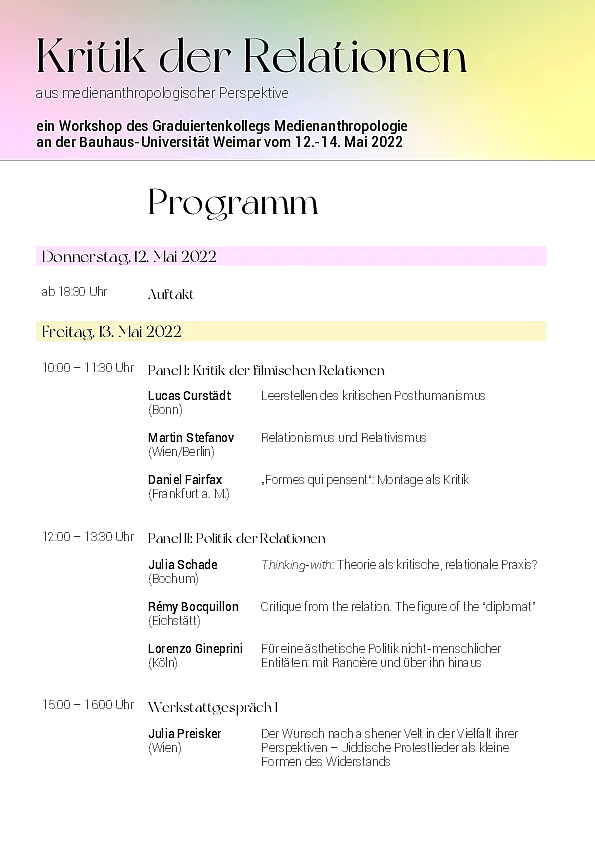
Kritik der Relationen
12.05. - 14.05.2022
Im Rahmen eines Workshops unter dem Titel „Kritik der Relationen // aus medienanthropologischer Perspektive“ möchten die Kollegiat_innen des Graduiertenkollegs Medienanthropologie der Bauhaus-Universität Weimar gemeinsam mit interessierten Teilnehmer_innen aus verschiedenen Fachrichtungen und unterschiedlicher akademischer Qualifizierungsstufen eine Doppelperspektive einnehmen. Einerseits geht es um die Möglichkeit von Kritik durch relationale Denkansätze, andererseits um eine kritische Befragung desselben. Fragen, die sich aus dieser zweifachen Problematisierung ergeben, lauten demnach: Welcher Kritikbegriff ist im Kontext eines relationalen Denkens noch haltbar? Welche Ideen von Kritik werden damit affirmiert oder verabschiedet, aktualisiert oder implizit mitgeführt? Wie lässt sich Kritik aus der Immanenz heraus konzipieren, praktizieren und denken? Was sind konkrete Szenen, Akteur_innen und Aktanten, Medien und Materialitäten sowie Milieus für relationale Kritik?
Eine ausführliche Themenskizze sowie alle Informationen zum Workshop finden Sie unter www.kritik-der-relationen.de.