
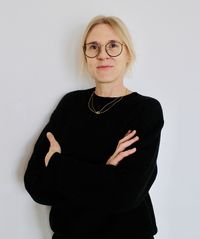
Rebekka Ladewig is Professor of the History and Theory of Cultural Techniques at Bauhaus University Weimar. She obtained her doctorate from the Department of Cultural History and Theory at Humboldt University, Berlin in 2012 and was a postdoctoral researcher at the Cluster of Excellence Image, Knowledge, Gestaltung at Humboldt University (2012 -2014) and the Faculty of Media at Bauhaus University, Weimar (2014 - 18). From 2018 - 2020 she was acting professor in the History and Theory of Cultural Techniques at Bauhaus-University. She has since held visiting professorships in Media Theory at the University of Vienna (2020 - 2021), in the Theory of Perception at University of Art and Design Offenbach (2023 - 2024) and, most recently, she was acting professor of Art Research and Media Philosophy at Karlsruhe University of Arts and Design (2023 - 2025). Rebekka received an ›Originalitätsverdacht‹ grant from VolkswagenStiftung in 2021 and has held research fellowships at the International Research Centre for Cultural Studies (IFK Vienna) and funded by the Federal State of Thuringia. She has been a Member of the Common Room of St Cross College, University of Oxford since April 2024.
Rebekka’s research is grounded in cultural studies and media theory, with particular emphasis on material and visual culture, the history of technology, feminist science studies, and media ecologies. Her publications include Schwindel: Eine Epistemologie der Orientierung (Mohr Siebeck 2016), Symmetries of Touch (Special Issue of Body and Society 2022, ed. with Henning Schmidgen), Modell Hütte (diaphanes 2021, ed. with Karin Krauthausen), Milieu-Fragmente (diaphanes 2020, ed. with Angelika Seppi). She is also the editor of the first German translation of Michael Polanyi’s classic book Personales Wissen. Auf dem Weg zu einer postkritischen Philosophie (Suhrkamp 2023). Rebekkja is a founding co-editor of the journal ilinx: Berliner Beiträge zur Kulturwissenschaft and the book series ilinx-kollaborationen (since 2008).
Her current writing and teaching focusses on histories of cultural studies and decolonial perspectives on cultural techniques; cross-disciplinary approaches to material and visual culture, and theories of projection; cultural memory and tacit knowing; contemporary art and exhibition practices, and histories and historiographies of lasting and outlasting.