
A New Master’s Degree Program
The ecological crisis is not merely a matter of climate change, resource constraint, and environmental destruction. It manifests itself equally in media infrastructures as well as in social and geopolitical inequalities and in the forms according to which we perceive, think, and act. From melting glaciers and deep-sea extractive logics to the data architectures of global platforms, ecological processes are inextricably intertwined with media, technologies, and social assemblages.
Against this background, Félix Guattari’s notion of the “three ecologies” takes on new urgency; it presents an attempt not to think of the environment, social relations, and mental processes—or ways of subjectivation—in isolation, but to analyze them in terms of their mutual connections. In light of the environmental crisis, an intensified conflict between labor and capital, and the resurgence of totalitarian subjectivities, what is at stake today more than ever are the “transversal” connections between the three ecologies.
The Program
The MediaEcologies master’s degree program at Bauhaus-Universität Weimar addresses these connections. It conceives of media not merely as forms of representation, but as ecological structures that actively co-produce experience, sociality, and environmental relations.
The two-year, English-language program explores, on the one hand, the role that media—from photography and film to computer models—play in the emergence and development of the three ecologies. At the same time, it examines media as ecologies, i.e. as machinic assemblages of bodies and architectures that increasingly surround, envelop, and control us (e.g. Virtual Reality, self-driving cars, Smart Cities).
Based on extensive research on planetary experiments, vitalist Marxism, and Institutional Psychotherapy, the program includes course modules on the Anthropocene, Theory and History of Ecology, Planetary Media, MediaNatures, and Future Environments. Additional modules can be selected from all courses offered at Bauhaus University, particularly in the faculties of Art and Design or Architecture and Urbanism. Another module can be chosen from the German language courses offered by our Center for Language and Cultural Learning.
The MediaEcologies master’s degree program is designed for small cohorts of students (15-20) and is free of tuition fees. We seek applicants who have a background in Media Studies, Cultural Studies, and related fields—whether directly following a bachelor’s degree or professional experience—and are keen to join us in a critical and creative environment for exploring diverse ecologies of media as well as the media of ecology. For application requirements, please see here.
The Context
Weimar is a small, green, and culturally rich city in the heart of Germany. Known as the birthplace of the so-called Weimarer Klassik—with Johann Wolfgang von Goethe, Friedrich Schiller, Johann Gottfried Herder etc.—it was also a formative hub of ecological thought. In the early 20th century, with the founding of the Bauhaus by Walter Gropius in 1919, Weimar became a laboratory of modern design. Under the guidance of teachers such as Paul Klee, Wassily Kandinsky, László Moholy-Nagy, and Gertrud Grunow the Bauhaus was dedicated to discovering connections between the body, art, technology, and the environment.
MediaEcologies builds on these at once classical and innovative resources and recombines them in contemporary contexts: as the study of transversal interconnections between ecological, social, and mental media aspects that responds creatively and with steadfast commitment to the challenges of the present.
Henning Schmidgen on the Master’s program (in English)
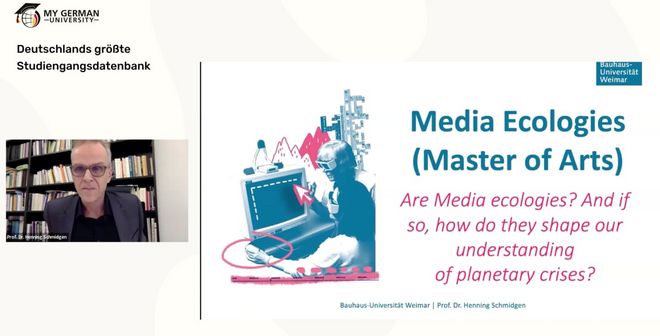
Henning Schmidgen on Media Ecologies (Master of Arts)
von Media Ecologies
Klicken Sie auf den Play-Button, um externe Inhalte von Vimeo.com zu laden und anzuzeigen.
Externe Inhalte von Vimeo.com zukünftig automatisch laden und anzeigen (Sie können diese Einstellung jederzeit über unsere »Datenschutzerklärung« ändern.)
Featured Content
On Media and Ecology: A Conversation with Henning Schmidgen (in German)
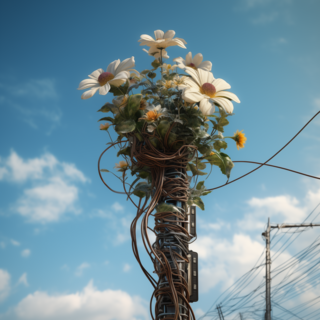
Smartphones track our bodies, computers generate climate forecasts, and companies are building digital ecosystems—while AI data centers and smartphones consume vast amounts of electricity, water, and rare earth materials. In conversation with Nicolas Oxen, Henning Schmidgen, professor of the history of science and media theory, reflects on how we can rethink the relationship between media and ecology.
Ecologies: Sustainability and Digital Culture – Blog post by Nicolas Oxen and Henning Schmidgen
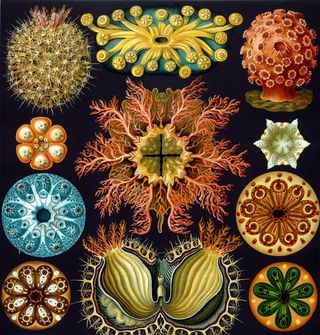
“In Weimar, we are developing a master’s program in the research field of media ecology. Alongside the technical environments shaped by media, we also aim to engage with the conceptual and perceptual history of ecology as a scientific discipline. The focus is on the technical media through which ecology produces knowledge, but also, for example, on how strongly media shape our understanding of nature.”
Media Ecologies on Radio Lotte (in German)
As a guest on Radio Lotte, Henning Schmidgen discussed the upcoming master’s program Media Ecologies at Bauhaus-Universität Weimar. Learn more about the program’s focus and the interdisciplinary field of media ecology in the broadcast.