
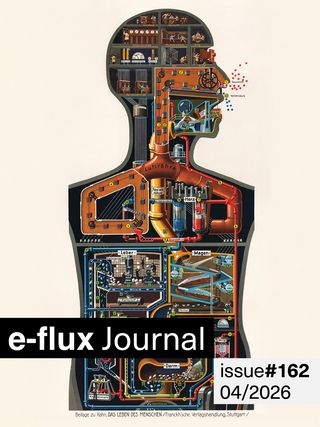
Join us at Aula Mario Baratto, Ca’ Foscari University in Venice on Tuesday, May 5, 2026 at 4:30pm for the launch of e-flux journal issue #162, edited by Elena Vogman and Matteo Pasquinelli. The launch will be followed by a reception.
The program features: Matteo Pasquinelli, Ca’ Foscari University, ERC project AIMODELS / Elena Vogman, Bauhaus Weimar University, e-flux journal / Olexii Kuchanskyi, eikones, University of Basel / Peter Sit, curator of the Czech and Slovak Pavilion of the Venice Biennale, e-flux journal / Carles Guerra, curator of the Spain Pavillion of the Venice Biennale.
Organised by e-flux journal, ERC project AIMODELS and Freigeist-Fellowship VolkswagenStiftung “Madness, Media, Milieus.”
Find more information about the event here.
About the issue
e-flux Journal #162 (April 2026) entitled Operativism: Labor, Automation, Agitation was edited by Matteo Pasquinelli and Elena Vogman. Their research for the issue originated in the context of the workshop “Operativism: Social Intelligence and Mediation,” organized by Marietta Kesting and Elena Vogman and held at ICI Berlin Institute for Cultural Inquiry in June 2025.
With: Elena Vogman, Matteo Pasquinelli, Harun Farocki, Tom Holert, Olexii Kuchanskyi, Alla Vronskaya, Aleksei Gastev, Evgenii Petrov, Aleksandra Selivanova, Devin Fore, Kalindi Vora, and Neda Atanasoski.
From the editorial:
“Responding to the intensification of “military operations” in Ukraine, Gaza, and Iran, this special issue of e-flux journal advocates for a return to a materialist genealogy of “operativism”—a concept that spans labor politics and scientific management throughout the twentieth century, from the Soviet avant-gardes to postwar cybernetics to modern warfare and the multiple interpretations of Harun Farocki’s “operational images.” “Operations” have been theorized primarily within the technological register of power, often obscuring other genealogies and readings that see operations as falling within the logic of cooperation in labor and social relations. While debates on the “operative ontologies” of media have foregrounded technical configurations, this issue turns to the “social machine” and the organization of labor that underwrite operations. Elaborating on Sandro Mezzadra and Brett Neilson’s idea of “the operations of capital” and against the mute compulsions of capital today, we propose “operativism” as the other side of its technical and tactical operations.”
Access the full issue here.