


News

You can also follow our project and current lecture announcements on Facebook and Instagram.

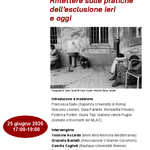
Reflecting on Practices of Exclusion, Then and Now, 25 June 2026

On June 25, at 17h, Camilla Caglioti, PhD researcher of "Madness, Media, Milieus", will take part in the roundtable discussion Reflecting on Practices of Exclusion, Then and Now at the MLAC – Museum Laboratory of Contemporary Art, Sapienza University of Rome.
The event forms part of the public programme accompanying the travelling exhibition Morire di classe. The Asylum Condition Photographed by Carla Cerati and Gianni Berengo Gardin, promoted by the Basaglia Archive.

Marlon Miguel in Conversation in Paris, 19 June 2026

On 19 June, Marlon Miguel will discuss his recent book on "Fernand Deligny and the ecologies of the human" (Rio de Janeiro, 2024), as part of the seminar “Dispositifs hors-langage et dans les marges des institutions” at the Centre d’études du vivant of Université Paris Cité.

Marlon Miguel will be in conversation with Keren Alcantara, Manon Piette, and Felipe Saavedra. The event will also feature a contribution by Nicolas Robert (Aix-Marseille University) on clinical practice in street outreach and prison settings.

The seminar begins at 19:00 and will take place in the library seminar room of the Maison Heinrich Heine / Fondation de l’Allemagne at the Cité Internationale Universitaire de Paris.

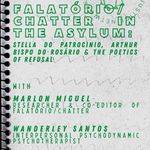
Falatório/Chatter in the Asylum: Stella do Patrocínio, Arthur Bispo do Rosário & the Poetics of Refusal, 15 May 2026

​Marlon Miguel researcher of Madness, Media, Milieus & co-editor of Falatório/Chatter
and
Wanderley Santos interpersonal psychodynamic psychotherapist

​Friday, 15th May 2026 - 6 pm to 8 pm
Black & White Room, BLOC, Arts One building, Queen Mary, E1 4PD - London

​This event will explore how Stella do Patrocínio’s (1941–1992) speech and Arthur Bispo do Rosário’s (1909–1989) creations defied the logics of the psychiatric institution, Colônia Juliano Moreira in Rio de Janeiro, in which they were both incarcerated for the majority of their lives.

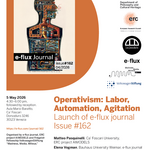
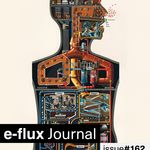
Out now: e-flux Journal 162, Operativism: Labor, Automation, Agitation

e-flux Journal special issue 162, "Operativism: Labor, Automation, Agitation", is out now. Edited by Matteo Pasquinelli and Elena Vogman and with contributions by Elena Vogman, Matteo Pasquinelli, Harun Farocki, Tom Holert, Olexii Kuchanskyi, Alla Vronskaya, Aleksei Gastev, Evgenii Petrov, Aleksandra Selivanova, Devin Fore, Kalindi Vora, and Neda Atanasoski.

Book Presentation: Stella do Patrocínio's "Falatório/Chatter"

Join us for the presentation of Stella do Patrocínio's "Falatório/Chatter", edited by Iracema Dulley and Marlon Miguel!
Marlon will be joined by Anna Carolina Zacharias, Carolina Rodrigues, Diana Kolker, Natasha Felix, Sara Ramos, and Sofia Sk for a roundtable discussion on Stella do Patrocínio's life and work.
The event will take place on Monday, 30 March 2026, 16:30 at Paço Imperial in Rio de Janeiro, Brazil.

Talk by Camilla Caglioti: "Frantz Fanon's Social Therapy and Its Legacies: Politics, Phenomenology, and Deinstitutionalization", 9 February 2026

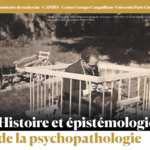
Camilla Caglioti will present “La social-thérapie de Frantz Fanon et ses héritages : politique, phénoménologie et désinstitutionalisation” on Monday, 9 February, 18:00–20:00 at the ENS Paris (Salle Émile Borel). The talk takes place within the research seminar "Histoire et épistémologie de la psychopathologie", dedicated to the historical and philosophical study of psychopathology.

Thinking Sumud and Clinical Work in extremis with Samah Jabr, Panel Discussion @ spore initiative Berlin, on Januar 28, 2026, 19.00-20.30

For over two decades, Palestinian psychiatrist Samah Jabr has critiqued the inability of these models to analyse, diagnose, and offer care within the permanent state of violence endured by Palestinians. Simultaneously, she insists on psychiatry’s “humanizing” task, calling for its radical redefinition. In a context structured by oppression, she argues that clinical “neutrality” is not only impossible but complicit. Instead, she roots her practice in Sumud (steadfastness), framing therapy as an act that supports dignity, fights helplessness, and strengthens collective bonds.