
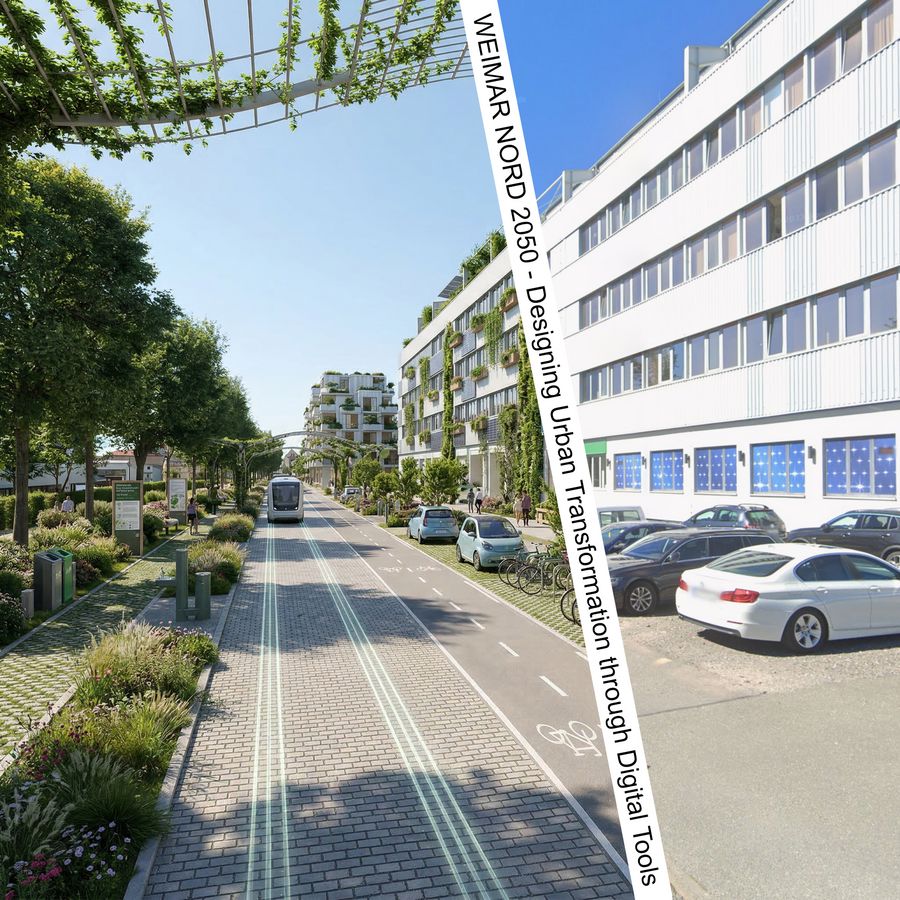
Thesis Topic - Weimar Nord 2050
Designing Urban Transformation through Digital Tools
The area north of Weimar’s main train station is on the verge of a significant transformation. With the planned development of a new mobility hub behind the station, a previously disconnected urban zone will gain direct accessibility and strategic importance. This intervention will not only improve connectivity but also unlock the development potential of the surrounding areas, particularly along Riesnerstraße.
In the coming decades, this area is expected to evolve into an attractive mixed-use urban quarter. Its proximity to the station will make it especially appealing for both residential living—enabling efficient commuting to cities such as Jena and Erfurt—and for commercial activities that benefit from high accessibility and visibility.
Within this context, the thesis topic “Weimar Nord 2050” invites students to explore and shape this transformation process through the application of advanced digital tools. The focus lies on speculative yet grounded design approaches that integrate data-driven methods, simulation, and emerging technologies to envision sustainable and inclusive urban futures.
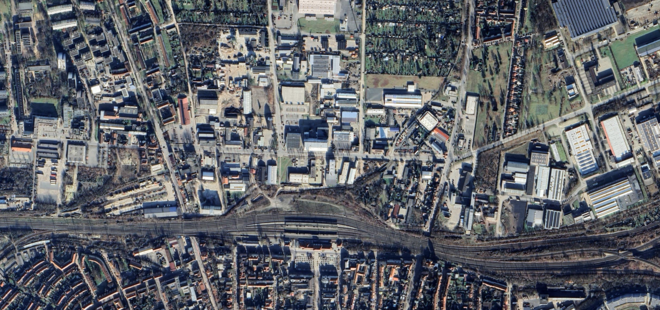
Students are encouraged to approach the site from different perspectives, combining urban design with computational methodologies. Possible directions include, but are not limited to:
- Parametric and Simulation-Assisted Design of a Sustainable Urban Quarter
Investigating how parametric modeling and environmental simulations can inform the design of resilient, resource-efficient urban structures. This may include studies on density, microclimate, energy performance, mobility flows, and land-use optimization. - Virtual Reality-Based Evaluation of Public Space Design
Exploring how immersive environments can be used to assess spatial quality, user experience, and social interaction in public spaces. Students may develop VR scenarios to test design proposals and gather qualitative feedback. - AI-Assisted Generation of Urban Futures in Citizen Engagement
Examining the role of artificial intelligence in participatory planning processes. This includes the use of generative models to visualize alternative urban scenarios and to facilitate dialogue between stakeholders and citizens. - AI-Assisted Exploration of Alternative Housing Models
Investigating new forms of communal living beyond the traditional nuclear family by critically analyzing historical and contemporary precedents—from indigenous and matriarchal societies to modern co-housing and shared living models. Using generative AI tools, students will develop and visualize innovative housing concepts, exploring spatial, social, and organizational structures for future neighborhoods.
The overarching goal is to develop forward-looking, digitally informed design strategies that respond to the specific spatial, social, and infrastructural conditions of Weimar Nord. By combining technological innovation with urban thinking, students will contribute to envisioning how this emerging district could evolve by the year 2050.