
summaery2026 at the Faculty of Media: What Comes After the Prompt‽ New Perspectives from the Faculty of Media’s Labs
What happens between a question and its answer? Between an impulse and the reaction to it? The theme of »prompt‽« focusses on exactly that: triggers, reflection, and experimentation. At summaery2026, the Faculty of Media will be presenting projects that show how input influences virtual worlds, how intelligent systems respond to questions, and how new perspectives emerge when people and technology intersect.
The prompt is more than just an instruction given to a machine. In projects carried out at the Faculty of Media, it acts as the starting point for discussions about creativity, trust, learning, and social change. These projects explore how people interact with intelligent systems, how digital technologies influence our perception, and what new forms of collaboration result from this. These questions will be brought to life in a tangible way at the Open Lab Night on 10 July 2026, when labs and research spaces will open their doors and invite visitors to test out current research.
The »Prompt Me If You Can‽« exhibition shows just how broadly the theme can be understood. In this project, Media Management students explore the prompt as an interface, decision-making logic, and creative inspiration. Scientific analyses, audiovisual projects, and interactive applications explore platform logics, digital public spheres, AI-supported workflow, and new methods of user interaction.
Visitors are also invited to experience just how strongly input influences the responses of intelligent systems in the »Debate Arena«. As language models compete against each other, participants assess their tone, strategy, and argumentation style. But it’s not just artificial intelligence that is put to the test here; the role of the humans controlling digital systems is also examined.
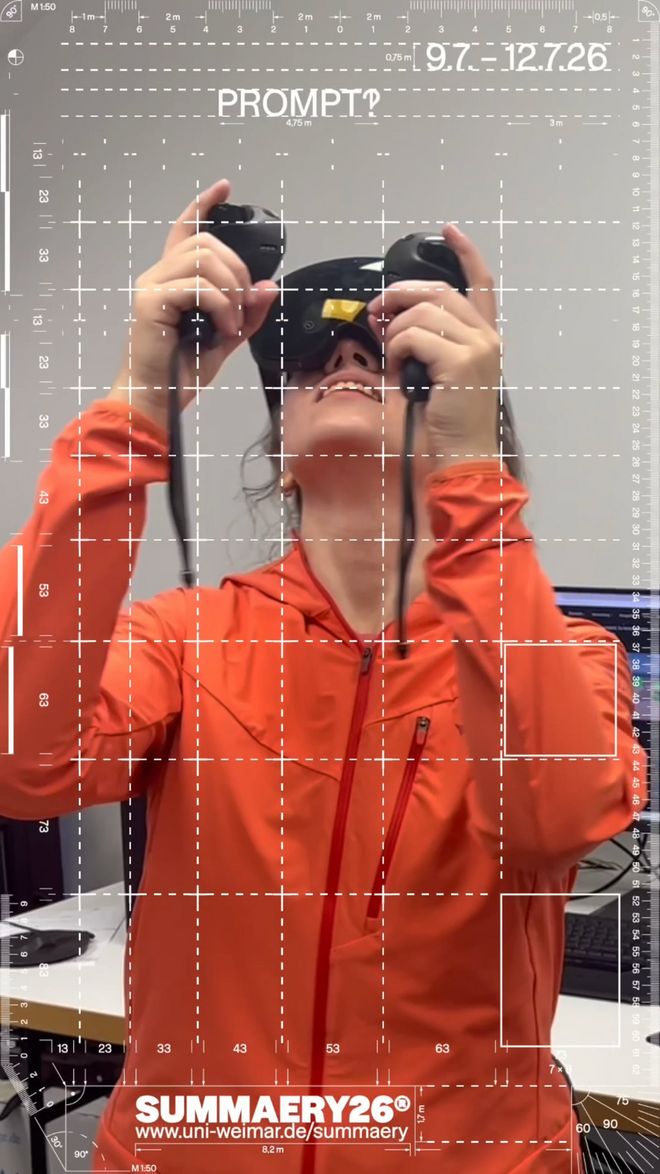
summaery2026 | Fakultät Medien
Click the Play button to load and view external content from Vimeo.com.
Automatically load and view external content from Vimeo.com (You can change this setting at any time via our »Data protection policy«.)
Other projects look at human-machine collaboration. The »Learning with Agents in Virtual Museums« project investigates how conversational, embodied language agents can help support learning processes. In doing so, it is made clear that what often matters is not what AI can provide, but rather what questions we ask it.
And it’s not only digital systems that respond to stimuli. Students in the »Der Körper als Datensatz« project are exploring how mental states are reflected in physiological signals. Visitors can test out sensors and observe how heart rate, skin conductivity, and eye movements react to stress, concentration, or surprise. This makes processes that are typically unnoticed visible.
Projects like »Social Simulacra« and »Cloned Testing« address the social consequences of intelligent systems. They ask how trust is established, how digital identities are perceived, and what dynamics emerge when artificial entities become part of social spaces.
The »Reale Projektionen« module looks at how media and technology shape our everyday understandings of society and reality. The displayed pieces engage with historical and modern visions of society and explore how AI models also influence our perspective of the world. By doing this, they expand the focus of the annual theme to include a media-cultural angle.
Visitors can experience and try out many of these projects— and many more — at the Open Lab Night on Friday evening, 10 July 2026. The highlight of the event is the Open Lab Night, which highlights what makes the Faculty of Media unique: Research isn’t just explaining but also experiencing it together.
Annual Exhibition of the Bauhaus-Universität Weimar
summaery2026 »prompt‽«
Thursday, 9 July to Sunday, 12 July 2026
Overview of all projects from the Faculty of Media:
Open Labs | Computer Science of Media Department
Friday, 10 July 2026, 5 – 10 pm
Saturday, 11 July 2026 , 1 – 4 pm
Der Körper als Datensatz – Physiologische Signale erleben und verstehen
Digital Twin for the Bauhaus Energy Hub
Gaussian Splatting for Mobile Virtual Reality Devices
Eine Einführung in die Verschlüsselung - die Caesar Chiffre
Learning with Agents in Virtual Museums
Immersive Decision Theater – Green Jena
Haystack: Ein postquantensicheres verteiltes Signaturverfahren
PLAYAI: Experimental Games with Large Language Models
Play the Attacker: Social Engineering Game
Social Simulacra: Simulating Human Behavior with AI Agents
VECo2: Virtual Embodiment and Communication: Social VR-Avatar Perception
Visual Questionnaire Analytics
Experimentelle Videospiel-Entwicklung II
Projekte aus dem Fachbereich Medienwissenschaft:
Arbeitender Körper, versehrter Körper. Biomechanik, Prothesen und Roboter um 1920
Projekte aus dem Fachbereich Medienmanagement:
Kontakt
Bauhaus-Universität Weimar
Dana Höftmann
Pressesprecherin
Tel.: +49(0)3643/58 11 73
Luise Ziegler
Mitarbeiterin Medienarbeit
Tel.: +49(0)3643/58 11 80
Fax: +49(0)3643/58 11 72
E-Mail: presse[at]uni-weimar.de
Web: www.uni-weimar.de/medienservice