
We are looking forward to welcoming you to the Bauhaus-Universität Weimar and starting the winter semester 2026/27 together.
Please note that Saturday 3 October is a public holiday in Germany and the university all offices, shops and supermarkets will be closed. Please make sure, in particular, to buy your groceries for example on one of the days before the weekend.
To enter Germany to study, you will need a student visa. You should apply for this as soon as you receive your admission letter at your local German embassy. You can find all the relevant information on the Federal Foreign Office website Successful visa application also requires the opening of a so-called “‘Sperrkonto”
Please note: Do not enrol without a visa!
In order to finalise your enrolment for the 2026/27 winter semester, please use the button "Request for enrolment" in the Bauhaus.CampusPortal once you have been admitted. Please have the following documents ready:
- Proof of health insurance: Health insurance is compulsory for studying at a German university. During the enrolment process, you must provide proof that you are insured with a German public health insurance provider. Please request “Registration Reason 10 for Bauhaus-Universität Weimar” (university code: H0000493) from your statutory health insurance provider. With this confirmation, the health insurance provider will notify the university whether you are insured with them as an independent member or have been exempted from the statutory insurance obligation, e.g. due to membership of a private health insurance scheme. You are free to choose which statutory health insurance provider should handle this notification on your behalf.
- Payment of the semester fee, including the charges for the initial issue of the Thoska chip card
- Certificate of de-registration from the university or universities previously attended (only in Germany)
* If you have received conditional admission subject to “Studienkolleg”, please contact the Studienkolleg directly. The nearest Studienkolleg is in Nordhausen. You can find out more about the further procedure on the following website: https://www.hs-nordhausen.de/international/staatliches-studienkolleg After passing the Studienkolleg, please contact us again to receive information regarding further steps.
* For applicants admitted to the following degree programmes, enrolment in the following semester is generally also possible: Digital Engineering (Master’s), Human-Computer Interaction (Master’s), Computer Science for Digital Media (Master’s), Bauingenieurwesen – Konstruktiver Ingenieurbau (Master’s), Umweltingenieurwissenschaften (Master’s), Management [Bau Immobilien Infrastruktur] (Master’s), Baustoffingenieurwissenschaften (Master’s), Medienwissenschaften (Master’s). To do this, please log in again via the Campus Portal and indicate that you are already admitted for the previous semester. As soon as your application has been formally received, an up-to-date letter of admission will be issued as soon as possible. After receiving the visa, the enrolment can then be requested via the portal.
Your thoska student ID card and your login details for using the IT infrastructure at Bauhaus-Universität Weimar will handed to you in person at the start of the semester.
Checklist
To help you start university life on the right foot, we provide a list of things you should do as soon as possible so you don’t forget anything important at the beginning of your studies:
Information
- Have you obtained your curriculum, study regulations, examination regulations and other info material regarding your degree programme? You can find the curriculum to your program on the faculty websites under service.
- Do you know how to access information about lectures and seminars and sign up for modules using the BISON portal?
- Have you noted the dates for upcoming introduction and orientation events?
- Have you signed up for beginner seminars/practical sessions?
- Have you noted the date and location for a language aptitude/language evaluation test (if required)?
Orientation
- Have you taken a tour of the faculty buildings, labs and workshops?
- Have you taken a library tour?
Organisation
- Have you applied for a room in a student hall of residence?
- Do you know where (or what newspapers to consult) to find a place to live?
- Have you registered with the Resident Registration Office? Have you notified them if you’ve changed your address?
- Have you noted the period for re-registering for next semester?
- Do you have health insurance cover?
Sometimes teaming up with a new friend can make your start at university easier. There are many opportunities to make new friends – by taking part in the orientation week events at the beginning of the semester, meeting up at the dining hall, revising at the library, working at the computer centres or simply hanging out at student pubs and residence halls.
The Bauhaus-Universität Weimar also offers an extensive range of academic advising services. We can put you in contact with more experienced students or representatives of the faculty student councils who would be happy to help you anytime.
Living in Weimar
Depending on what you prefer, you can choose to live in a student hall of residence or a room in a flat share (WG), which you’ll find advertised on the university’s electronic message board “Piazza”, or you could contact a real estate agent or the Weimarer Wohnstätte.
Hint: You don’t necessarily have to pay exorbitant brokerage fees. Simply arrange to visit Weimar for a few days and try to find the right flat on your own. The price for a room in a flat share ranges between 150 to 450 Euros per month. You’ll also find inexpensive one-room apartments starting at 350 euros per month.
Flat sharing in Weimar
There are plenty of flat shares in Weimar. Students are always moving in and out, so the best time to find a room is at the beginning or end of the semester.
If you’re looking for a room in a flat share, the first place you should go is the university’s electronic message board "Piazza". You’ll also find ads for rooms posted in the foyer of the Mensa am Park (main dining hall).
Student halls of residence
The Studierendenwerk Thüringen operates several student halls of residence in and around Weimar. Most of the rooms are singles and are arranged in “living units” that are designed for three or more tenants. It’s quite difficult, though, to get a room in a student hall of residence. Students have to apply before the beginning of the upcoming semester. So it definitely pays off to apply far in advance. The application fee is 20 euros for two room offers. One-room apartments are also available to tenants who have been living in a student residence hall for an extended period of time. (last updated 2011)
Your own flat
The Weimarer Wohnstätte offers one-room flats (ca. 30 m2) starting at 300 Euros per month.
There are several real-estate agents in Weimar who can show you a portfolio of small apartments located in the centre of town. However, the monthly rental costs are generally higher – and if you rent an apartment through a real-estate agent, you will have to pay a broker’s commission totalling 2-3 months of rental payments.
Furniture
The most inexpensive way to get furniture is to peruse the ads on the “Piazza” message board at the Bauhaus-Universität Weimar. Students are always moving around or away – which means you’ll find plenty of great bargains on used furniture.
Buying furniture (used)
Used furniture doesn’t always fit everyone’s taste. But then again, it’s often an inexpensive alternative to buying brand-new furniture.
“Mobilé” is a low-price department store operated by the social welfare organisation Diakonie. There you’ll find furniture and decorative items from yesteryear, as well as electronics and large kitchen appliances at very reasonable prices. They have the best bargains! And all the money earned by Diakonie goes to financing its social welfare projects.
Georg-Haar-Straße 18
99423 Weimar
phone: 03643 850170
Buying furniture (new)
If you need to buy new furniture, the well-known schwedish furniture makeris located in Erfurt.
Eisenacher Straße 50
99094 Erfurt Bindersleben
The Danes have also set up shop in Weimar. At their bed warehouse, you can find a wide selection of furniture and household items.
Rießnerstraße 27
99427 Weimar
Transporters
Inexpensive transporters are available to let at the Hababusch Hostel. You’ll also find private transporters, advertised on the Piazza message board. Of course, you can also rent a transporter from one of the established rental car companies located in Weimar or lease a transporter (Ford Connect) from the student council (StuKO, Marienstr. 18, top floor).
Registering in Weimar
The first place you should go after moving to Weimar is the mobile workstation from migration office at the Campus.Office. Please arrange an priority appointment under service-international[at]uni-weimar.de
If you have already registered in Weimar, but are moving to a new apartment within the city limits, you must notify the Resident Registration Office within one week after moving to your new address. If you miss the deadline, the Resident Registration Office may slap you with a fine when you show up to register.
When you go to register, be sure to take your personal ID (or passport) and the completed registration form with you.
Scholarships

Scholarships honour outstanding achievements, outstanding projects or special social commitment. The following scholarships are available at the Bauhaus-Universität Weimar - we look forward to receiving your application!
Scholarships for Students
- MINT/STEM Scholarships for female Master's students (Call 31.1.)
- Deutschlandstipendien (Germany Scholarship, Call 31.1.)
- STIBET Study Completion Grant (April and Oct)
For your studies abroad: International Office
For starting your own business: Startup Hub neudeli
Scholarships for Graduates, Ph.D. and postdoc researchers
- Thüringer Graduiertenförderung (alumni, 1 artistic-design project, Call 31.1.)
- Bridge Scholarship for starting a doctorate for women (Call 31.1.)
- Thüringer Graduiertenförderung (doctorates, Call 31.1.)
- Equal Opportunity Doctoral Degree Completion Scholarships for women (Call 31.1.)
The following scholarship formats are suspended for the upcoming funding year 2026/27
- Bauhaus Scholarship for students
- Bauhaus Degree Completion Scholarships (2 deadlines, 15 Jan and 31 Aug)
- President's Office Scholarship for dedicated international students
- Start-Up Scholarships for a Doctorate (alumni)
- Bauhaus Doctoral Scholarships
- Equal opportunity Re-Entry scholarship - for doctoral candidates returning after a leave
- Bauhaus Doctoral Degree Completion Scholarships
- Bauhaus-Postdoc Scholarship
- Thuringian Program for female postdocs (ends in 2025)
- Bridge Scholarship for female postdocs (ends in 2025)
You can check further opportunities on scholarship databases or at StipendiumPlus, the online overview about the 13 organizations for the promotion of young talent (Begabtenförderungsorganisationen) under the umbrella of the Federal Ministry of Education and Research (BMBF).
Working Part-Time While Studying
A part-time job can be a good way to finance your studies. Many students seek employment as student assistants in their departments and in the central university facilities. Be sure to check the job openings which are regularly posted by the university.
You can also find other job openings on the job portal operated by the Careers Service and at the Studierendenwerk Thüringen. As a student, you are allowed to earn as much as you wish. However, there are some income restrictions which apply to eligibility requirements for social benefits and financial aid, e.g. BAföG or children’s allowance. Please bear in mind, however, that excessive hours or long commutes to work may significantly prolong your studies or negatively influence your academic performance.
International students are only permitted to work in Germany with a work permit. The work permit allows you to work 120 full days (1 day = 8 hours), which can be spread out over 240 half-days (1/2 day = 4 hours). This allows you to work during semester breaks. You should also keep in mind that if you earn more than 450 Euro a month, you will be subject to higher health insurance premiums.
You should also keep in mind that a job not related to your field of study can have a significant effect on the duration of your studies and cost additional time and energy. It is advisable to find a part-time job in your field, which offers practical experience for you and your subsequent transition to a
career.

Sag mal Marieke.. Wo lebst du?
Click the Play button to load and view external content from Vimeo.com.
Automatically load and view external content from Vimeo.com (You can change this setting at any time via our »Data protection policy«.)
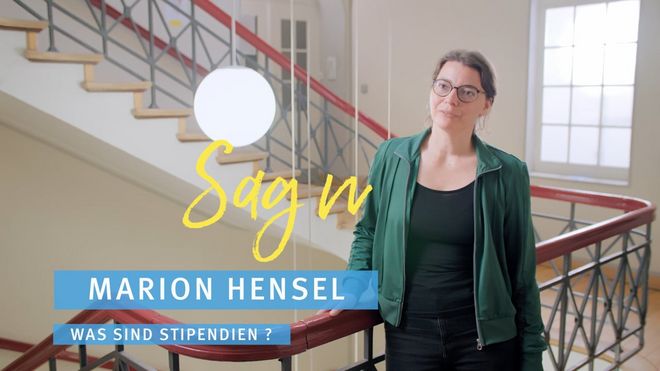
Sag mal Marion Hensel.. Was sind Stipendien?
Click the Play button to load and view external content from Vimeo.com.
Automatically load and view external content from Vimeo.com (You can change this setting at any time via our »Data protection policy«.)
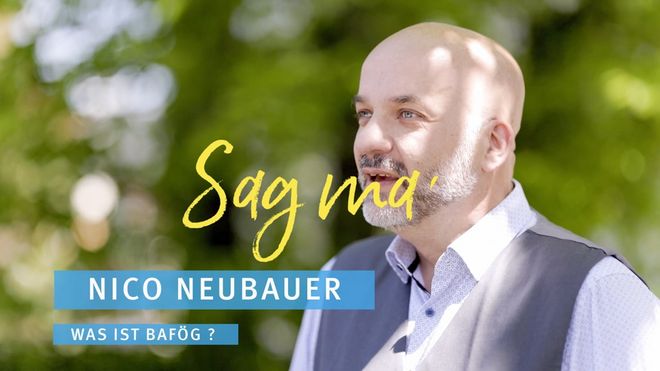
Sag mal Nico Neubauer.. Was ist Bafög?
Click the Play button to load and view external content from Vimeo.com.
Automatically load and view external content from Vimeo.com (You can change this setting at any time via our »Data protection policy«.)

Sag mal Wiebke.. Wo jobbst du?
Click the Play button to load and view external content from Vimeo.com.
Automatically load and view external content from Vimeo.com (You can change this setting at any time via our »Data protection policy«.)