
summaery2026 at the Faculty of Civil and Environmental Engineering: prompt‽ – When Questions Become Solutions
The theme of this year’s summaery is »prompt‽« – a term that naturally brings to mind digital systems and artificial intelligence. But engineering also often begins with a »prompt« – a question, challenge, or problem for which a solution is required.
At the Faculty of Civil and Environmental Engineering, these kinds of answers emerge at the intersection of research, technology, and societal transformation. Students explore natural hazards, resilient structural systems, digital planning and simulation methods, as well as the transformation of existing infrastructure. The exhibited projects show how engineering contributes to making cities, structures, and living spaces sustainable for the future.
Earlier this year during Tag der Ingenieurwissenschaften (Engineering Day), the Faculty focussed on increasing the profile of its research and teaching work. The projects at summaery reinforce this perspective and provide insights into current student work and research questions.
Understanding Natural Hazards, Evaluating Risks, Increasing Resilience
How can we better understand and assess the impact of earthquakes, floods, and other natural hazards? Projects at the Faculty are addressing these questions.
Students from the Natural Hazards and Risks in Structural Engineering (NHRE) international Master's degree programme will be presenting their research on risk and vulnerability analyses in various regions around the world. The projects explore, among other things, building typologies in Santo Domingo (Dominican Republic), and overlapping flood and earthquake risks in Myanmar. Modern risk analysis methods are used to improve hazard assessment and develop appropriate protective measures.
These projects are supplemented by student research work from the Professorship of Advanced Structures. The focal point is the impact of extreme loads on structures, ranging from cascading earthquakes to the seismic evaluation of masonry structures and the analysis of damage and failure mechanisms. Numerical simulations, experimental studies, and shake table tests provide new insights into the behaviour of structural systems under extreme loads.
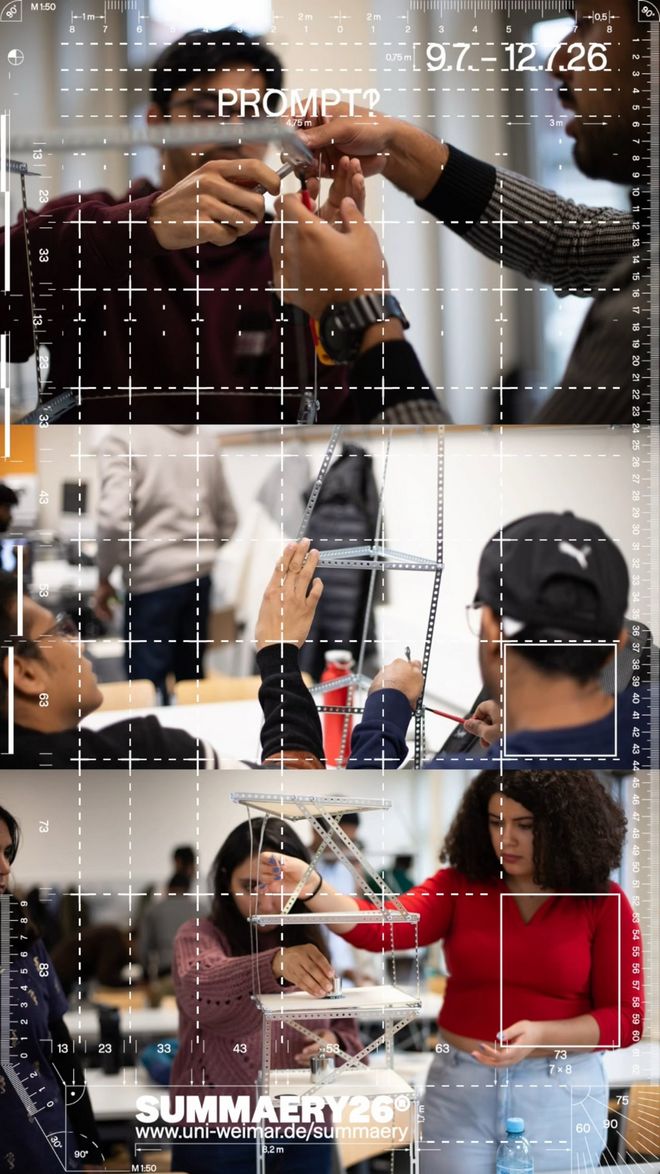
The interdisciplinary »Structural Soundscapes« project takes an unusual approach: the vibrations of structures are not only measured and analysed, they are also made audible. Project participants developed model structures, investigated their dynamic behaviour, and used sonification to convert the signals into sound. The result? A unique interplay between civil engineering, structural dynamics, and acoustics.
summyery2026 | Fakultät Bau & Umwelt
Click the Play button to load and view external content from Vimeo.com.
Automatically load and view external content from Vimeo.com (You can change this setting at any time via our »Data protection policy«.)
Digital Planning, Analysis, and Research Methods
Other projects are focussing on digital tools and simulation methods, which are increasingly unlocking new possibilities for research and engineering practice.
The Master's degree programme in Digital Engineering is presenting current work in engineering, computer science, and digital technologies. The students explore issues related to planning, analysis, simulation, and design, demonstrating how digital methods open new perspectives on complex technical challenges.
The »Im2Frac« project in another that focusses on combining experimentation and simulation. The goal was to develop an image to analysis pipeline that can be used to numerically model fracture processes in additively manufactured concrete components. The project combines modern image data with advanced simulation methods, contributing to a better understanding of innovative building materials and manufacturing technologies.
Rethinking the Existing
How can existing buildings and infrastructure be adapted to meet the needs of a changing society? This is the question that the »RE.shape | Neue Mitte Leonhardsvorstadt Stuttgart« project is asking.
The project looks at transforming a former parking garage into an open, community-oriented urban space. Taking evolving forms of mobility and societal transformation into consideration, students have developed concepts for a new neighbourhood centre that integrates social, spatial, and functional requirements. The project addresses a major challenge of modern urban development: the sustainable use of existing resources and structures.
Engineering as a Response to Complex Questions
The projects from the Faculty of Civil and Environmental Engineering reveal just how diverse engineering solutions to modern challenges can be. Whether natural hazards, digital simulations, or the transformation of urban spaces – each of these projects is seeking solutions to complex problems.
True to summaery’s theme of »prompt‽«, the projects show how questions generate new perspectives and that research, creativity, and technical knowledge can be combined to influence the built environment of the future.
Annual Exhibition of the Bauhaus-Universität Weimar
summaery2026 »prompt‽«
Thursday 9 July to Sunday 12 July 2026
Kontakt
Bauhaus-Universität Weimar
Dana Höftmann
Pressesprecherin
Tel.: +49(0)3643/58 11 73
Luise Ziegler
Mitarbeiterin Medienarbeit
Tel.: +49(0)3643/58 11 80
Fax: +49(0)3643/58 11 72
E-Mail: presse[at]uni-weimar.de
Web: www.uni-weimar.de/medienservice