



Archive

Second Round of Dialogue-Free, International »SalSa Film Festival« Begins

From 7 to 9 November 2024, the »International, Dialogue-Free SalSa Film Festival« will take place in Weimar. Following last year’s successful première, the Festival will, for the first time, be organised by Faculty of Art and Design students at CineStar Weimar. The event will include screenings of short, dialogue-free films from all over the world. Entrance is free of charge.

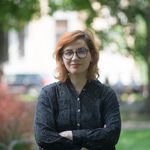
Junior Professor Anastasia Athanasiou heads the newly established professorship »Natural Hazards and Structural Resilience« at the Faculty of Civil and Environmental Engineering. Photo: private

Inaugural Lecture on 24 October: Multi-Hazard Engineering Expert Takes Stock

Natural hazards and severe weather events put buildings under great stress. Junior Professor Anastasia Athanasiou is investigating how to plan and build tall, slender structures safely and in a resource-efficient manner. Since July 2023, she has held the newly established chair of Natural Hazards and Structural Resilience at the Faculty of Civil and Environmental Engineering at Bauhaus-Universität Weimar. A native of Greece, she previously worked at the University of Catania (Italy) and Concordia University in Montreal (Canada). In her inaugural lecture, she will report on the challenges of the past year and provide an insight into current research achievements.

3D Printed houses? Digital construction can be optimised with the help of innovative concrete additives. Photo: Bauhaus-Universität Weimar, Thomas Müller.

Building Block of the Future: Adaptable, Intelligent Concrete

Concrete is the 21st century’s most important building material. At the Bauhaus-Universität Weimar, it is being further developed and brought into a new era with the »StimuCrete« research project. With the help of innovative additives, the plan is to develop an intelligent concrete that is adaptable in both its fresh and solid states. This innovation aims to boost digital, automated construction and to increase the service life of buildings. The Federal Ministry of Education and Research will be funding the NanoMatFutur research group, led by Luise Göbel, Junior Professor of »Werkstoffmechanik« at the Faculty of Civil and Environmental Engineering, with nearly 1.9 million euros until 2028.

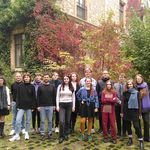
Fellows of the Research Training Group at the kick-off in October. Photo: Kathrin Meißner

»Gewohnter Wandel« Lecture Series Highlights Aspects of International Housing Research

The »Gewohnter Wandel. Gesellschaftliche Transformation und räumliche Materialisierung des Wohnens« joint research training group from the Bauhaus-Universität Weimar and the Goethe-Universität Frankfurt began their work on 1 October 2024. The research training group will be presenting itself during the winter semester to the public in a lecture series providing insights into current international housing research.

Congress Centrum Suhl in Thüringer Wald. Copyright: Clemens Pohl

Transforming Thuringian Spaces: Bauhaus-Universität Weimar Students Launch Projects in the Thuringian Forest

The rural Thuringian Forest is facing major challenges in managing the current social and ecological crises. But impending change provides opportunities. To identify these, many of the Bauhaus-Universität Weimar’s Institute for European Urban Studies (IfEU) planning projects from October 2024 to July 2025 are focussing on the Thuringian Mittelgebirge, an area rich in tradition. Under the title »Räume in Transformation Thüringen« (RiTT), students from the Faculty of Architecture and Urbanism are working closely with local partners to develop ideas on how sustainable and geographically equitable development in the region could succeed.

Photo: Bauhaus-Universität Weimar/ Thomas Müller

Invitation to the Matriculation Ceremony on 16 October 2024 at 5 pm

The Bauhaus-Universität Weimar Matriculation Ceremony welcomes new students in the upcoming 2024/2025 winter semester. The start of the new semester marks not only the return of already-enrolled students back to campus, but also the beginning of an exciting new phase for many first-year students.

A user tries out the Transcultural Listening Map on a touchscreen

Cultural Listening Techniques Around the World: A Journey Through the Transcultural Listening Map

The head of »Experimental Radio« at the Bauhaus-Universität Weimar is publishing a new kind of website in the form of a »Transcultural Listening Map«. The Map makes the interactive exploration of international projects based on cultural techniques of hearing and listening to radio possible. Artists and researchers are invited to participate by adding their own projects to the platform.

The joint exhibition includes works by students from the Bauhaus-Universität Weimar and the Fachhochschule Erfurt University of Applied Sciences displayed in the West Hall of the historic »Bahnhallenquartiers«. Photo: Mara Trübenbach

»LERNEN VOM BESTAND«: Student Project Exhibition from Weimar and Erfurt

In October 2024, the Bauhaus-Universität Weimar and the Fachhochschule Erfurt University of Applied Sciences will be showcasing student projects dedicated to questions of (re)building existing structures during a joint »Hochschulmonat« (university month). The projects are part of the »Sorge um den Bestand« exhibit, which the »Bund Deutscher Architektinnen und Architekten« (Association of German Architects) has been running in Erfurt’s »Bahnhallenquartiers« since August.

Annual Conference of the Chancellors of German Universities at the Bauhaus-Universität Weimar

Once a year, the chancellors of Germany’s universities convene for their annual conference in order to address current professional challenges within their areas of responsibility. This year’s conference is scheduled for 19 to 21 September at the Bauhaus-Universität Weimar and is dedicated to the keynote topic of »University Construction Despite/in Defiance of Crises«. Some 100 participants from across Germany are expected to attend the conference, which will focus on pioneering university construction initiatives and the concept of the »campus of the future«.

Photo of a person examining the printed material.

Studierende lernen praktisch mit Roboterarmen umzugehen: Fellowship für »RoboTec« eingeworben

Prof. Jan Willmann und Jun.-Prof. Lars Abrahamczyk haben sich mit ihrem Projekt »Robotic Tectonics – Roboterbasierte Lehr- und Lernumgebung für automatisierte Bauprozesse« (RoboTec) erfolgreich um eines von neun Fellowships des Stifterverbands und des Thüringer Wirtschaftsministeriums beworben. Rund 50.000 Euro stehen nun für ein interdisziplinäres Lehrformat zur Verfügung, das den Studierenden den Umgang mit Roboterarmen praktisch beibringen soll. Bereits mehrfach profitierte die Bauhaus-Universität Weimar von den Förderungen für Innovationen in der Digitalen Hochschullehre Thüringen, um neue Lehrvorhaben zu entwickeln.

In future, the bus timetable in rural areas will be better tailored to the needs of the population. Photo: KomBus GmbH bus service, photographer: A. Kranert

Thuringian Test Field: Demand-Based Mobility Concepts for Rural Areas

The joint BMBF-funded MOVEwell project is scheduled to begin in September 2024 under the leadership of the Bauhaus-Universität Weimar. The goal of the project is to make rural areas more accessible, thus increasing the attractiveness of the regions as business locations – in particular for skilled workers. Using three model regions in Thuringia as examples, innovative and sustainable public transport concepts will be developed, tested and integrated with workplace mobility management concepts. Nearly 4.6 million euros are being provided by the federal government for this project over the next five years.

The VertiKKA prototype was developed during the 2019 to 2022 project period and was tested under real conditions in Weimar in 2024. Photo: Dorothee Siemer

Climate Mitigation in Urban Areas: Bauhaus-Universität Weimar Launches Test Site

After several years in development, the prototype for a new type of façade greenery system integrated with solar panels is being tested under real conditions at the Faculty of Civil and Environmental Engineering. The Federal Ministry of Education and Research (BMBF) funded »Vertikale Klima-Klär-Anlage« (VertiKKA for short) project will be installed on the façade of the Bauhaus-Institute for Infrastructure Solutions (b.is) at Coudraystraße 10. The prototype will be presented to the public for the first time during the grand opening on 5 September 2024 starting at 4 pm.

Collage von Fotos der Ausstellungsorte und der Zeitung

Fotoprojekt von Bauhaus-Uni-Studierenden mit Kindern und Jugendlichen aus Weimar-West stellt im öffentlichen Raum aus

Im Sommersemester 2024 hat die Professur »Fotografie« ein besonderes Projekt angeboten: Unter dem Titel »MULTIPERSPEKTIVITÄT« haben Studierende der Visuellen Kommunikation mit Kindern und Jugendlichen aus Weimar-West zusammengearbeitet. In zahlreichen Workshops und bei verschiedenen Veranstaltungen sind Fotografien entstanden, die nun bis Ende September im Stadtraum von Weimar-West ausgestellt sind.

Collage of photos of two presented works: »The Brainless Dancer« and »Heart to Heart«

Media Art Students from the Bauhaus-Universität Weimar to Participate Once Again in Ars Electronica 2024

Media Art and Design students from the Bauhaus-Universität Weimar will be presenting their work at this year’s »Ars Electronica 2024« in Linz from 4 to 8 September 2024. Under this year’s slogan, »sense & sense-abilities«, artists are inviting visitors to reflect on subjective sensory experiences and how they influence our behaviour through interactive installations and performances.

VI. Weimar Silent Film Retrospective Presents Films from 1924 as Part of the Kunstfest Weimar

From 26 August to 6 September, the 6th »Weimarer Stummfilm-Retrospektive«, together with the Media Studies Department and the University Library, will be screening a selection of silent films under the slogan »Weltenecho! Filme der Weimarer Republik in den Weimarer Kinos 1924«. The event, which has established itself as a permanent fixture in the Kunstfest Weimar programme, will provide insights into one of the most influential periods in film history. Over ten evenings, a total of 20 films that played in Weimar cinemas in 1924 will be screened at the Lichthaus-Kino Weimar.

»Weimarer Wissensdialog« event poster. Design: Cissy Hecht

»Weimarer Wissensdialog«: Public Discussion Hosted by Art and Science

Together with other Weimar educational institutions, the Bauhaus-Universität Weimar will be hosting the »Weimarer Wissensdialog. Wissenschaft und Kunst für eine starke Demokratie« (Weimar knowledge dialogue. Science and art for a strong democracy.) on Friday, 23 August 2024. The attending researchers and artists will be presenting their projects and are hoping to engage in discussions with Weimar citizens. The event is being held as part of the »Weltoffenes Thüringen« (Open-Minded Thuringia) initiative.

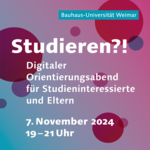
Studieninteressierte, Schüler*innen sowie deren Eltern sind eingeladen, sich über das Studium zu informieren.

Digitaler Orientierungsabend für Studieninteressierte und Eltern

Die Bauhaus-Universität Weimar lädt dazu ein, sich umfassend über die Studienwahl und die Rahmenbedingungen des Studiums zu informieren. Der nächste Orientierungsabend findet online am Donnerstag, 29. August 2024, 19 bis 21 Uhr statt. Hierzu sind sowohl zukünftige Studierende als auch ihre Eltern herzlich eingeladen.

The newly renovated and refurbished entrance area at Bauhausstraße 11, where the Faculty of Media will return starting in the 2024/2025 winter semester. Photo: Tina Meinhardt

Renovation and Refurbishment of Bauhausstraße 11 Completed: »Kassenärztliche Vereinigung« Hands Building Back Over to the Bauhaus-Universität Weimar Faculty of Media

One semester earlier than planned, the owner of the building, the »Kassenärztlichen Vereinigung Thüringen (KVT)«, will hand the building at Bauhausstraße 11 back over to its tenant, the Bauhaus-Universität Weimar, on Friday, 16 August, 2024 at 10:30 am. For over 25 years, the Faculty of Media has been home to the departments of Computer Science of Media and Media Studies, as well as the Faculty’s labs, seminar rooms and offices. Extensive renovations, including a new extension, on the building began in autumn of 2021 at the request of the KVT and in accordance with the building’s status. The renovations will provide modern and improved study and working conditions in the 2024/2025 winter semester.