


Archive

Thinking About Nature: A Transatlantic Cooperation Between Weimar and Baltimore

From 18 to 21 June 2025, scientists from the Faculty of Media at the Bauhaus-Universität Weimar and the Department of Comparative Thought and Literature at Johns-Hopkins University in Baltimore are organising their first Summer Lab in Weimar. The event marks the beginning of an ongoing cooperation between the two institutions, which is aiming to bring researchers from both countries together to explore the concept of nature from philosophical, media, political, and literary perspectives. Jane Bennett, renowned political scientist at Johns Hopkins University, was already a Bauhaus Guest Professor in Weimar in 2023, and will also be taking part.

Photo: Tarek Rishmawi

Art in Penal System: Photography Project with Students Show Perspectives from Prison

In the 2024/2025 winter semester, three Visuelle Kommunikation (Visual Communication) students from the Bauhaus-Universität Weimar had the rare opportunity to get to know six women who were incarcerated at the Chemnitz Prison and to carry out a photography project together. The results of this project will be exhibited on the outside wall of the Chemnitz Prison starting on 13 June 2025.

Lynn Haag awarded a Silver Nail for her Bachelor's thesis »Arthropods of the Anthropocene«; Film still: Lynn Haag

Bauhaus-Universität Weimar Recognised with Five 2025 ADC Talent Awards

With one Silver Nail and two Bronze Nails as well as two additional awards, design students from the Faculty of Art and Design have once again impressed at the renowned ADC Talent Award. The award-winning projects were designed in the Visuelle Kommunikation (Visual Communication) and Media Art and Design degree programmes and display a broad range of design and content, from biodiversity and typography to collective authorship, protest culture, and philosophically motivated forms of publication.

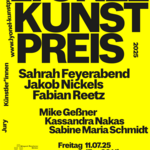
Poster of the event

Works of Art Take Over Bauhaus-Universität Weimar Administrative Offices

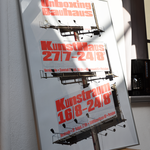
The »nova space« University Gallery is breaking new ground: With the »Liebe in Zeiten der Bürokratie« (love in times of bureaucracy) exhibition, it is relocating the classic exhibition space to somewhere you might least expect it – the offices of administrative staff. Tea kitchens and meeting rooms are also transformed into exhibition spaces, administrative staff become hosts, and works of art become flatmates in everyday office life. The exhibition will be accessible at set times as part of guided tours.

The numerous partners of the Cluster of Excellence »Imaginamics. Practices and Dynamics of Social Imagining« on the occasion of the announcement of the award of excellence in the Botanical Garden in Jena. Photo: Claudia Weinreich

Social Imagining: Researchers at the Bauhaus-Universität Weimar Successfully Took Part in the New »Imaginamics« Cluster of Excellence

Yesterday evening, 22 May 2025, it was confirmed that the »Imaginamics. Practices and Dynamics of Social Imagining« Cluster of Excellence, submitted under the leadership of Friedrich Schiller University Jena, has been awarded funding within the Excellence Strategy of the German federal and state governments. This is also significant for the Bauhaus-Universität Weimar, which is involved in the project through three of its leading researchers.

Portrait of Wolf Singer

Brain Versus Computer: Same Principles?

Renowned neuroscientist Wolf Singer will be a guest at the Faculty of Art and Design at the Bauhaus-Universität Weimar on Tuesday, 27 May 2025 at 7 pm. With his public lecture on »Oszillationen, Wellen und Interferenzen als Lingua Franca der Großhirnrinde« (oscillations, waves, and interface as the lingua franca of the cerebral cortex), he will be opening his new lecture series »Sonic Talks«, which will focus on focus on rhythm, sound and healing in the 2025 summer semester.

In Lecture Hall A at Marienstraße 13, employees provide information about study options, degree courses and general conditions. Photo: Thomas Müller

What Programs are Offered at the Bauhaus-Universität Weimar, and How Do I Apply? The Open Campus Day on 24 May 2025 Provides Answers

The Bauhaus-Universität Weimar will open its doors on Saturday, 24 May 2025 from 9 am to 3 pm for the annual Open Campus Day. What is the right degree programme for me? How can I finance my studies? What can I expect in Weimar and on campus? These questions and others will bye answered by Bauhaus-Universität Weimar and Studierendenwerk Thüringen staff in the foyer of the Mensa am Park at Marienstraße 15 starting at 9 am. Guests will be provided with general and subject-specific information on studying.

Prof. Dr. Guido Morgenthal has been appointed Vice President for Projects and Research at the Bauhaus-Universität Weimar. Photo: Matthias Eckert

Prof. Dr. Guido Morgenthal Appointed Vice President for Projects and Research at the Bauhaus-Universität Weimar

On Wednesday, 7 May 2025, the Senate confirmed the Bauhaus-Universität Weimar’s new Vice Presidents. Prof. Dr. Guido Morgenthal will hold the office of Vice President for Projects and Research for the next three years. During their session, Senate members voted strongly in favour of President Prof. Peter Benz’s proposal. Prof. Dr. Timon Rabczuk, the previous Vice President, resigned from the position due to personal reasons. During the session, the Senate bid farewell to Prof. Rabczuk and President Prof. Peter Benz thanked him for his commitment over the past two years. With the appointment of Prof. Morgenthal, the Presidential Board is again complete.

Buchvorstellung »Städtebau im Nationalsozialismus«

Wie wurde Städtebau im Nationalsozialismus zum Instrument von Macht, Ausgrenzung und Krieg? Welche Rolle spielte er im Vergleich zu anderen autoritären Regimen in Europa zwischen 1933 und 1945? Antworten auf diese Fragen gibt eine neue, umfangreiche Publikation, die am 16. Mai, 18 Uhr, im Bauhaus-Museum Weimar der Öffentlichkeit vorgestellt wird.

»The Future of Artificial Intelligence« – Invitation to the Third Event of the »BEYOND NOW ⸺ Questions on the Future of Society« Series on 8 May

The third edition of the event series centres around artificial intelligence (AI). The possibilities offered by artificial intelligence AI seem incredible, even magical. Digitalised aspects of life are developing at lightning speed – AI seems omnipresent and omnipotent. This brings up questions that refer to the fundamental relationship between technology and society and can only be answered from an interdisciplinary perspective, a task that guests will attempt during the event.

Scientists from the Computer Science of Media Department at the Bauhaus-Universität Weimar are researching digital watermarks in AI as part of the Lantmark research project. Image: Fraunhofer IDMT, generated with DALL-E 3 (OpenAI) by Patrick Aichroth

Digital Watermarks Help Identify AI-Generated Texts

Whether it’s a chatbot, language assistant, or automatic text generation – artificial intelligence is being used in many areas. But how can we prove whether a text was written by a human or generated through a computer programme? Are invisible watermarks the solution to identifying authorship? The new »Lantmark« research project, which began at the Bauhaus-Universität Weimar in early April 2025 and is being funded through the BMBF with nearly 1 million euros, is hoping to answer these questions.

Earthquakes, floods, storms - extreme weather conditions and natural disasters pose major challenges for civil engineers. Students present their latest research findings at various events, including summaery. Bauhaus-Universität Weimar, Photo: Thomas Müller

Progress Through Education: DAAD Supports International Experts from Weimar

The German Academic Exchange Service (DAAD) is funding the English-taught »Natural Hazards and Risks in Structural Engineering« (NHRE) Master's degree programme at the Bauhaus-Universität Weimar with nearly 850,000 euros. This funding will go towards full scholarships for students from developing and industrialising countries and annual grants for tutorials until 2032. Scholarship recipients acquire the technical skills required for planning, construction, and redeveloping in high-risk areas. Once students have successfully completed the programme, they are expected to bring their knowledge back to their home countries as international experts and contribute to sustainable development.

»The Future of Democracy« – Invitation to the Second Event of the »BEYOND NOW ⸺ Questions on the Future of Society« Series on 24 April

The second part of the event series will focus on a variety of questions about the future of our democracy. Democracy did not simply appear out of nowhere and it is not a guaranteed success. For the Bauhaus-Universität Weimar, the experiences of National Socialist, the GDR, reunification, and the post-reunification period all shaped and influenced the understanding of democracy, as was demonstrated in the last elections. How should universities deal with this? How should the Bauhaus-Universität Weimar deal with this?

Many buildings in the Syria city of Aleppo were destroyed in the war. They are to be sustainably re-built in the future. Adobe Stock image, Photo: Torsten Pursche.

Reconstruction After the War – Prospectives for a Sustainable Syria

At least two million buildings have been destroyed in Syria as a result of the war. The majority of these buildings were concrete or steel structures. An international workshop scheduled to take place in Weimar on 24 and 25 April 2024 will focus on the rubble from these buildings can be recycled into valuable raw material. Nearly 100 partners from science, the industry, and politics, including the United Nations (UN), are expected to attend the event.

Logo of the theme year 2025 »BEYOND NOW ⸺ Environments«. Graphic: University Communication

»Beyond Now«: Bauhaus-Universität Weimar Funds Ten Projects as Part of Its Annual Theme

On Thursday, 3 April 2025, the Bauhaus-Universität Weimar presented its six-semester annual theme programme to kick off the summer semester. The current annual theme, »Beyond Now ⸺ Environment«, focussed on projects and partners that explore the interaction between living beings and their material and immaterial environments through research, teaching, science, and art.