






Archive

Thüringens Wirtschaftsministerin Colette Boos-John (Mitte) überreicht den Förderbescheid über knapp 5,5 Millionen Euro an Prof. Horst-Michael Ludwig, Prof. Peter Benz (beide Bauhaus-Universität Weimar), Prof. Carsten Könke (MFPA) sowie Robert Fetter (IAB) (v.l.n.r.). Foto: Thomas Müller

Innovationszentrum für nachhaltiges Bauen entsteht in Weimar: Wirtschaftsministerin Boos-John übergibt Förderbescheide über insgesamt rund 5,5 Millionen Euro

Gemeinsame Medieninformation mit dem TMWLLR: Thüringen bündelt und verstärkt seine Kompetenzen in der Bautechnologie. Am »Thüringer Innovationszentrum für die Zukunft des Bauens« (ThIZ-BAU) sollen künftig ressourcenschonende und nachhaltige Baustoffe und Bauprozesse entwickelt und neue Produkte und Technologien in die industrielle Anwendung überführt werden. Als ersten Schritt dazu übergab Thüringens Wirtschaftsministerin Colette Boos-John heute in Weimar drei Förderbescheide über insgesamt knapp 5,5 Millionen Euro (EFRE- und Landesmittel) an die beteiligten Forschungseinrichtungen – das F.-A.-Finger-Institut für Baustoffkunde an der Bauhaus-Universität Weimar (BUW) (0,9 Millionen Euro), das Institut für Angewandte Bauforschung Weimar gGmbH (IAB) (2,5 Millionen Euro) und die Materialforschungs- und -prüfanstalt (MFPA) (2,1 Millionen Euro). Die Mittel fließen insbesondere in die Anschaffung von Forschungsgeräten. Alle drei Einrichtungen werden gemeinsam Träger des neuen Innovationszentrums sein.

Photo: Amayu Wakoya Gena

New Book Release: »Ein Experiment in Holz und Energie – Bauhaus Energy Hub« (an experiment in wood and energy – Bauhaus Energy Hub)

The Bauhaus-Universität Weimar has always been synonymous with experimental work, interdisciplinary thinking, and learning through real-life projects. The experimental »Bauhaus Energy Hub« is an outstanding example of this aspiration. Designed and implemented by students from various disciplines, the building acts as a working and learning space as well as a Reallabor. On 19 January 2026, the Bauhaus University Press will publish a comprehensive documentation of this extraordinary teaching and research project.

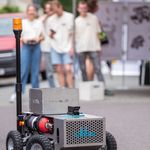
Robotic arm placing a brick onto a brick wall, guided by a red laser line. In the background, a person wearing a high-visibility vest and gloves holds a tablet inside a partially constructed or renovated building.

Smart Building and Renovating: Bauhaus-Universität Weimar Tests Robotics in Skilled Trades

Small and mid-sized skilled trades businesses are facing growing challenges; repurposing and renovating existing buildings is becoming increasingly complex, time pressure is mounting, and there is a growing shortage of skilled workers. Digital tools and robotics are promising relief. But how can new technologies be used in a way that they actually help craftspeople in their everyday life? This is the question being asked by the interdisciplinary research team at the Bauhaus-Universität Weimar in the »Handwerk der Zukunft« project. The team will be receiving nearly one million euros in funding from the European Social Fund from 2026 to 2028.

TURN Conference 2026: Call for Participation Open Until 28 February

With a focus on the theme of »Experiential Turn – Erfahrungsräume für zukunftsfähiges Lernen« (experiential turn – experiential spaces for future-proof learning), the Bauhaus-Universität Weimar is inviting you to this year’s TURN Conference: On 24 and 25 September, everything will be evolving around »Experiential Learning«. This term refers to a sustainable learning process though which knowledge is gained from concrete experiences. These experiences are then reflected upon, theoretically conceptualised, and further developed through repeated experimentation. Experiential learning influences not only the learning process, but also how knowledge is generated and insights are produced. Those interested can submit contributions until 28 February 2026.

Design: Cissy Hecht

»There is no memory without perception«: New Publication from Bauhaus-Universitätsverlag Honors Maurice Halbwachs’ Thinking and Work

In December 2024, the Bauhaus-Universität Weimar held a ceremony to rename its auditorium maximum the »Maurice-Halbwachs-Auditorium« in honor of the French sociologist and philosopher. The ceremony on 4 December 2024 featured numerous speeches by prominent academics – these can now be read in the volume »Es gibt also keine Erinnerung ohne Wahrnehmung« / »Il n'y a donc pas de souvenir sans perception«, which has just been published by Bauhaus-Universitätsverlag.

Zwei Gold- und zwei Silbermedaillen würdigen die innovativen Bauverfahren der Bauhaus-Universität Weimar. Foto: Katrin Linne

Bauhaus-Universität Weimar Receives Four Awards for Innovative Construction Methods

With its application-oriented, cutting-edge research into resource-saving building materials and forward-looking construction methods, the Bauhaus-Universität Weimar was represented at the international »Ideen – Erfindungen – Neuheiten« (iENA) trade fair in November 2025: Four patent applications have now been awarded two gold and two silver medals. At the award ceremony on 11 December 2025 at the Technischen Universität Ilmenau, the scientists were presented with their medals and certificates in a festive ceremony.

Die öffentliche Weihnachtsvorlesung findet im Seminarraum A in der Fakultät Medien der Bauhaus-Universität Weimar statt. Foto: Thomas Müller

Between Code and Candlelight: Invitation to the Weimar Informatics Christmas Lecture

Artificial intelligence writes texts in seconds, accurately summarizes content, and provides answers to the most complex questions. Its results are usually convincing, fluid, and extremely plausible. But how reliable are they really? The Weimar Department of Informatics is using current AI systems as an opportunity to critically examine their output: its meaning, correctness, and consequences for our own thinking. On 18 December 2025, at 5 pm, the Faculty of Media at the Bauhaus-Universität Weimar invites you to its traditional Christmas lecture at Bauhausstraße 11.

Between Goethe, Bauhaus, and Blind Spots: New Study Shows How Weimar is Perceived as a World Heritage Site

Weimar is a double UNESCO World Heritage Site: as a place of »Classicism« and as part of the serial World Heritage Site »Bauhaus and its Sites in Weimar, Dessau, and Bernau.« But how does this cultural landscape actually affect residents and visitors? This question will be explored in a public lecture in English as part of the “Debating Heritage” series organized by the International Heritage Center at the Bauhaus-Universität Weimar on 18 December 2025 at 5:30 pm.

Ihab Al-Rikabi, DAAD Prize winner 2025 at the Bauhaus-Universität Weimar. Photo: Angye Diener

Ihab Al-Rikabi Receives DAAD Prize 2025

This year's German Academic Exchange Service (DAAD) Prize goes to doctoral student Ihab Al-Rikabi from Iraq. He is being honored for his outstanding commitment to social, societal, and intercultural issues at the Bauhaus-Universität Weimar.

Two monitors standing side by side in front of a white fabric background. On the left, a dark interface from VOXAIPE; on the right, a light-coloured page with generated letter shapes.

Transforming Voice into Dynamic Fonts: Visuelle Kommunikation (Visual Communication) Students Honoured at DDC

Mai Do’s »VOXAIPE – Decoded« digital typography project was honoured at the Deutschen Design Club (DDC) competition. The innovative, AI-supported typography design tool stood out with its conceptual originality and design quality in the »Digital Talents« category. Her work explores how artificial intelligence can translate voices into visual forms.

 The F.A. Finger Institute for Building Material Engineering (FIB) conducts research and development on building materials, renovation, and recycling. The focus is on cement, mortar, concrete, gypsum, polymers, and wood. Bauhaus-Universität Weimar, photo: Guido Werner

Hidden Champion: How Weimar Has Been Shaping Building Materials Research for Decades

With over 60 employees and millions of euros in third-party funding, the F.A. Finger Institute for Building Materials Engineering (or FIB) is currently the most important research facility at the Bauhaus-Universität Weimar. Founded in 1995, the Institute’s roots go back to the 1940s, when Friedrich August Finger, the man after whom it was named, established this innovative field of research and teaching. Together with the »Institut für angewandte Bauforschung« (IAB) and the Materials Research and Testing Laboratory (MFPA), Weimar’s innovative location is going to expand to become a Federal Construction Research Centre. These and other milestones of the FIB will be honoured at a ceremony marking its 30th anniversary.

Veranstaltungsplakat. Copyright: Jens Weber, Foto: Max Schmidt

Harald Lesch über die Energie-Revolution: Vortrag im Maurice-Halbwachs-Auditorium der Bauhaus-Universität Weimar

Im Maurice-Halbwachs-Auditorium der Bauhaus-Universität Weimar findet am Montag, 8. Dezember 2025, um 19 Uhr der Vortrag »Erneuerbare Energie – die unerkannte Revolution« von Harald Lesch statt. Der renommierte Astrophysiker und Naturphilosoph gilt als einer der bekanntesten Wissenschaftskommunikatoren Deutschlands und begeistert mit verständlichen, leidenschaftlichen Einblicken in komplexe Themen.

Event poster. Grafic: Andrea Nicolò

International »Planet Uncanny« Conference Examines the Uncanny in Technology, Nature, and Society

The world seems increasingly uncanny: Artificial intelligence now generates images and texts on its own, plants react to their environment in surprisingly complex ways, and planet Earth itself presents itself as a wilful actor. From 3 to 5 December 2025, the DFG-funded research »Animismus/Maschinismus« project to the transdisciplinary »Planet Uncanny« conference in Weimar to explore precisely these disturbances. At the Bauhaus Museum Weimar, scientists and artists will gather to discuss how familiar roles between humans, machines, and nature are being rearranged in a changed world.

During TeleVisionale, students play freshly edited material directly from the festival onto a wall of tube television monitors. Photo: Halina Schiefer

Bauhaus-Universität Weimar Cooperates with TeleVisionale Film and Series Festival

The TeleVisionale film and media festival will take place this year from 1 to 5 December in Weimar, right next door to the Bauhaus-Universität Weimar. This traditional festival, which is being held in Weimar for the first time this year, provides a wonderful opportunity to initiate projects that will allow students to contribute to the programme and the festival week. The Faculty of Media and the Faculty of Art and Design will also be participating.

© IAB / Thomas Müller

Significant Momentum for Weimar as a Centre for Building Materials Research: Federal Government and Three States Decide to Establish Federal Construction Research Centre

This decision represents a major move towards a sustainable future for the construction industry. Today, Monday, 24 November 2025, representatives from the Bundesministeriums für Wohnen, Stadtentwicklung und Bauwesen (BMWSB) and the three federal states of Thuringia, Saxony, and Baden-Württemberg signed a key issues paper confirming the establishment of a »Bundesforschungszentrums für klimaneutrales und ressourceneffizientes Bauen (BFZ)« (Federal Research Centre for Climate-Neutral and Resource-Efficient Construction). The federal government will invest a total of 52.5 million euros in this project over the next few years.