
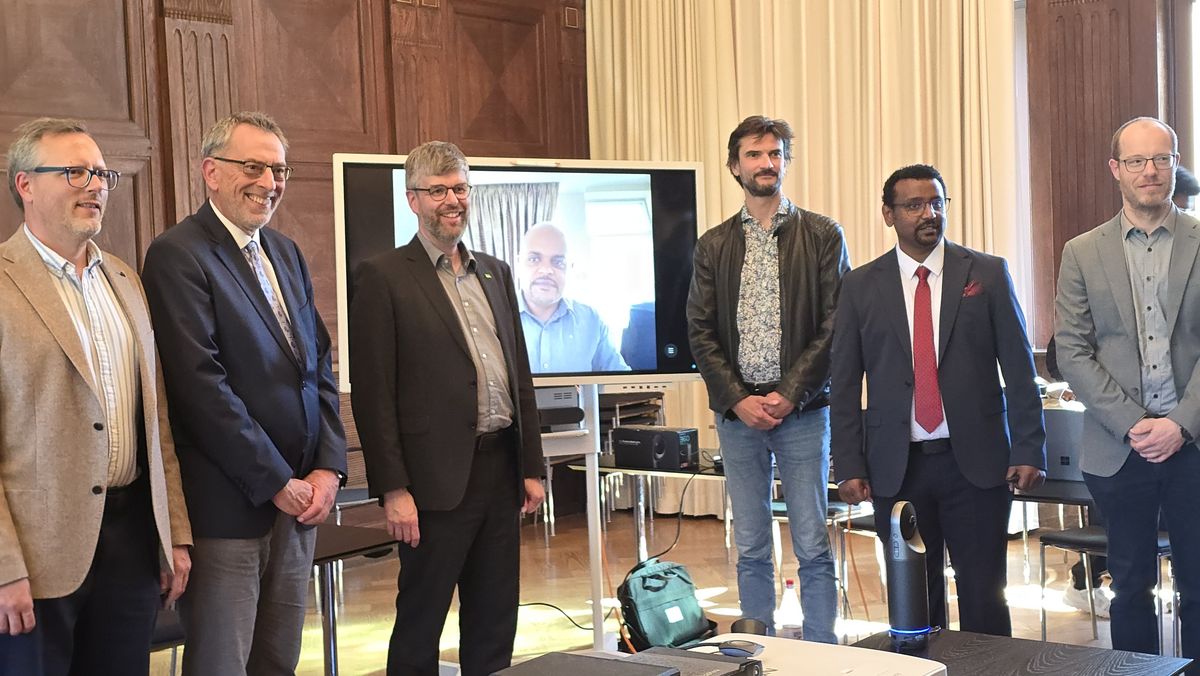
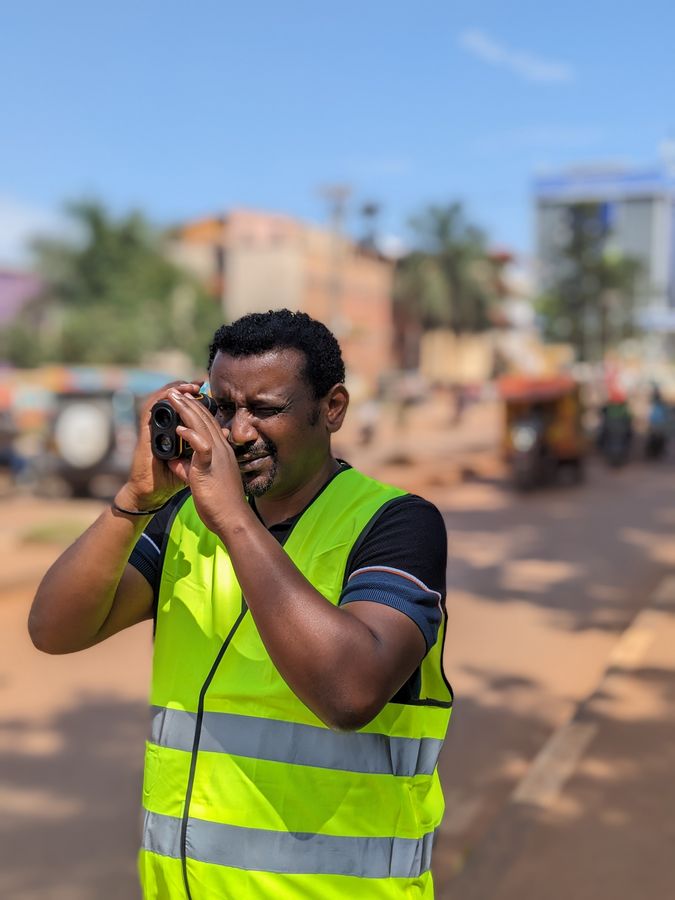
Wondwossen Taddesse Gedamu successfully defends his doctoral dissertation
According to the World Health Organization (WHO), approximately 1.2 million people die in traffic accidents each year, and over 50 million are injured. Although they account for only a small share of the global vehicle fleet, Low- and Middle-income Countries (LMICs) account for 92 percent of road fatalities. Despite a global decline in road fatalities, Ethiopia is one of the countries experiencing an increase in deaths. In his doctoral thesis, Wondwossen Taddesse Gedamu therefore examined traffic safety in Addis Ababa and identified factors related to roads, traffic, and land use that influence the severity of accidents.
Addis Ababa, the capital and largest city of Ethiopia, plays a central role in the country’s political, economic, and social life. With a population of over five million, rural-to-urban migration is exacerbating the challenges of urban mobility and traffic safety. In 2022 alone, Addis Ababa recorded 403 traffic fatalities—nearly ten times more than Berlin and four times more than London. As a focus area, Addis Ababa provided important data on accident numbers and hotspots.
The effective identification of accident black spots enables road authorities and traffic monitoring agencies to implement effective safety measures. Traditional methods of identifying black spots, which are based on accident frequency and rate, suffer from statistical biases, do not provide spatial insights, and do not take into account the exact locations of accidents. In contrast, the analysis of spatial patterns offers the opportunity to explore the relationship between accident severity levels and to determine whether accident events follow a random pattern or exhibit spatial dependencies based on severity, as well as to identify high-risk locations (hotspots) using the Network Kernel Density Estimation (KDE) method. In his work, Wondwossen Taddesse Gedamu developed a methodological framework to extend kernel density estimation (KDE) for a more objective identification and prioritization of accident black spots. Wondwossen Taddesse Gedamu examined how patterns of accident severity differ between urban and peripheral areas, emphasizing the need to go beyond the traditional distinction between urban and rural areas in safety analysis.
Wondwossen defended his doctoral dissertation, titled “Spatial Pattern Analysis and Modeling of Road Traffic Crashes,” on April 29, 2026, under the supervision of Prof. Uwe Plank-Wiedenbeck (Transportation Systems Planning, Bauhaus-Universität Weimar) and Dr. Bikila Teklu (Addis Ababa University, AAiT). We congratulate Wondwossen on his outstanding achievement and wish him all the best in his future academic and professional endeavors!
Publications:
- Gedamu, Wondwossen Taddesse, Uwe Plank-Wiedenbeck, and Bikila Teklu Wodajo. "A spatial autocorrelation analysis of road traffic crash by severity using Moran’s I spatial statistics: A comparative study of Addis Ababa and Berlin cities."Accident Analysis & Prevention 200 (2024): 107535.
- Gedamu, Wondwossen Taddesse, Uwe Plank-Wiedenbeck, and Bikila Teklu. "Spatio-Temporal Analysis of Road Traffic Crash Severity and Collision Type." Available at SSRN 4895003 (2024).
- Gedamu, Wondwossen Taddesse, Uwe Plank-Wiedenbeck, and Bikila Teklu Wodajo. "Spatio-temporal analysis of road traffic crashes by severity."Transportation Engineering 20 (2025): 100327.