
Media Information

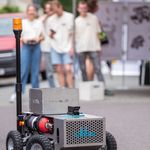
Wasserstoff als Teil der Lehre: An der Bauhaus-Universität Weimar entwickelten Studierende der Umweltingenieurwissenschaften unter anderem eine innovative Robotikplattform, die mit einer Wasserstoff-Brennstoffzelle betrieben wird und kleinere Gegenstände transportieren kann. Bauhaus-Universität Weimar, Foto: Thomas Müller

Mobilitäts- und Energiewende vor Ort: Wasserstoffbus »Walter Gropius« in Weimar

Die Transformation von Mobilität und Energieversorgung gehört zu den zentralen Herausforderungen der Gegenwart. Kommunale Unternehmen wie die Stadtwirtschaft Weimar GmbH übernehmen hierbei eine Vorreiterrolle, indem sie innovative Technologien mit wissenschaftlicher Begleitung, unter anderem durch die Bauhaus-Universität Weimar, unter realen Bedingungeneinsetzen. Erlebbar wird die enge Verbindung von Wissenschaft, Lehre und kommunaler Praxis am Beispiel des Wasserstoffbusses »Walter Gropius«, welcher ab 8. April 2026 mit neuer Gestaltung durch Weimar fährt.

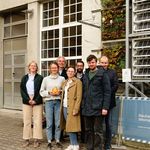
Prize winners from left to right: Theresa Paskert, Maria Hartmann, Prof. Eckhard Kraft, Gloria Kohlhepp, Hayder Alsaad, Gregor Biastoch and Prof. Silvio Beier in front of VertiKKA at Coudraystraße 10, photo: Bauhaus-Universität Weimar

Bauhaus-Universität Weimar Recognised for »Vertikalen KlimaKlärAnlage« Research

The »Tilia Awards« were presented for the first time on 20 March 2026 for scientific and practice-based projects that take new approaches to urban spaces. Out of over 150 entries, 24 winners were selected, including the Bauhaus-Universität Weimar and the IAB-Institut für angewandte Bauforschung Weimar for their work in the »Akademische Arbeiten und Forschung« (academic work and research) category. The interdisciplinary »GrayToGreen« research project was honoured for its integration of vertical greening and grey water treatment.

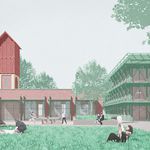
 The Schinkel-Preis in the »Städtetbau« (urban design) category awarded to »DAZWISCHENstadt Luckenwalde«: Perspektive der Alten Wache. Design: Till Pulst, Emil Kuenzer, Jorik Flohr and Jesse Puhan-Schulz

Outstanding Success at AIV-Schinkel-Preis 2026

Huge success for the Bauhaus-Universität Weimar: Architecture students win the AIV-Schinkel-Preis 2026 in the »Städtebau« (urban design) category. The competition, organised by the »Architekten- und Ingenieur-Verein (AIV)« of Berlin and Brandenburg, is one of the most prestigious awards for young urban planners in the German-speaking world. Weimar was also the recipient of the special prize for »Interdisziplinär und nachhaltig bauen« (interdisciplinary and sustainable construction) and two honourable mentions. The official awards ceremony will take place on Friday, 13 March 2026 at the Stadttheater Luckenwalde as part of a celebratory event.

Photo: Carlos Santos

International Teaching Format Continues to Grow: Five Years of the Bauhaus Spring School

From 12 to 21 March, the Bauhaus Spring School will once again bring students from all over Europe together in Weimar and celebrate its fifth anniversary. Since 2022, the international teaching format at the Bauhaus-Universität Weimar has been successfully connecting students from European partner universities. The anniversary programme is taking things to the next level: with a total of eleven interdisciplinary courses, there are more options that ever.

Aerial view of the Bauhaus-Universität Weimar campus as part of the Bauhaus site in Weimar, a UNESCO World Heritage Site. Photo: Bauhaus-Universität Weimar/ Thomas Müller

30 Years of UNESCO World Heritage Sites: Anniversary of Bauhaus Heritage in Weimar

In 1996, the Bauhaus sites in Weimar and Dessau were designated the status of UNESCO World Heritage Sites. This recognition and inclusion in the UNESCO World Heritage Site List were significant steps toward permanently anchoring the Bauhaus in international cultural memory. The inclusion was also crucial for the sustainable preservation and public awareness of the Bauhaus heritage. Over the years, numerous individuals have contributed to the preservation, scientific research, and contemporary and educational presentation of the historic Bauhaus through their commitment and perseverance.

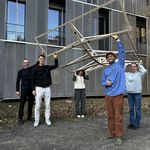
Bauhaus-Universität Weimar students present their construction elements for the new exhibition stand for the 2026 Leipzig Book Fair. The design was developed in the interdisciplinary Bauhaus.Module »typotopie«, led by Prof. Michael Herrmann and Torsten Müller. Photo: Professorship of Construction Design and Structural Design

Bauhaus Goes Leipzig: Students Design New Book Fair Stand

Wood, textiles, and light make up the stand while typography provides the narrative structure. At the end is a shared goal: Representing the Bauhaus-Universität Weimar at the 2026 Leipzig Book Fair. This is the mission that 15 students started their 2025/2026 winter semester with. Under the academic direction of Prof. Michael Herrmann and Torsten Müller from the Professorship of Construction Design and Structural Design, five experimental designs were conceived as part of the interdisciplinary Bauhaus.Module »typotopie«. The concept by students Petter Bolstad, Nina Siegle, and Ngoc Truc Phuong Nguyen was selected for the Fair.

Copyright: hla.studio

Continue Living as Usual? International Conference at the Bauhaus-Universität Weimar Explores Housing Transformation

How is housing evolving in times of multiple crises? How do social change and the material design of architecture, neighbourhoods, and infrastructures influence one another? These questions will be addressed on 7 and 8 May 2026 at the »Weiter wohnen wie gewohnt? Gesellschaftliche Transformation und räumliche Materialisierung des Wohnens« conference at the Bauhaus-Universität Weimar.

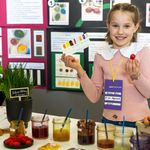
Farben aus der Natur (1. Preis »Jugend forscht junior« Chemie): Emilija Zunic präsentiert selbst hergestellte Pflanzenfarben – gewonnen aus Beeren, Gewürzen und Kräutern. Foto: Bauhaus-Universität Weimar/ Matthias Eckert

Turbokompost, Algen-Biokraftstoff und Drohnen zur Blütenbestäubung: Regionalsieger*innen von »Jugend forscht« an der Bauhaus-Universität Weimar ausgezeichnet

Die Gewinnerinnen des 31. Regionalwettbewerbs Mittelthüringen »Jugend forscht« stehen fest: Insgesamt 17 Erstplatzierte sowie zwei Regionalsieger*innen für die besten interdisziplinären Projekte wurden am Mittwoch, 25. Februar, ausgezeichnet und haben sich für den Landeswettbewerb Thüringen qualifiziert. Mit kreativen Ideen zu Nachhaltigkeit, Medizin, Ressourcenschutz und Digitalisierung überzeugten 110 Schüler*innen aus 16 Schulen und drei Schülerforschungszentren die Jury.