
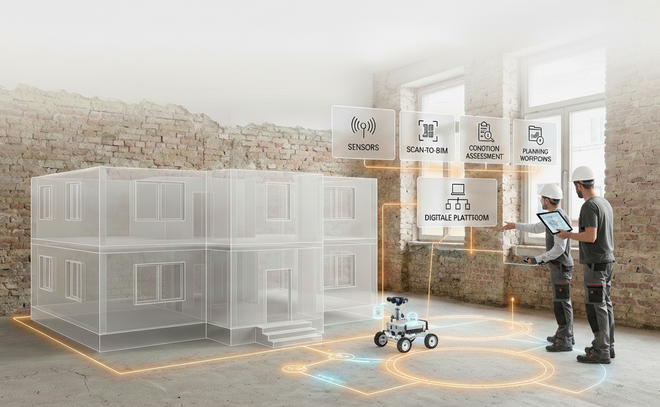
Craftsmanship of the Future: Data-driven planning and human-robot interaction in existing buildings
Small and medium-sized craft businesses are facing a dual transformation: They must upgrade existing buildings to be climate-friendly and future-proof while simultaneously coping with increasing complexity, tight deadlines, and a shortage of skilled workers. This is precisely where the project "Crafts of the Future: Data-Driven Planning and Human-Robot Interaction in Existing Buildings" comes in. An interdisciplinary team from the Bauhaus University Weimar and the MFPA Weimar is researching how digital methods and robotics can be designed to provide concrete support for practical work on construction sites in existing buildings – instead of creating additional obstacles.
The focus is on new forms of collaboration between experienced craftspeople and a mobile robot assistant: This robot is intended to perform tasks on-site such as 3D surveying, condition assessment, and marking work, and be linked to planning data via a seamless digital process chain. This creates a foundation for networked, flexible construction processes that contribute to the decarbonization of existing buildings while simultaneously relieving the strain on scarce personnel resources in the construction industry.
The ITD team is investigating how existing building data, planning models, and schedules can be linked so that relevant information is available to tradespeople and robotic systems at the right time and in the right place. Based on this, prototypical workflows for 3D data acquisition, condition assessment, and marking tasks are being developed, seamlessly integrating into a networked, data-driven approach to the processing of existing buildings.
With AP2, the Chair of Intelligent Technical Design is making a significant contribution to ensuring that the use of robotics in the trades is not only technically feasible but also organizationally and digitally well-integrated – as a basis for a long-term productive, safe, and climate-conscious construction practice in existing buildings.
The project is funded by the European Social Fund with approximately one million euros for the period 2026–2028.
Faculty of Civil and Environmental Engineering, Chair of Intelligent Technical Design;
- Prof. Dr.-Ing. Christian Koch,
- Essam Fadel
Faculty of Civil and Environmental Engineering, Chair of Complex Structures;
- Junior Prof. Dr.-Ing. Lars Abrahamczyk,
- Lissethe González Lamadrid
Faculty of Art and Design, Chair of Design Theory and Design Research
- Prof. Dr. Jan Willmann,
- Dr. Michael Braun,
- Josha Helmchen
In cooperation with MFPA Weimar:
- Alexander Freyburg,
- Dr. Anne Tretau,
- Valerii Dobiazgho (Materials and Product Qualification Working Group),
- Prof. Dr.-Ing. Carsten Könke (Head of the Institution)