Schlieren mirror
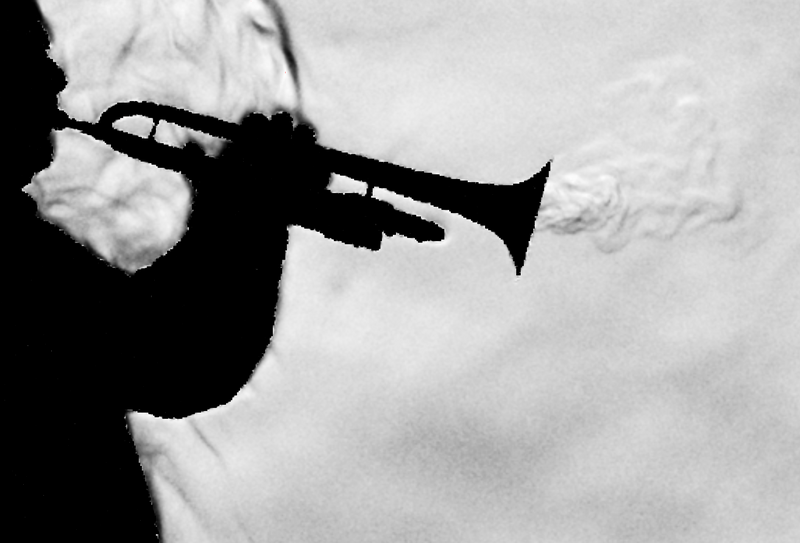
The schlieren imaging is a technique for visualizing and measuring indoor air currents. The measurement setup essentially consists of a concave and extremely finely ground mirror (Ø = 1002 mm, focal length: 3001.5 mm, micro-roughness: <2.7 nm RMS, surface defects: <λ / 9.75 @ 633 nm), a light source (LED), a knife edge and a camera with very good resolution (Canon EOS 5DS R DSLR mit 50,6 MP), and a lens with very high sharpness (ZEISS Milvus 2/135).
The functional principle of schlieren imaging is based on the deflection of light beams as a result of refractive index gradients. The light rays from the light source are directed with the help of the schlieren mirror and passes through the measuring section. Density gradients in test section lead to refractive index gradients that deflect the light rays. On the other side of the measuring section, the light beams are focused on a point at the radius of curvature of the mirror and then fall on the camera lens. In order to make the deflected light rays visible, a knife edge e.g. can be placed at the focal point from bottom, so that it can block about half of the light rays. Hence, the downwardly deflected light rays at the test section can no longer fall on the lens of the camera, thus creating dark areas (shadow), while the upwardly deflected light rays passes the knife edge and thus result in brighter areas on the camera lens. These differences in brightness enables to visualize the first derivative of the refractive index.
With the commissioning of this unique schlieren imaging system for examining the indoor climate, the Professorship of Building Physics now has an innovative, non-invasive measurement technique for determining air movement with high temporal and spatial resolution.
In the future, new materials, technologies and processes in the area of heating / cooling / ventilation of buildings can be developed and a contribution can be made in the specialization fields of »Sustainable Use of Energy and Resources« and »Healthy Living and Health Management«.
The project is funded by the Free State of Thuringia under the number 2015 FGI 0005 and was co-financed by funds from the European Union as part of the European Regional Development Fund (ERDF).
The schlieren imaging system and the background-oriented schlieren system were awarded with the Thuringian Research Award 2021 in the category "Applied Research".


Background-oriented schlieren (BOS)
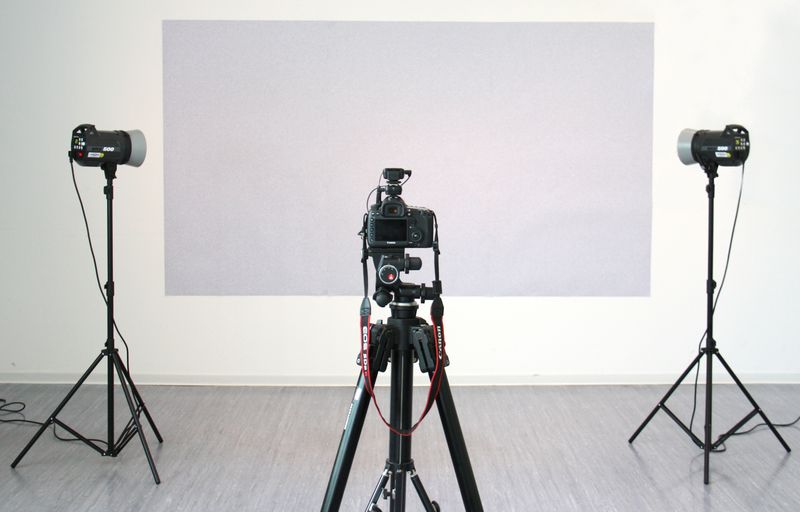
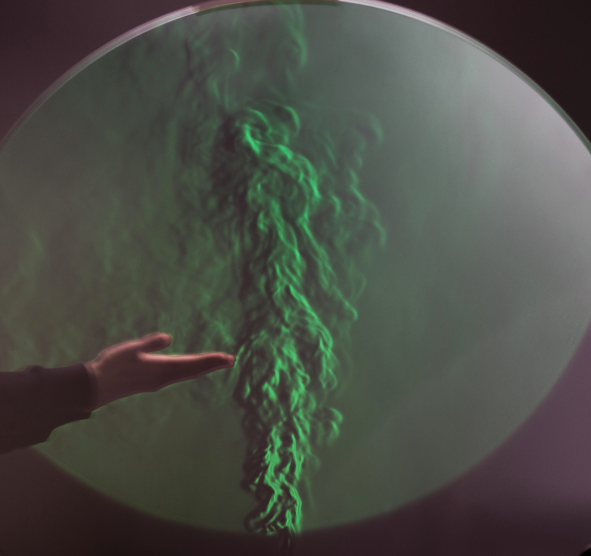
The optical background-oriented schlieren (BOS) method is able to visualize indoor airflows non-invasively without disturbing the flow field. The setup consists of a structured background (black dots on a white surface), a high-resolution camera (Canon EOS 5DS R DSLR mit 50,6 MP) and a lens with very high sharpness ((ZEISS Milvus 2/135), and the object under investigation. For a better illumination, the background is lit by flashlights (two Elinchrom ELC Pro HD 1000).
BOS visualizes differences in densities of fluids due to differences in temperature or pressure. For light rays, these density gradients cause refractive index gradients that can be detected by BOS. To capture the schlieren, the object of interest, which causes the density gradient (phase object), is placed in front of a structured background. The camera records the virtual displacement of the background, which occurs due to the phase object. To evaluate the density gradients, a measuring image with the phase object (flow-on) is taken first. Subsequently, a reference image is taken that only shows the background without the disturbing flow (flow-off). When these two images are compared, a certain pixel on the reference image appears at a different location compared to the measuring image. Hence, these virtual displacements show the density gradient under investigation.
The simple setup, the almost unlimited size of the measurement field, and the relative ease of measurements are significant advantages of the BOS technique.