
Logo: Bauhaus-University Weimar
≡
  • Jump to main menu
  • Jump to page menu
  • Jump to breadcrumbs and menu
  • Jump to subpage menu
  • Jump to main content
  • Jump to contacts and information
  • Webmail
    • for students
    • for staff (OWA)
  • Moodle
  • Course Catalogue
  • Message Boards
  • DE
  • EN
Shortcuts
  • Webmail
    • for students
    • for staff (OWA)
  • Moodle
  • Course Catalogue
  • Message Boards
  • Academic Advising
  • BAUHAUS.JOURNAL ONLINE
  • Calendar
  • University Library
  • Language Centre
  • Sports Centre
  • International Office
  • Dining Menu
  • Emergency
  • Search people
  • DE
  • EN
Logo: Bauhaus-University Weimar Bauhaus-Universität Weimar
  • University
    • News
      • Bauhaus.Journal online
      • Newsroom and Communications+
      • Social Media
      • Podcasts+
      • Calendar+
      • Message Boards+
      • Open-minded Thuringia+
      • Aid for Ukraine from the Bauhaus-Universität Weimar+
      • A Cleaner Campus: More Respect
      • Saving Energy at the University+
      • Bauhaus.Module
      • Academic Year
      • Current competitions
      • Elections at the Bauhaus-Universität Weimar
      • Job Openings+
      • Fairs
      -
    • Profile+
    • Structure+
    • Studies+
    • Teaching+
    • International+
    • Research and Art+
    • Transfer
    • Partners and Alumni+
    • Bauhaus100
    • Student Representative Committees+
    • Doctoral Council
    • Mittelbauvertretung
    • Services+
    -
  • Architecture and Urbanism
    • News+
    • Profile+
    • Structure+
    • Studies+
    • Research and Art+
    • International+
    • Partners and Alumni
    • Services+
    • Projekte
    +
  • Civil and Environmental Engineering
    • News+
    • Profile+
    • Structure+
    • Studies+
    • Research+
    • International+
    • Partners and Alumni+
    • Services+
    +
  • Art and Design
    • News+
    • Profile+
    • Studies+
    • Structure+
    • Research and Art
    • International+
    • Partners and Alumni+
    • Services+
    • Projekte+
    +
  • Media
    • News+
    • Structure+
    • Studies+
    • Research+
    • International+
    • Partners and Alumni
    • 25-year anniversary
    • Services+
    +
  • {{facultySearchbase[$index].title}}

nothing was found

WHAT WAS THE QUESTION?
  1. University
  2. News
  3. Bauhaus.Journal online
Contact and Information
  • Official Instagram account of the Bauhaus-Universität Weimar
  • Official LinkedIn account of the Bauhaus-Universität Weimar
  • Official Vimeo channel of the Bauhaus-Universität Weimar
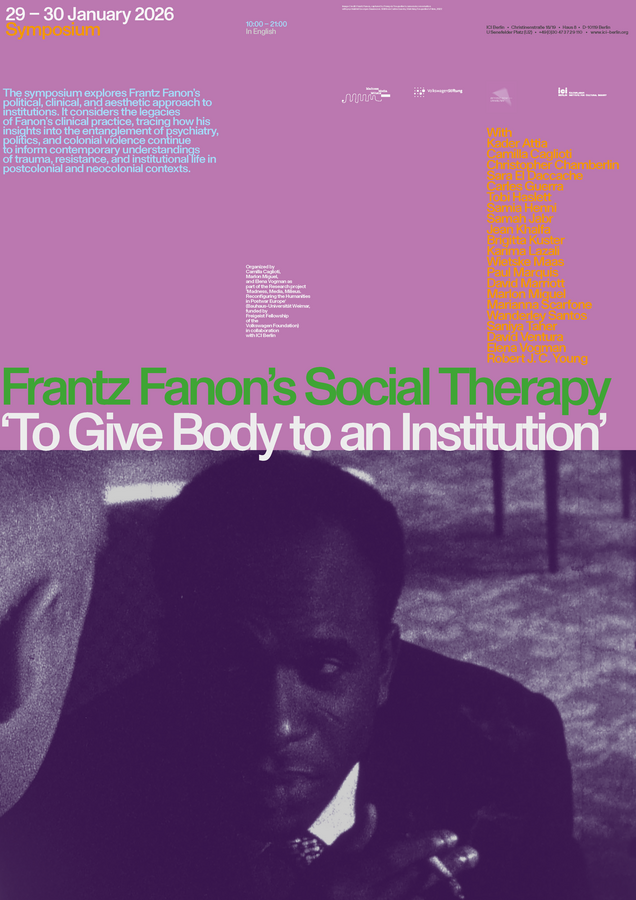
Poster zum internationalen Symposium: Frantz Fanon’s Social Therapy 'To Give Body to an Institution'
Published: 20 January 2026

Internationales Symposium: Frantz Fanon’s Social Therapy - »To Give Body to an Institution«

Am 29. und 30. Januar 2026 findet am ICI Berlin das internationale Symposium »Frantz Fanon’s Social Therapy: ›To Give Body to an Institution‹« statt. Die Veranstaltung wird im Rahmen des an der Bauhaus-Universität Weimar angesiedelten Forschungsprojekts »Madness, Media, Milieus. Reconfiguring the Humanities in Postwar Europe« (Fakultät Medien) organisiert und ist Teil der durch ein Freigeist Fellowship der VolkswagenStiftung geförderten Forschung.

Die Veranstaltung findet in englischer Sprache statt.

About the symposium

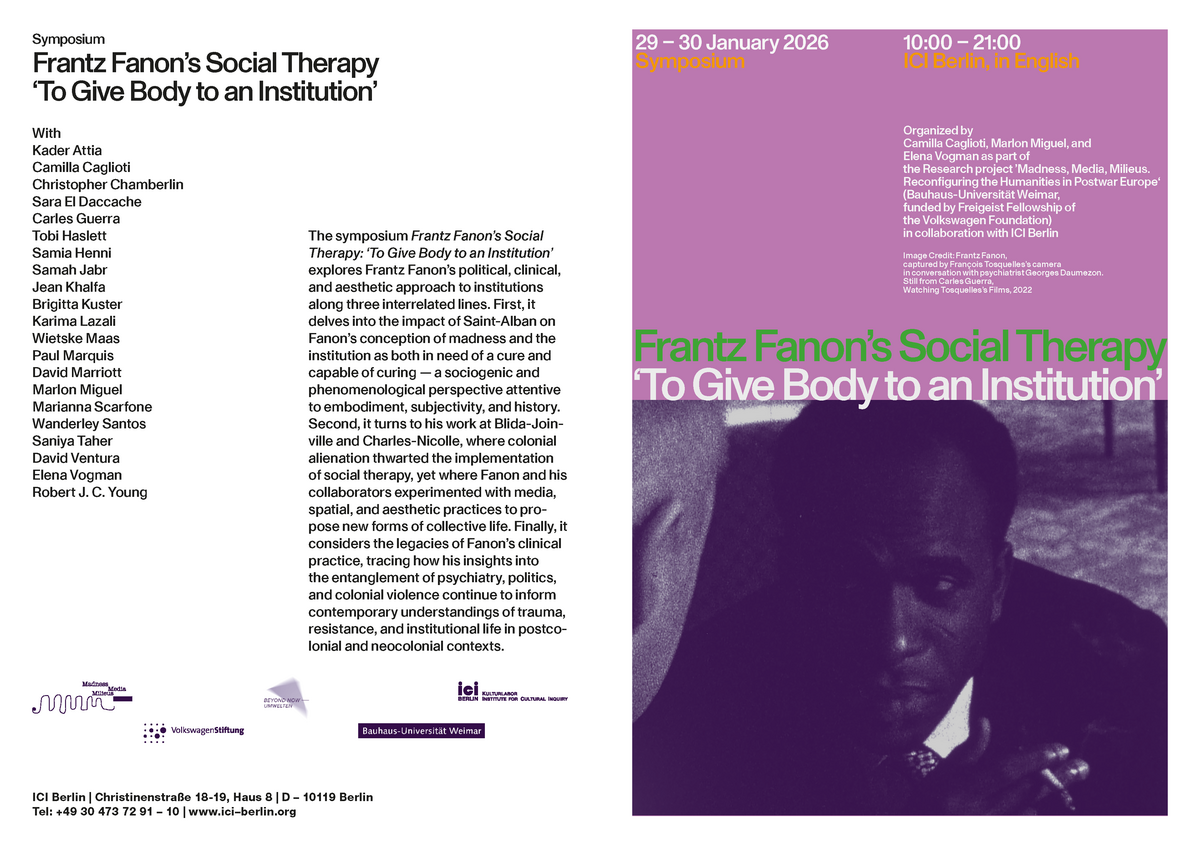
The symposium Frantz Fanon’s Social Therapy: ‘To Give Body to an Institution’ explores Frantz Fanon’s political, clinical, and aesthetic approach to institutions along three interrelated lines. First, it delves into the impact of Saint-Alban on Fanon’s conception of madness and the institution as both in need of a cure and capable of curing — a sociogenic and phenomenological perspective attentive to embodiment, subjectivity, and history. Second, it turns to his work at Blida-Joinville and Charles-Nicolle, where colonial alienation thwarted the implementation of social therapy, yet where Fanon and his collaborators experimented with media, spatial, and aesthetic practices to propose new forms of collective life. Finally, it considers the legacies of Fanon’s clinical practice, tracing how his insights into the entanglement of psychiatry, politics, and colonial violence continue to inform contemporary understandings of trauma, resistance, and institutional life in postcolonial and neocolonial contexts.

In the 1955 editorial of Notre Journal — the intra-hospital newspaper published by patients and staff of the Blida-Joinville Psychiatric Hospital in Algeria — Fanon confronts the question of the institution and the dangers of its vitiation: ‘Does not every attempt to give body to an institution [donner corps à l’institution] risk taking directions that are fundamentally opposed to the open, fecund, global and nevertheless qualified character of the institution?’ His answer unfolds, tracing an embodied idea of the institution: ‘You have to place yourself at the heart of the institution and interrogate it.’ For it is the entangled social and material sensorium that mediates the institution’s therapeutic efficacy. Fanon’s emphasis on the constant reactivation of the institution from within — as a social body, a ‘movement’ that fosters ‘interminable and fruitful encounters’ — points to the transmission of experience from the Saint-Alban clinic in the French Lozère to Blida-Joinville. In the 1940s, the Catalan psychiatrist, anarcho-syndicalist Francesc Tosquelles prompted, in a collective effort, to transform the psychiatric hospital into a ‘place of exchange’. Institutional psychotherapy integrated psychoanalysis, Marxism, and Gestalt psychology in its practice, aiming first at curing the institution — its ‘milieu’, ‘atmosphere’, and ‘ambience’ — before any individual treatment. In Tosquelles’s words, its process entailed a ‘disalienation of the total fact of madness: the sick person, the asylum, and the psychiatrist at once’. Saint-Alban became the point of departure for an environmental approach to the cure, a géo-psychiatrie fostering ‘migrant work’ and opening the clinic to its social and human geography. Between studying medicine in Lyon and his psychiatric work in Algeria and Tunisia, Fanon worked at Saint-Alban (1952–1953) together with Tosquelles. This experience shaped Fanon’s psychiatric approach and his understanding of the institution as an ‘experimental milieu’. Instituting such a milieu meant actively engaging both patients and staff through social therapy, film, and media practices, all designed to work in concert with medical treatment.

With

  • Kader Attia

  • Camilla Caglioti

  • Christopher Chamberlin

  • Sara El Daccache

  • Carles Guerra

  • Tobi Haslett

  • Samia Henni

  • Samah Jabr

  • Jean Khalfa

  • Brigitta Kuster

  • Karima Lazali

  • Wietske Maas

  • Paul Marquis

  • David Marriott

  • Marlon Miguel

  • Marianna Scarfone

  • Wanderley Santos

  • Saniya Taher

  • David Ventura

  • Elena Vogman

  • Robert J. C. Young

Organized by

Camilla Caglioti, Marlon Miguel, and Elena Vogman

as part of the Research project ’Madness, Media, Milieus. Reconfiguring the Humanities in Postwar Europe‘ (Bauhaus-Universität Weimar, funded by Freigeist Fellowship of the Volkswagen Foundation) in collaboration with ICI Berlin

Further information: 

https://www.ici-berlin.org/events/frantz-fanons-social-therapy/#1559655155442-ff9bb510-ecca7e82-1f26

Back All News

Kategorien

  • BAUHAUS.INSIGHTS
  • Studies
  • Projects | Research and Art
  • Awards
  • Events
  • University
  • International
  • Personnel matter

Archiv

Archiv-Beiträge des BAUHAUS.JOURNAL ONLINE

Kontakt

Dana Höftmann, Pressesprecherin
Luise Ziegler, Mitarbeiterin Medienarbeit

E-Mail: presse[at]uni-weimar.de

  • Official Instagram account of the Bauhaus-Universität Weimar
  • Official LinkedIn account of the Bauhaus-Universität Weimar
  • Official Vimeo channel of the Bauhaus-Universität Weimar
  • The Bauhaus-Universität Weimar uses Matomo for web analytics.
  • Print
  • Send by e-mail
  • Feedback this Page
  • Studies

    • Academic Programmes
    • Advising
    • Discover the university
    • Application
    • New Students
    • Course Catalogue
    • Moodle
  • Information

    • Alumni
    • Employees
    • Researchers
    • Visitors and Guests
    • Academic Staff
    • Emergency Information
    • Press and Media
    • Doctoral candidates
    • Students
    • Businesses
  • Services

    • Message Boards
    • Campus Maps
    • Sitemap
    • Media Service
    • Data Protection Policy
    • Accessibility Statement
    • Legal Notice
  • Contact

    • Contact form
  • Contact
  • Data protection policy
  • Accessibility Statement
  • Legal Notice
  • Sitemap
  • Internal
  • TYPO3
  • The Bauhaus-Universität Weimar uses Matomo for web analytics.
© 1994-2026 Bauhaus-Universität Weimar
  • Contact
  • Data protection policy
  • Accessibility Statement
  • Legal Notice
  • Sitemap
  • Internal
  • TYPO3

Accessibility panel

Simple language

Information about the Bauhaus-Universität Weimar in German.

Set contrast Read more about this setting

Changes from color to monochrome mode

contrast active

contrast not active

Darkmode for the lightsensitive Read more about this setting

Changes the background color from white to black

Darkmode active

Darkmode not active

Click- and Focus-feedback Read more about this setting

Elements in focus are visually enhanced by an black underlay, while the font is whitened

Feedback active

Feedback not active

Animations on this Website Read more about this setting

Halts animations on the page

Animations active

Animations not active