

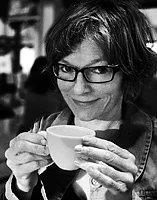
Prof. Liz Bachhuber
Sculptor and Installation Artist Liz Bachhuber was a Professor of Fine Art (Frei Kunst) at the Bauhaus-Universität Weimar from 1993 till 2018. Her research interests and artistic practice focuses on the environment with a particular emphasis on the found object in Art and the global implications of unbridled consumerism and the resulting garbage. She has a long history, in the tradition of the Bauhaus University of working in the intersection of Art and Science and initiating collaborations with engineers, scientists and waste disposal experts. Liz Bachhuber is currently living and working in Weimar and Berlin.
Prof. Heiko Bartels (1947 – 2014)
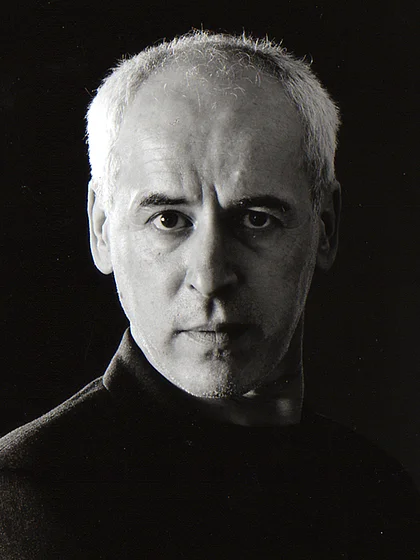
Heiko Bartels was a product designer, lighting designer and, from 1993 until his retirement in 2012, Professor of Product Design at the former Faculty of Design at the Bauhaus-Universität Weimar. As the first elected dean after the founding dean, Lucius Burckhardt, he played a key role in shaping the development of the fledgling faculty from 1994 to 1997. He championed the interdisciplinary »Weimar Model« and remained actively involved in university committees even after his term of office had ended.
Bartels initiated and led the working group tasked with establishing the Media Art and Design degree programme. The concept developed by this group contributed to the subsequent founding of the Faculty of Media. In his teaching, he combined design practice with theoretical analysis and interdisciplinary collaboration. His areas of specialisation included product design, lighting design and sustainable product development.
Alongside his teaching, Bartels oversaw numerous collaborative projects with companies and international universities. In doing so, he worked with, amongst others, BMW, Siemens and Philips Research, as well as partner universities in Australia, China, the UK, Spain and the USA.
Before his appointment in Weimar, Bartels studied at the University of International Trade in Vienna and at the Werkkunstschule in Krefeld. From 1975, he worked as a freelance designer. He was one of the founding members of the internationally active design group »Kunstflug«, whose experimental and conceptual designs were frequently exhibited and awarded prizes.
Prof. Elfi E. Fröhlich
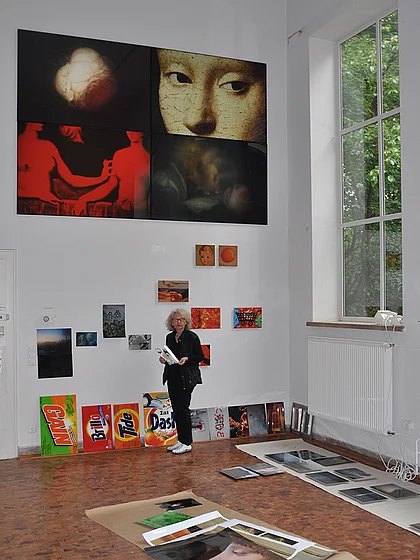
Prof. Elfi E. Fröhlich, born in 1951 in Lünen, North Rhine-Westphalia, completed her studies at the Berlin University of the Arts in the mid-1970s and worked there as an Artistic Associate from 1981 to 1989, followed by a visiting professorship in Technical Visual Media at the Berlin University of the Arts, after which she taught as a visiting professor of Painting and Art Education at the University of Kassel in 1991/92.
In 1994, she was appointed Professor of Fine Art at the newly established Faculty of Design (now the Faculty of Art and Design) in Weimar. From 1994 to 2016, she taught narrative and conceptual photography, installation, painting and drawing. Exhibitions and projects with students that she curated were presented in public spaces and cultural institutions, including the 1996 exhibition Satyrn – Fliegen – Rokoko at Belvedere Palace in Weimar.
The artist has gained recognition through her national and international exhibitions, particularly in the fields of narrative and conceptual photography, cross-disciplinary artistic strategies and appropriation art. Numerous publications, fellowships and works held in public and private collections attest to her artistic career.
Elfi E. Fröhlich lives and works in Berlin.
www.elfi-froehlich.de
Contact: elfi.froehlich[at]uni-weimar.de
Prof. Dr. Jens Geelhaar (1963 – 2019)
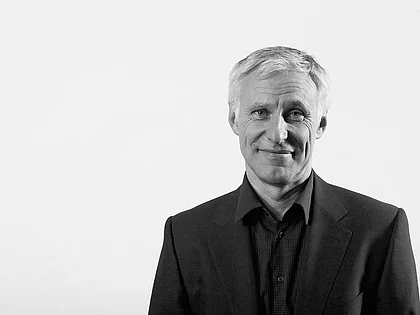
Jens Geelhaar was an artist, designer and academic. From 1999 to 2019, he held the professorship of Interface Design at the Bauhaus-Universität Weimar, initially in the Faculty of Media and later in the Faculty of Art and Design. As Dean of the Faculty of Media from 2006 to 2009 and later as Vice-Dean, he played a key role in shaping the faculty’s development. He was particularly committed to the transition of the Media Art and Design degree programme to the Faculty of Art and Design.
In his teaching and research, Geelhaar combined artistic and design-based approaches with scientific and technological issues. A key focus of his work was the development of new interfaces between humans and technology. Among other things, his work centred on printed electronics and new possibilities for interaction with digital technologies.
He was actively involved in the international Master’s programme in Media Art and Design, as well as in exchange and study programmes with Tongji University in Shanghai and the University at Buffalo in the USA. He also worked closely with the MediaArchitecture programme.
Before his appointment in Weimar, Geelhaar studied chemistry at the Universities of Karlsruhe and Heidelberg and obtained his PhD from the Faculty of Medicine at the University of Heidelberg. At the same time, he studied Fine Art, specialising in New Artistic Media, at the Saar College of Fine Arts. He published numerous academic papers and organised the international MediaCity conference in 2010.
Prof. Dr Siegfried Gronert
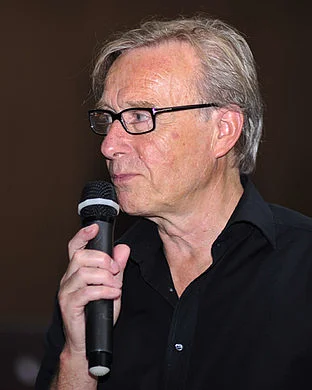
Born in Magdeburg in 1946; qualified as a seaman in merchant shipping; technical draughtsman; studied at the Werkkunstschule Krefeld and qualified as an industrial designer; studied art history, theatre, film and television studies, and philosophy at the University of Cologne and at University College London. Awarded a PhD (Dr. phil.) from the University of Cologne.
Prof. Dr. phil. habil. Frank Hartmann (1959 – 2019)
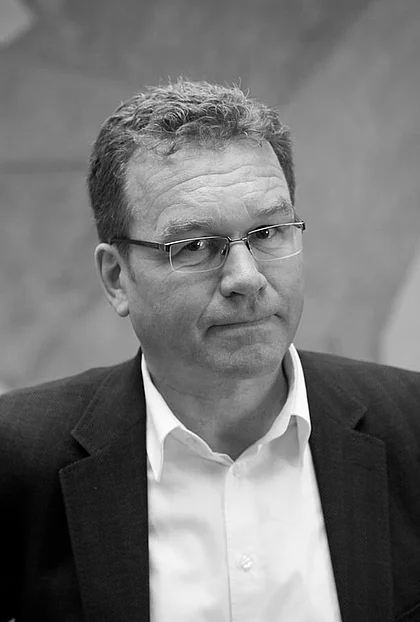
Frank Hartmann was a media philosopher and, from 2009 to 2019, Professor of the History and Theory of Visual Communication at the Bauhaus-Universität Weimar. As early as 2008, he taught as a guest professor at what was then the Faculty of Design. From 2011 to 2015, he served as Dean of the Faculty and oversaw significant changes to the degree programmes and the faculty’s academic focus. From 2015 onwards, he was a member of the University’s Academic Senate.
In his teaching and research, Hartmann focused on the history and theory of visual culture, as well as on questions of media philosophy. He examined media phenomena from historical and cultural studies perspectives, combining theoretical approaches with material- and problem-oriented questions. In doing so, he strengthened the academic foundations of design education at the Faculty of Art and Design.
Hartmann was particularly committed to the »Art and Design« PhD programme. As the programme’s spokesperson, he helped develop the curriculum and supported research projects at the intersection of art, design and science. The support of international PhD students was a particular priority for him. Hartmann was also active in research and teaching on an international level. Visiting professorships took him to São Paulo and Havana, amongst other places.
Before his appointment in Weimar, Hartmann studied at the University of Vienna, where he obtained his PhD in Philosophy in 1987 and completed his habilitation in the field of media philosophy in 2000. He subsequently taught at various Austrian universities and worked as a journalist and academic writer.
Prof. Norbert W. Hinterberger
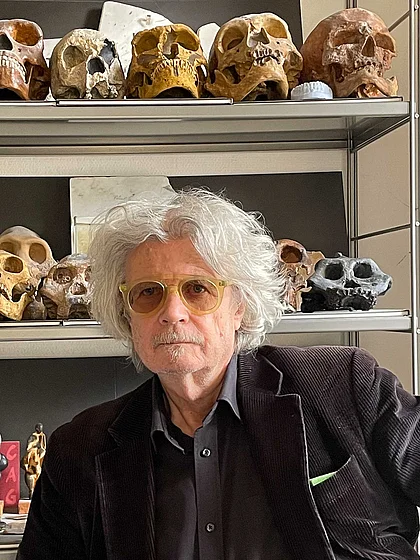
From 1979 to 1993, Prof. Norbert W. Hinterberger worked as an assistant at the University of Art and Design in Linz under Prof. Laurids Ortner of Hausrucker-Co. The Masterclass in Visual Design based there was one of the first art colleges in the world to introduce the concept of interdisciplinary studies and projects that changed each semester.
The establishment of the Faculty of Design at what was then the University of Architecture and Civil Engineering – now the Bauhaus-Universität Weimar – adopted the fundamental ideas of this model and, with its degree programmes in Fine Art, Visual Communication and Product Design – together with the associated theoretical subjects – a similar profile and thus an alternative to the traditional academies with their masterclasses.
Professor Hinterberger’s projects within the Fine Art programme were largely guided by his philosophy as a visual artist, one primarily concerned with exploring human existence – from our beginnings and inevitable end, through the stages of evolution and knowledge, to more or less problematic inventions and visions of the future.
»Eros und Thanatos«, »Sammeln und Jagen«, »Das Rohe und das Gekochte«, »RE:volution«, »Krieg und Frieden« and »Utopia – Die Verbesserung der Welt« are mentioned here by way of example and were mostly reinforced through two-week field trips. The collaboration with the theory lecturers and, above all, with the congenial colleagues Gabriele Rothemann, Silke Feldhoff and Naomi Tereza Salmon has proved successful and enduring.
Norbert W. Hinterberger, born in 1949 in Upper Austria, studied at the Academy of Fine Arts and the University of Vienna; from 1979 to 1993 he was an assistant at the University of Art and Design Linz; guest professor in Rio de Janeiro in 1993 and in Newcastle, Australia, in 1998; professor at the Bauhaus-Universität Weimar from 1993 to 2015 and Dean of the Faculty of Design from 1999 to 2001.
Exhibitions and context-specific installations in Austria, Germany, the Netherlands, Switzerland, Italy, Spain, Croatia, Ireland, Sweden, Israel, the Czech Republic, Lithuania, Russia, Australia and Brazil.
Norbert W. Hinterberger lives in Berlin.
Prof. Werner Holzwarth

Werner Holzwarth was born in Winnenden in 1947 and studied at the Hochschule der Künste Berlin. From 1973, he worked as a copywriter in international advertising agencies, and from 1980 to 1982 as a freelance journalist in South America. He later became Creative Director at Ogilvy, until 1990, when he founded the agency »Tostmann, Domann, Holzwarth« with two partners; the agency was voted »Newcomer Agency of the Year« in 1991.
From 1995 to 2012, Holzwarth was Professor of Visual Communication at the former Faculty of Design. There, alongside his main areas of work – concept development and text/image – he developed and strengthened the field of illustration, establishing it as a further key focus of the degree programme. As the author of »The Story of the Little Mole who knew it was none of his business« (worldwide print run: 4.5 million), he also drew on his close contacts with publishers and the book industry.
Since his retirement, Holzwarth has been working as a children’s book author and is one of the most sought-after authors in the industry.
Prof. Dr Michael Lüthy
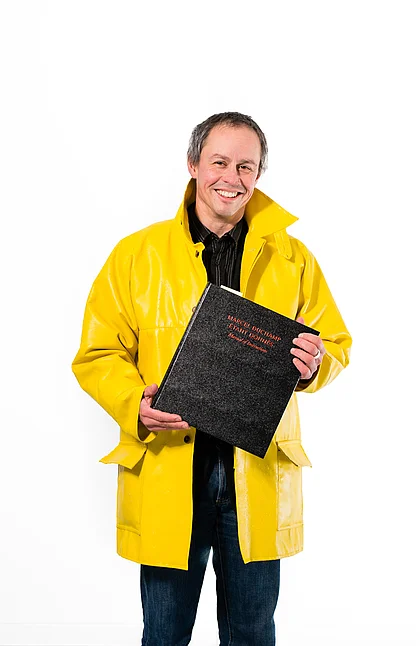
Prof. Dr. phil. habil. Michael Lüthy was Professor of History and Theory of Art at the Faculty of Art and Design from 2014 to 2020. He was a member of the Dean's Office, the Faculty Board and the Academic Senate, as well as Deputy Chair of the Senate Committee for Research and Projects. He was strongly committed to the reorganisation of the faculty in the wake of the partial merger with the art professorships of the Faculty of Media, as well as to the reorganisation of the faculty’s PhD degree programme, in particular by pushing through the establishment and appointment of a junior professorship to serve as director of studies for the degree programme.
In his coursework, his aim was to bridge the two poles mentioned in the title of his professorship: those of art history and art theory. He wanted students to gain a clear understanding of how art has reached its current state, and how the theoretical definition of what is understood as art has evolved over the course of history.
In October 2020, he accepted a professorship for Modern and Contemporary Art History at the State Academy of Fine Arts in Stuttgart. His personal website can be accessed at www.michaelluethy.de.
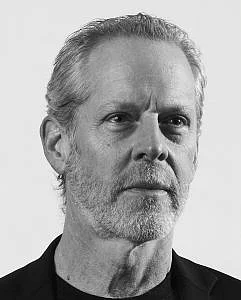
Prof. Robin Minard
Born in Montreal in 1953, Robin Minard studied composition and electro-acoustic music in Canada and Paris. since the early 80s he has concentrated his work on electro-acoustic composition and sound installations in public. In 1997 he took over the professorship of Electro-Acoustic Composition and Sound Production at The LISZT SCHOOL of Music and the Bauhaus University Weimar and was the head of the Studio for Electro-Acoustic Music (SeaM).
Prof. Barbara Nemitz

Barbara Nemitz (born 1948) was Professor of Fine Art at the Faculty of Art and Design at the Bauhaus-Universität Weimar from 1993 to 2014. She was part of the first generation of professors at the newly founded faculty.
In her artistic practice and teaching, Nemitz explored painting, photography, spatial installations and the relationship between art and nature. A particular focus was on the poineering work involving living plants as a medium within the realm of fine art. With the »KünstlerGärten Weimar«, launched in 1993, she created a long-term, process-oriented art project that combined artistic practice, research and teaching. Alongside artistic works in outdoor spaces, she organised exhibitions, symposia, publications and teaching projects in which a large number of international artists were involved. The »KünstlerGärten Weimar« were an official contribution to the European Capital of Culture year in 1999.
Another central theme in her artistic work is the colour pink, which she explored in depth in exhibitions, installations and publications. This includes the international project »Pink – The Exposed Colour«, an official contribution to the Year of Germany in Japan in 2005/06. Projects such as »GREEN SPACE – Le jardin souterrain«, which was shown in a Paris metro station in 2013/14, also highlight the breadth of her artistic practice. In her teaching, she has also focused intensively on painting and its potential as an independent and cross-media form of artistic expression.
Before her appointment in Weimar, Nemitz studied at the Hamburg University of Fine Arts from 1968 to 1973. Barbara Nemitz lives and works in Berlin.
barbaranemitz.de
Contact: mail[at]barbaranemitz.de
Prof. Dr. phil. habil. Achim Preiß
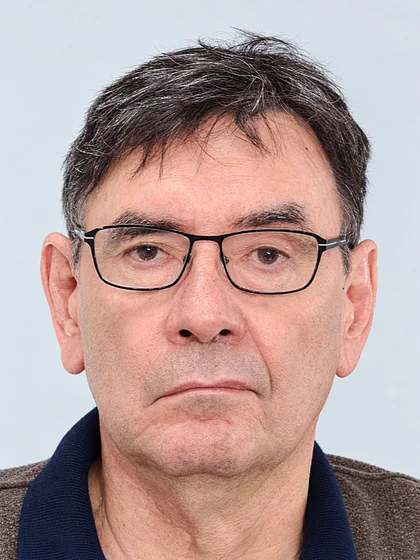
Achim Preiß was Professor of Architectural History at what was then the Faculty of Design at the Bauhaus-Universität Weimar from 1992 to 2016. Upon his appointment in 1992, he was tasked with establishing the field of architectural history at the newly founded faculty. He was thus part of the faculty’s first generation of professors.
In his teaching, Preiß focused on the history of architecture from the Middle Ages to the modern era, as well as on issues relating to the history of art and design. His main areas of academic research included modernist architecture, the history of museum architecture and the art history of the GDR.
The history of the Weimar University was also a key focus of his work. Together with Klaus-Jürgen Winkler, he published the book »Weimarer Konzepte. Die Kunst und Bauhochschule von 1860–1995« in 1996, which traces the development of the university using historical documents.
Before his appointment in Weimar, Preiß studied art history, with political science and urban planning as minor subjects, at the University of Bonn. There, he completed his doctorate in 1984 with a thesis on the architectural history of the Church of St Chrysantus and Daria in Bad Münstereifel. In 1991, he completed his habilitation at the University of Wuppertal in medieval and modern art history.
Prof. Kuno Prey
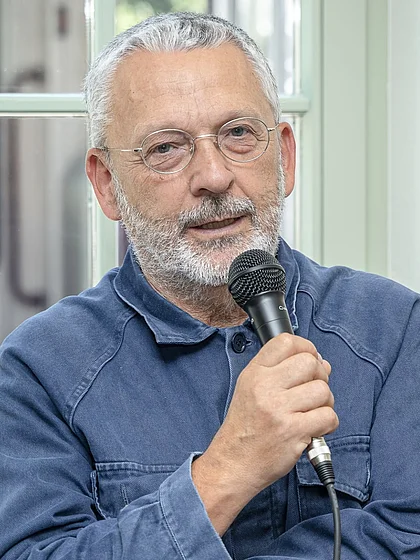
The designer Kuno Prey (born 1958) designed products for companies such as Alessi, Rosenthal, Zanotta, Rosti, Rexite and Nava. Through his collaboration with industry, he explored innovative materials and new technologies, thereby gaining international recognition. From 1993 to 2002, he was Professor of Product Design at what was then the Faculty of Design. In 2002, he returned to his home region of South Tyrol and founded the Faculty of Design and Arts at the Free University of Bolzano, which he headed as Dean until 2010. He remained a professor of product design there until September 2026. Prey lives and works in Neumarkt and Innichen (South Tyrol).
Contact: kuno.prey[at]gmail.com
Prof. Fritz Rahmann (1936 – 2006)
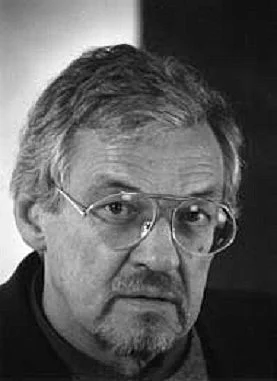
Fritz Rahmann was an artist and, from 1993 to 2001, a professor on the Fine Art programme at the Faculty of Design at the Bauhaus-Universität Weimar. He was part of the first generation of professors at the faculty, which was newly established in 1993, and shaped its artistic teaching through an understanding of art that closely linked theoretical reflection and practical work.
His artistic work centred on a critical examination of the concept of art and the social role of art. Together with Raimund Kummer and Hermann Pitz, he founded the artists’ group »Büro Berlin∑ in West Berlin in 1979. Through temporary interventions in public spaces, the group challenged traditional notions of art, its venues and its social function. Alongside these site-specific works, Rahmann also created objects, installations, drawings and paintings.
This understanding of art also shaped his teaching in Weimar. Rahmann encouraged students to question established perspectives, to develop their own artistic positions and to continually re-examine the relationship between thought and action. In doing so, he combined conceptual inquiries with direct sensory experience and practical artistic work. He also played a critical yet constructive role in the development of the fledgling faculty.
Before his appointment to Weimar, Rahmann studied art at the Düsseldorf Art Academy and architecture at Aachen University of Technology. He subsequently lived and worked in the Netherlands for several years before moving to West Berlin in 1979. His works were exhibited internationally, including at documenta 8 in Kassel in 1987.
»On the Death of Prof. Fritz Rahmann« – »bogen« University Journal, Issue 4/2006, page 35 (only available in German langugage)
Honorary Professor Micky Remann
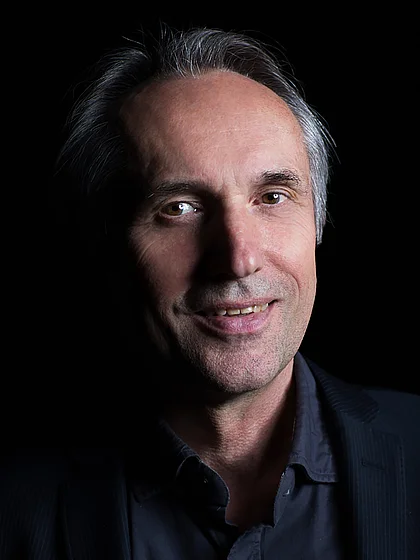
Micky Remann was an honorary professor of »Immersive Media« at the Faculty of Art and Design from 2014 to 2026. Prior to this, he had been leading regular courses as a lecturer since 2004. Micky Remann is the founder and one of the directors of the international »FullDome Festival« in Jena, which takes place annually at the Zeiss Planetarium in Jena. Many productions from the Bauhaus-Universität Weimar have been honoured with the JANUS Award at the festival. Through numerous projects and courses, Micky Remann has made a significant contribution to the further development of presentation and narrative techniques that draw the audience into immersive worlds beyond the usual limits.
In particular, Remann’s work has focused on the production of innovative formats for 360° dome projections. The projects he has led have included coursework in technology, aesthetics and multimedia performative applications in immersive spaces. Born in 1951, Micky Remann studied German language and literature at Goethe University in Frankfurt am Main. He works as a media artist and curator of events and projects such as the Liquid Sound underwater concerts at the Toskana Therme in Bad Sulza and the Apolda World Bell Ringing. Between 2004 and 2026, Remann worked as a lecturer and Honorary Professor on the Media Art and Design degree programme at the Bauhaus-Universität Weimar.
Prof. Jay Rutherford
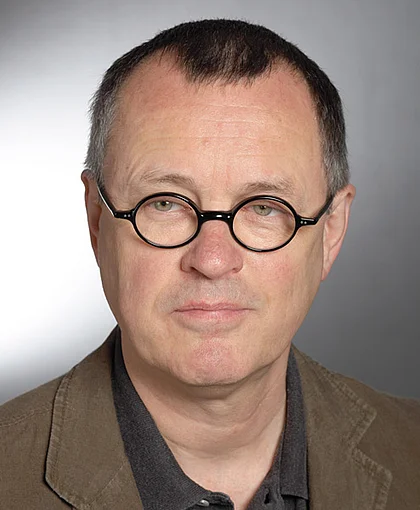
Jay Rutherford (born 1950) was Professor of Visual Communication, specialising in typography, at the Faculty of Art and Design at the Bauhaus-Universität Weimar from 1993 to 2016. He was part of the first generation of professors at the newly founded faculty and, for more than two decades, shaped typographic training within the Visual Communication degree programme.
His teaching centred on the diverse possibilities of typographic design. Rutherford combined traditional printing and typesetting techniques with digital type design and taught typography as an essential component of visual communication. In addition to typeface design, his areas of expertise included corporate identity, publication design, information design and wayfinding systems. In this work, he addressed both the creative and functional requirements of visual communication.
Before his appointment in Weimar, Rutherford studied graphic design in Kingston (Ontario) and Halifax (Nova Scotia). He subsequently worked as a printer, lettering artist, teacher and graphic designer, amongst other roles, and ran his own design studio in Canada. In 1992, he moved to MetaDesign in Germany, where he contributed to the expansion of the FF Meta typeface family and designed an italic style for what would later become FF Transit.
Jay Rutherford lives in Weimar.
Contact: jay.rutherford[at]uni-weimar.de
Prof. Wolfgang Sattler
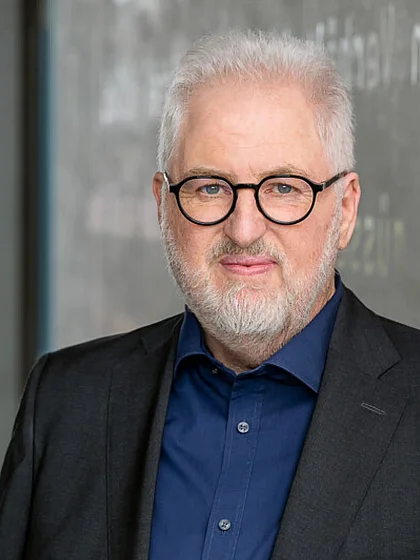
Wolfgang Sattler (born 1956) was Professor of Interaction Design on the Product Design degree programme at the Bauhaus-Universität Weimar from 1993 to 2022. He was part of the first generation of professors at the then newly founded Faculty of Design and, for almost three decades, played a key role in shaping teaching in product design and the development of the faculty.
He served as Dean from 2003 to 2005 and again from 2015 onwards. In between, he held the post of prorector for International Affairs from 2005 to 2007 and later served on the senate. As Chair and Spokesperson of the Founding Commission, he oversaw the reorganisation of the Faculty of Design in 2016 and the integration of the Media Art and Design degree programme into the newly established Faculty of Art and Design.
In his teaching and research, Sattler focused in particular on interaction design and universal design. His work centred on the relationships between people, products and technologies, as well as the question of how design can improve the everyday lives of as many people as possible. His interdisciplinary teaching projects combined experimental design processes with technical, social and environmental issues.
Another key concern of his was fostering exchange between the university, industry and society. From 2007 to 2021, he headed the Bauhaus.TransferzentrumDESIGN, which combined design research with the practical development and marketing of innovative products. In addition, he was committed to promoting the social significance of universal design and organised the first Universal Design Conference in Weimar in 2009.
Before his appointment in Weimar, Sattler studied industrial design at the Schwäbisch Gmünd University of Design. From 1983 to 1990, he worked for Olivetti in Milan in the field of corporate identity. Since 1990, he has run his own design studio specialising in industrial, exhibition and interface design.
Wolfgang Sattler is Chairman of Universal Design Forum e.V. and a member of the Executive Board of Deutscher Designtag.
wolfgangsattler.de
Contact: wolfgang.sattler[at]uni-weimar.de
Prof. Dr. Karl Schawelka
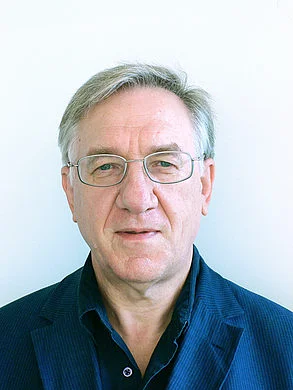
Karl Schawelka studied painting and art education at the Academy of Fine Arts Nuremberg and the Academy of Fine Arts Munich from 1964 to 1971, followed by art history at Ludwig-Maximilians-Universität München and in Paris from 1971 to 1977. In 1978, he received his doctorate from Ludwig-Maximilians-Universität München with a thesis on the art theory of Eugène Delacroix. From 1978 to 1984, he was a research assistant at the Technical University of Munich, and from 1984 to 1988 a research associate at Friedrich-Alexander-Universität Erlangen-Nürnberg.
In 1990, he completed his Habilitation at the Technical University of Munich with a thesis on the »Ideal of the ›Musical‹ in Painting from 1800 onwards«. Following his appointment as Professor of Modern Art History at the Kassel School of Art, he was Professor of History and Theory of Art at the Faculty of Art and Design at the Bauhaus-Universität Weimar from 1993 until his retirement in 2010. He served twice as Dean of the Faculty.
His main areas of research include art theory, colour and perception, and art in public space. In 2025, his book »Die Handlungsmacht des Betrachters – Kunstausstellungen und ihr Publikum« (The Viewer’s Power to Act – Art Exhibitions and Their Audience) was published.
Contact: karl.schawelka[at]uni-weimar.de
Prof. Hermann Stamm
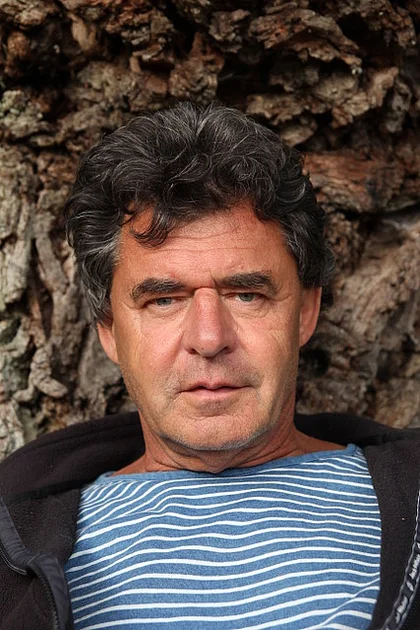
Hermann Stamm (born 1953) studied at the University of Applied Sciences in Würzburg and at the Kassel Academy of Fine Arts. From 1977 onwards, he took part in numerous exhibitions, and his work has been published and awarded on several occasions; in 1990, he was appointed to the German Photographic Academy.
In 1993, he was appointed to the Faculty of Design at what was then the Weimar University of Architecture and Civil Engineering as a professor of Visual Communication and Photography.
Hermann Stamm planned and oversaw the establishment of the photography workshop at the Bauhaus-Universität Weimar for studio work and darkroom processes, as well as the introduction and expansion of digital image processing. Two floors of the former lemonade factory on Steubenstraße, with its large skylights, were converted into a 90-square-metre photography studio following extensive building work. A blackout system for the skylights makes it possible to completely darken the room and work with studio lighting independently of daylight. This makes it possible to create both experimental and precise lighting set-ups for a variety of media applications. The establishment and expansion of the photography workshop were supported by grants from the German Research Foundation (DFG).
As a member of the Faculty Council, Senator and Dean, Hermann Stamm was responsible, amongst other things, for the affairs of the university and the faculty. During his time as Dean, the Faculty of Art and Design saw the establishment and launch of the first Master’s programme in Public Art based on the Weimar model in the Federal Republic of Germany.
In his teaching role, over the course of 25 years he supervised numerous student projects, which were also organised in collaboration with other faculties or external partners and were supported by interdisciplinary academic input, drawing on both art-historical theory and contributions from invited guests. This is evidenced by various publications of the study projects and numerous exhibition projects by students during his time as a lecturer.
In his teaching in the field of visual communication at the faculty, Hermann Stamm focused on reflecting on traditional photographic imagery and examining visual content within the context of image and design techniques. This also involved experimentally linking visual strategies with other media and developing an understanding of how different forms of presentation work.
Hermann Stamm has been living and working in Hammelburg since 2019.
www.uni-weimar.de/~stamm
Prof. Dr.-Ing. Olaf Weber (1943 – 2021)

Olaf Weber was born in Dresden in 1943. After completing an apprenticeship as a bricklayer, he studied architecture from 1964 to 1970 at the University of Architecture and Civil Engineering (HAB) in Weimar. In 1973, he was awarded a doctorate for his thesis on »Architecture as a Means of Communication«. He then worked as a teaching / research associate at the GDR’s Bauakademie in Berlin until 1980. After returning to Weimar, he qualified as a professor in 1987 with his habilitation thesis »The Function of Form in Architecture«.
Olaf Weber engaged intensively with Theory of Architecture, aesthetics, semiotics and the theory of perception. In 1991, he took over as head of the Institute of Art and Design and played a key role in the founding of the Faculty of Art and Design. From 1993 until his retirement in 2009, he taught and conducted research as Professor of Aesthetics at the Bauhaus-Universität Weimar.
Alongside his academic research, Olaf Weber was active in the arts, literature and politics. He organised public events and Performance presentations, championed pacifism, social justice and climate protection, and initiated, amongst other things, the »42nd Congress of the Absurd«. Despite losing his sight completely in 2003, he remained a vocal and outspoken figure in Weimar’s public life until his death in October 2021.
Alumni interview with Olaf Weber: »I Can’t See Bauhaus Anymore« (2018)
The Faculty of Art and Design mourns the loss of Prof. Dr.-Ing. habil. Olaf Weber (2021)
Prof. Herbert Wentscher
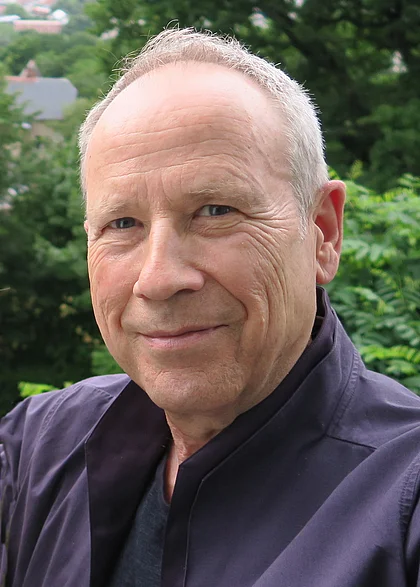
Herbert Wentscher (born 1951) was Professor of Visual Communication, specialising in moving images, at the Bauhaus University Weimar from 1993 to 2016. He was part of the first generation of professors at the newly founded Faculty of Design and, for more than two decades, shaped the artistic and design-related exploration of the moving image. From 1997 to 1998 he was Prorector of the university, and from 2006 to 2008 Dean of the Faculty of Design.
As an artist, Wentscher belongs to the generation that explored the medium of video artistically and theoretically as early as the 1970s. In addition to video art, his work encompasses painting, photography, installations, objects and artist’s books. His work centres on the relationships between images, signs and symbols, as well as their meanings in various media contexts.
In his teaching, Wentscher combined experimental moving-image design with interdisciplinary project work. As early as 1993, he took part in the »Weimar Explorations« project alongside lecturers from the fields of fine art, product design, visual communication and aesthetics. In other teaching projects, he explored the possibilities of electronic visual language, cinematic time, narrative and experimental forms of the moving image, and the interplay between image, music and poetry.
Before his appointment in Weimar, Wentscher studied at the art academies in Stuttgart and Düsseldorf, as well as art history at the universities of Stuttgart and Cologne. Scholarships took him, amongst other places, to the Royal College of Art in London and the Brooklyn Museum Art School in New York. His artistic works have been exhibited internationally, including at the Museum of Modern Art in New York, the Centre Georges Pompidou in Paris and the National Gallery in Berlin.