
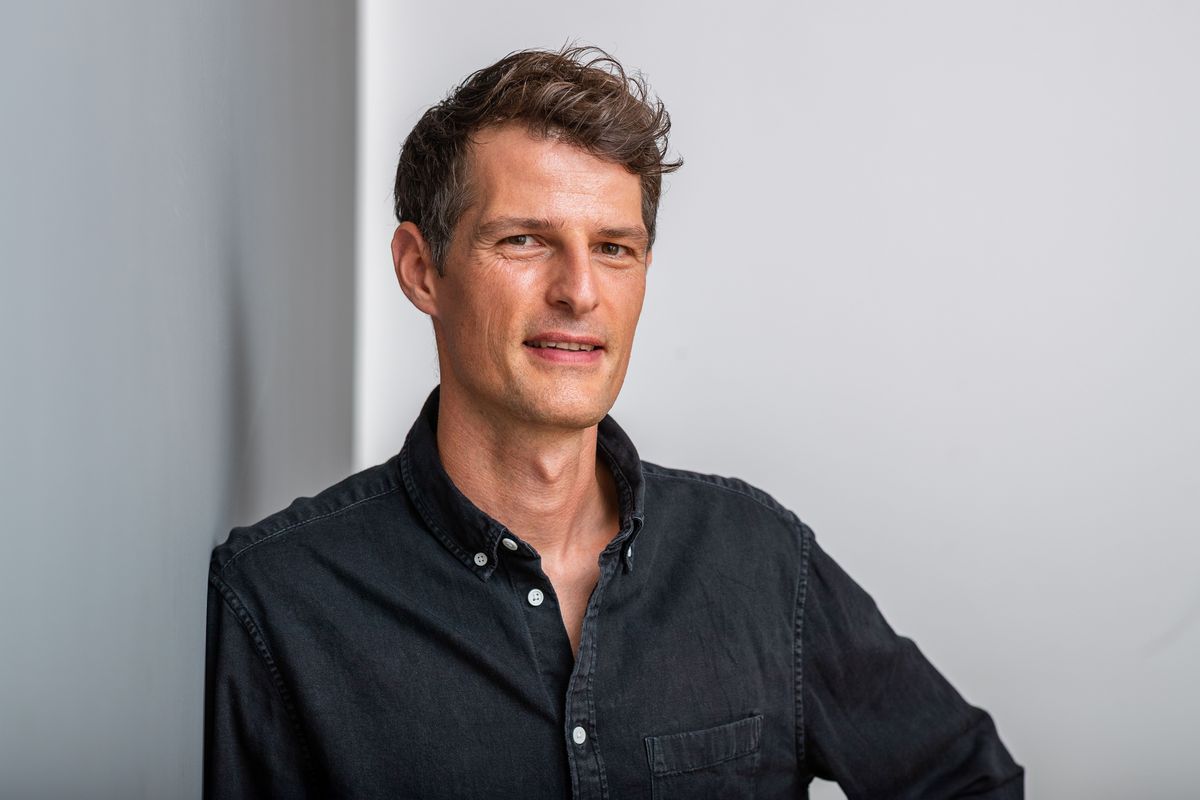
Michael Herrmann Appointed to Structural Design and Construction Design Joint Professorship
Prof. Michael Herrmann joined the Professorship of Structural Design and Construction Design at the Bauhaus-Universität Weimar in October 2025. The joint professorship is based in the Faculty of Architecture and Urbanism and the Faculty of Civil and Environmental Engineering.
Throughout his career, Michael Herrmann has worked, taught, and carried out research at the confluence between architecture and structural engineering. After completing his doctoral degree under the supervision of Werner Sobek, Prof. Herrmann taught structural design at the Bartlett School of Architecture in London and at the Berkeley’s University of California. From 2020 to 2025, he taught as Professor of »Digitales Konstruieren« at TH Lübeck. In 2024, his research was honoured with the Kulturland Schleswig-Holstein Award and exhibited in the Kieler Landtag.
Michael Herrmann is a co-founder and partner of the str.ucture GmbH. The company develops structural solutions that combine architectural quality, economic efficiency, and sustainability from the initial ideas to the finalised construction. Their projects focus on precise and efficient implementation of complex designs carried out in collaboration with architects and other planning partners. The close relationship between research and practice guarantees continuous innovation. Current projects include the German Expo Pavillion in Osaka, the »parametrische Holzraumfachwerk OAR« Reutlingen, public buildings such as the Waldorf School in Backnang, multi-purpose venues, and lightweight surface structures.
What fascinates you about the connection between architecture and engineering?
I’m interested in the creative process of collaboration and the development of design concepts. It is only when the respective experts in design, construction, and calculation come together that truly new approaches can emerge. In my opinion, an architectural project is convincing when the design, structure, and sustainability concept are equally strong and merge together in the design.
This discourse brings up exciting questions about, for instance, the resource-friendly use of traditional building materials and developing new sustainable building materials. I consider myself to be following in the tradition of pioneers like Frei Otto and Werner Sobek.
Combining practice and research with teaching is an important part of my concept. Since its very beginnings, the Bauhaus has represented the fusion of art and craftsmanship with the aim of collaborative building. This connection has led to one of the most successful schools of architecture ever and the tradition continues through the close relationship between architecture and engineering. I’m really excited to be working at this intersection between the two disciplines.
Which of your career projects would you say has been particularly significant for you?
With so many challenging projects, it’s hard for me to name one that stands out. It’s more important to me that the projects promote the development of construction in the spirit of »Evolutionary Design«.
And here I refer to evolutionary in the sense of planning sustainable buildings and structures that take environmental impact into account, such as »Effizienzhaus Plus mit E-Mobilität« in Berlin. A designated pilot project by the Bundesbauministeriums, it meets the new »Effizienzhaus-Plus-Standard«. The micro power plant highlights the system integration of support functions, energy generation, insulation and recycling, as well as networking with electromobility and neighbourhood supply; the project tests out new materials and construction methods.
Evolutionary here means building with a minimal amount of materials and using optimised form and material distribution, from membrane structures to lightweight structural engineering in solid construction. Together with Werner Sobek, I developed graded concrete as part of my doctoral thesis, in which the material distribution inside a component can be modified according to its load, thus reducing mass and grey energy. Based on the »Gradientenwerkstoffe im Bauwesen« research project, a separate branch of research has developed with several DFG projects. The consistent development of the research topic allowed me to investigate the performance of functionally graded concrete under seismic stress, funded by a DFG research fellowship at UC Berkeley.
This is evolutionary in the sense of automation and technological advancement through, for instance, 3D concrete printing for the »Hexastone Forschungspavillon« or sustainable timber constructions at str.ucture, such as the »Holzraumfachwerk OAR« Reutlingen and the circular German Expo Pavilion in Osaka.
What teaching concept do you follow and what elements do you focus on? What can your students expect from you next semester?
Once of the main goals of my courses is to establish a culture of collaboration in design and to foster cooperation with practice and industry. I want to open students' eyes to the fundamentals of structural design and different materials and to the range of construction methods and support systems that exist. I also hope to spark their interest in the design potential that emerge from a deeper understanding of structural systems, construction, and experimental approaches.
My aim is not just to teach the fundamentals, but also to foster a mindset that naturally incorporates the increasing possibilities of digital construction culture and sustainability. Through research-oriented learning, I want to spark students’ interest in continuing their academic studies, right up to the doctoral level.
The Construction Design and Structural Design Joint Professorship offers an interdisciplinary design project with a focus on construction within the curriculum. Teams made up of Architecture and Civil Engineering students are given to opportunity to test what future professional collaboration might be like in a university environment, leading to mutual appreciation of each other's specialist knowledge. The design task involves buildings with innovative concepts, designs, and manufacturing, often focussing on sustainability, digitalisation, and/or building renovation. Examples include designs for converting a historic cattle market hall in Denmark and modular extensions using polymer 3D printing. In addition to design and aesthetic aspects, structural details play an important role; some cases include a design-and-build element.
What research topics do you hope to pursue at the Bauhaus-Universität Weimar?
The Bauhaus-Universität Weimar offers an excellent environment for conducting challenging third-party funded research. In addition to continuing to focus on sustainable material systems for load-bearing structures, I have defined the following research fields for myself:
- Shell and lattice shell structures for automated production: I am currently working on a »Zukunft-Bau« project on the design and robotic production of lattice shell structures on flexible frames. The concept is based on the idea of producing load bearing, lightweight and material-efficient roof structures by applying a thin fibre-reinforced concrete or clay layer to flexibly-formed frames made of wood or carbon slats. Together with Professor Schleicher from UC Berkeley, I was able to manually produce a promising prototype for this. In future, a robotic arm will be used to print the concrete onto the flexible frames. This resource-friendly construction method was specifically developed for robotic construction since there is currently no effective solution for printing suspended structures without support material. The »Hexastone-Schale« is another such development.
- Design tools and analysis instruments at the confluence between architecture and engineering: This approach forms the foundation for other research areas and aims to bring together all of the disciplines and technologies involved in construction to promote the transition to a new digital construction culture. Rethinking the entire process – from the first drafts to the robotic manufacturing – will lead to radical changes in design and productivity.
- Graded concrete – optimising interior load-bearing components: The automated production of density-optimised concrete components makes it possible to reduce mass and CO₂ emissions by up to 63% while maintaining the same load-bearing capacity. The continuously changing density influences material properties such as porosity, strength, and rigidity and allows the interior of the component to be adapted to the static or structural requirements. The optimal density distribution is determined by numerical topology optimisation; this serves as a digital construction plan for automated production by a gradient injection robot.
I am currently working with professors from three faculties on a large-scale equipment application to set up a RoboLab for digital manufacturing at the Bauhaus-Universität Weimar.
What do you see in the future of construction?
I think the future of construction looks more exciting than ever. The challenge is to find solutions for current issues concerning sustainable and circular construction without neglecting the demand for successful design. Construction needs to be more predictable and reliable again so that we can regain the trust of the public. This means boldly forging ahead with new designs and concepts and not standing still in the face of challenges.
The success of the Bauhaus is based on combining groundbreaking aesthetics with new materials and construction methods – and this is a future I want to build on.