
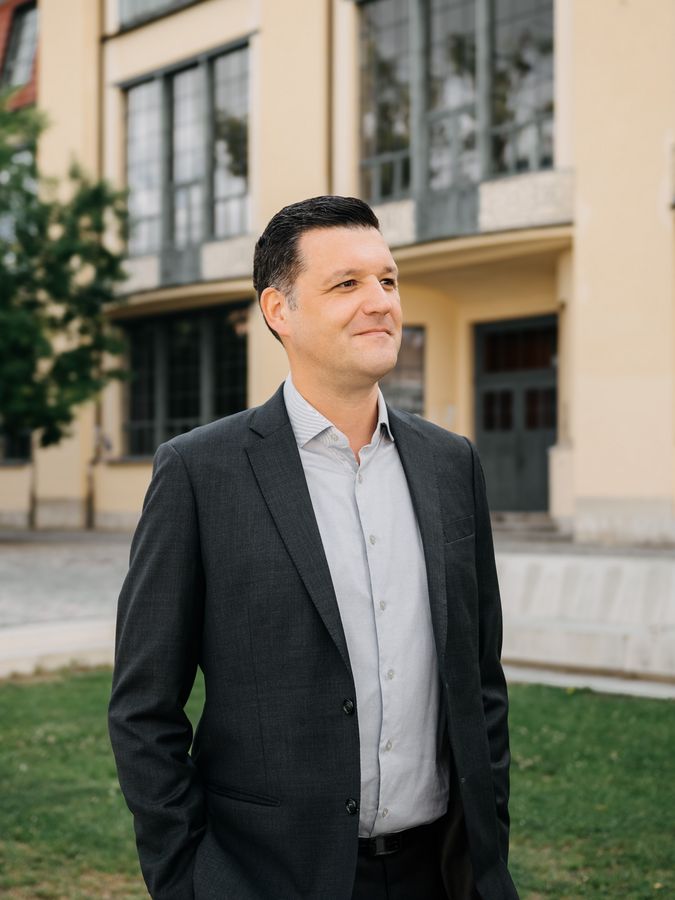
Five Questions from the University Community for President Prof. Peter Benz
At the end of last year, we called upon the University community for the first time to submit their questions for the University President. He will now be answering your questions once a month. The original idea was to select five questions each month, but it turns out, we didn't need to do the selecting: Exactly five questions were submitted.
Here are Prof. Peter Benz’s answers to the first set of questions.
First off, I want to wish everyone a happy and healthy New Year in 2026. In light of the challenges ahead, it’s bound to be an exciting year, to say the least. But we are in good shape to tackle these tasks with confidence and optimism.
1. How are you doing? (submitted by an employee from University administration and services)
Thanks for asking. I am, as always, doing well.
I have the privilege of being President of the most wonderful university in the world – my university, my alma mater – so it would be entirely inappropriate for me not to be doing well. This doesn’t mean that I don't have difficult days or weeks. It’s part of my job to deal with unpleasant issues and to make and ultimately take responsibility for decisions that can be tough. This is often quite emotional and can be overwhelming at times. But it is precisely these moments, brimming with energy, that make the job interesting and exciting. Although time are challenging at the moment, I still experience the University as an aware, committed place, full of bright minds asking justified questions. It can be exhausting at times, but it is, more than anything, a privilege. And so, to respond with a variation on Camus: »One must imagine the President happy.«
2. The Chancellor’s budget decree from 23 December 2025 states that, in University administration and services, every existing position should be reviewed for its operational necessity. Should employees in administration and services be preparing themselves to justify their own positions in the near future and compete with their colleagues for the most convincing justification? (submitted by an employee from University administration and services)
In short: No. Internal competition for the »most convincing justification« of positions is not intended or possible. The reference in the budget decree is not aimed at individuals, but at structures, job roles, and processes. The aim is for us to work together and figure out which tasks are indispensable, where there is overlap, and where we can reduce the workload, consolidate, or reorganise. I want to emphasise that this does not imply assessing individual performance, but rather a responsibility towards the institution as a whole. This assessment can only succeed if we work together – and it will be approached with that in mind.
3. Why is the Bauhaus-Universität finding it so difficult to digitalise administrative processes? Business travel applications and expense reports, holiday management, employee recruitment, procurement – these are all carried out incredibly inefficiently and waste our time. (submitted by an administrative employee from the Faculty of Civil and Environmental Engineering)
The short and honest answer: I don’t know either. If it’s any consolation, your point applies generally to the German higher education landscape and the German civil service. Ultimately, it has to do with the fact that these processes have developed historically and are legally quite complex. We are also stretched in terms of personnel and perhaps too patient with ourselves. But this doesn’t make me any less frustrated.
The (somewhat) longer answer: Administrative digitalisation isn’t simply a question of software; it includes process clarification, legal frameworks, and the willingness to change. Many of the examples you mention – business travel, procurement, HR processes – suffer from the fact that we are trying to apply analogue logic to digital processes instead of really rethinking them.
This is frustrating, but: We’re working on it. And I do believe it’s crucial for digitalisation not to create additional work, but rather to noticeably reduce workloads. We will be measured by this, and I will be measured by this.
4. What does your perfect day look like? (submitted by a Master’s student from the Faculty of Media)
Frankly, I’m not sure something like a »perfect day« actually exists. But a very good day is one where I can actually work through things instead of just reacting to them. It includes a few focused meetings that lead to concrete decisions, time for a Mensa visit including an after-lunch coffee and a chat, and maybe at least one opportunity to engage in some »normal« university activity like a critique session, an exhibition opening, a lab demonstration or similar. As President one occasionally feels somewhat removed from actual academia, thus it’s really nice – and helpful – to re-align with the real purpose of university. If, by the end of the day, I manage to even have fewer e-mails in my inbox than in the morning – then it has been a very good day.
5. You mentioned on one occasion that we might have a campus cat. The question remains: Who would take care of the cat? Where would its basket be? Does installing a cat ladder on the Main Building comply with UNESCO regulations? (submitted by a scientific employee from the Faculty of Art and Design)
As far as I'm concerned, we can have a campus cat; a campus cat would be an asset to academic culture, even if only as a low-threshold contribution to the resilience of the university community. We had a campus cat at the university where I previously worked, although it was less of a »campus cat« than a »faculty cat«. As far as I know, the cat was a stray; students built her a »nest« in a sheltered corner of the clay storage area in the ceramics studio. They put out a small bowl of water and might have given her a splash of milk for breakfast, but that was it. Otherwise, that cat was self-reliant – something cats tend to be good at. After a while, the cat became tame and enjoyed being petted, and many faculty members were happy to oblige. Later on, the cat had a litter of kittens, which was a major event for the faculty. This meant there were now several cats on campus, but their presence was sporadic.
Based on this experience, I would say, sure, let’s have a campus cat. I can imagine the Campus.Garden behind the Van de Velde Building, or the apple orchard behind the x-Stahl would make a lovely home. Could the campus kindergarten also be taken into consideration? Should there be a »Campus Cat« Bauhaus.Module to provide equipment and design a care system? Our University offers numerous possibilities, but I feel that a campus cat should come from the bottom up and from the community rather than a top-down decision by the Presidential Board, Good cats will find their way to campus themselves. And so: if you want a campus cat...
This series will continue throughout the year. Questions can be submitted by University members to wir[at]uni-weimar.de. The deadline for submitting questions is the 15th of each month.