



Im Folgenden bekommen Sie eine Übersicht über die angebotenen Lehrveranstaltungen für die Masterstudiengänge. Weitere Angaben zu den einzelnen Modulen finden Sie im Vorlesungsverzeichnis des laufenden Semesters im Serviceportal BISON.
Baudynamik (WiSe)
Beschreibung:
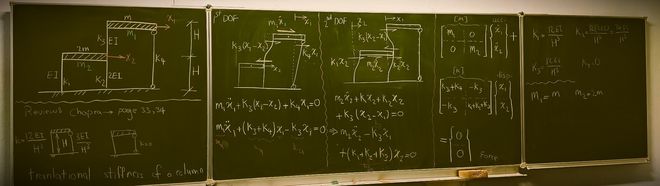
* Einfache Schwingungsvorgänge, freie Schwingungen von EFHG-Systemen
* Erzwungene Schwingungen von EFHG-Systemen: harmonische Anregung, Impulsanregung, periodische Anregung, Frequenzgangfunktion, Impulsreaktionsfunktion, dynamische Vergrößerungsfunktion
* Methoden zur Berechnung der dynamischen Antwort im Zeitbereich: Duhamelintegral, Methode der zentralen Differenzen, Newmark
* Methoden- Freie und erzwungene Schwingungen von MFHG-Systemen, Modalanalyse, modale Superposition- Kontinuierliche Systeme
* Anwendungen: Maschineninduzierte Schwingungen, Windinduzierte Schwingungen, Erdbebenanregung, Personeninduzierte Schwingungen
Modul-Seite >
Structural Dynamics (WiSe, EN)
Description:
* SDOF systems:
-free vibrations, harmonic, impulse and general excitation for undamped and damped systems,
-Impulse response function, frequency response function, base excitation,
-Time step analysis: Duhamel integral, central difference and Newmark methods;
* MDOF systems: modal analysis, modal superposition, modal damping, Rayleigh damping, Frequency response functions
* Continuous systems
Modul-Seite >
Experimental structural dynamics and Structural monitoring (SoSe, EN)
Description:
The students obtain deepened knowledge in structural dynamics, structural dynamic analysis, data processing, dynamic test equipment and its handling. They learn to analyse the dynamic behaviour of a structure utilizing both numerical and experimental state-of-the-art methods. Furthermore, the students have to develop strategies and concepts of investigation. The work in small groups enhances the social competence of the students.
Operational modal analysis, sensor types, sensor positioning, data analysis and assessment, assessment of structural changes, structural modelling, model updating
Finite Element Methods (FEM)
Finite Element Methods (WiSe, EN)
Description:
* Strong and weak form of equilibrium equations in structural mechanics
* Ritz and Galerkin principles, shape functions for 1D, 2D, 3D elements, stiffness matrix, numerical integration
* Characteristics of stiffness matrices, solution methods for linear equation systems, post-processing and error estimates, defects of displacement-based formulation
* Mixed finite element approaches
Nichtlineare FEM (WiSe)
Beschreibung:
* Einführung in die nicht-lineare Kontinuumsmechanik
* Geometrische Nichtlinearitäten
* Material Nichtlinearitäten
* Konsistente Linearisierung für Problemstellungen in der nicht-linearen Elastostatik
* FE-Formulierungen für geometrisch nicht-lineare Probleme und deren Lösung (Newton-Raphson, Line-Search, Arc- length)
* Detektierung von Bifurkationspunkten
* Kontaktformulierungen
Multiscale Analysis of Engineering Materials (SoSe, DE/EN)
Beschreibung:
Die Studierenden lernen experimentelle and analytische Methoden für die Charakterisierung von Baustoffen auf verschiedenen Ebenen kennen. Zunächst definieren und beschreiben die Studierenden die Mehrphasigkeit und Mehrskaligkeit ausgewählter Baustoffe. In Praktikumsversuchen, die unter fachlicher Anleitung durchgeführt werden, untersuchen sie die mikromechanischen Eigenschaften von ausgewählten Baustoffen und lernen dabei zum Beispiel die Methode der Nanoindentation und die dynamisch-mechanische Analyse kennen. Anschließend erfahren die Studierenden, wie diese experimentellen Daten in analytischen Ansätzen für die computer-basierte Abbildung der mechanischen Eigenschaften verwendet werden. Die Studierenden erlernen die Implementierung einfacher semi-analytischer Mehrskalenmodelle in MATLAB. Zudem lernen sie die thermodynamische Modellierung mittels GEMS kennen. Am Ende der Veranstaltung sind die Studierenden in der Lage, elastische Eigenschaften von Zementsteinen vorherzusagen.Description:
The students learn experimental and analytical methods to characterize building materials at different levels. The students start to define and describe the multiphase and multiscale nature of selected building materials. The students then conduct selected micromechanical experiments in practical tests under expert guidance and learn, for example, about the method of nanoindentation and dynamic-mechanical analysis. Students then learn how these experimental data are used in analytical approaches for computer-based modelling of mechanical properties. Students learn how to implement simple semi-analytical multiscale models in MATLAB. They also learn about thermodynamic modelling using GEMS. At the end of the course, students will be able to predict the elastic properties of hardened cement pastes.Kontakt:
Juniorprofessur Werkstoffmechanik
luise.goebel[at]uni-weimar.de
Stochastics for risk assessment / Mathematics for risk management (WiSe, EN)
Description:
- Introduction to probability theory with focus on situations characterised by low probabilities.
- Random events, discrete and continuous random variables and associated distributions.
- Descriptive statistics, parameter estimation. Risk Assessment by means of FORM and Monte Carlo Simulations.
- Introduction to reliability theory
- Extreme value distributions
- Stochastic modelling with software tools e.g. MATLAB, Octave, Excel, R.
- Reliability Analysis of Systems
- Catastrophic events + risk problems and Applications
Introduction to Optimization (SoSe, EN)
Description:
In engineering science, we are often faced with problems having potential for optimization. We learn how to formulate this in mathematical terms, and we will study techniques how to improve the situations, generally by involving numerical models. We will discuss classical optimization problems in the field of linear and nonlinear optimization, e.g. optimization of the use of resources, routing problems, calibration problems and structural optimization. In particular in structural optimization we learn techniques like dimensioning, shape and topology optimization. Optimized structures are discussed also in the context of additive manufacturing techniques.
Course Contents:
Definitions, Classification of Optimization Problems, Linear Problems, Simplex Method, Nonlinear Problems: Constrained and unconstrained continuous problems, descent methods and variants. (Robust) Structural Optimization (including Shape and Topology Optimization)
Optimization in Applications (SoSe, EN)
Description:
In engineering science, we are often faced with problems having potential for optimization. We learn how to formulate this in mathematical terms, and we will study techniques how to improve the situations, generally by involving numerical models. We will discuss classical optimization problems in the field of linear and nonlinear optimization, e.g. optimization of the use of resources, routing problems, calibration problems and structural optimization. In particular in structural optimization we learn techniques like dimensioning, shape and topology optimization. Optimized structures are discussed also in the context of additive manufacturing techniques.
Course Contents:
Optimization in Applications is generally a project assigned to the students including own programming and modelling. E.g. innovative optimization strategies are to be implemented in Matlab, Python or similar. Alternatively, engineering models could be subjected to optimization software.
Stochastic Simulation Techniques and Structural Reliability (SoSe, EN)
Description:
Soils, rocks and materials like concrete are in the natural state among the most variable of all engineering materials. Engineers need to deal with this variability and make decisions in situations of little data, i.e. under high uncertainties. The course aims in providing the students with techniques state of the art in risk assessment (structural reliability) and stochastic simulation.
The course topics comprise
- (a very brief review) of probability theory
- discrete and continuous random processes and fields
- estimation of statistical parameters
- stochastic simulation techniques (Monte Carlo Samplings)
- reliability-based design
- sensitivity analysis
- structural safety
- Risk assessment and stochastic modelling in practice