
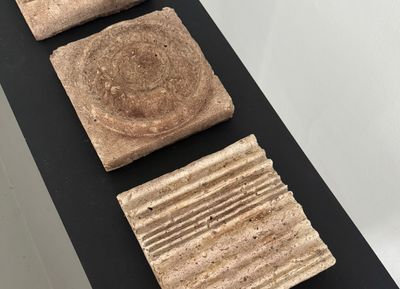
Liquid Clay (2026–2028)
What if, instead of simply ramming and pressing clay, we could pour it?
The aim of the project is to investigate the extent to which clay can be developed into a flowable building material that can be processed in a similar way to concrete. Thanks to its pourable consistency, clay is intended to be integrated into existing concrete processing infrastructures – as an ecological alternative to conventional load-bearing building materials. Particular focus is placed on the composition of the mixture: the aim is to develop a clay building material without chemical stabilisers. In addition to industrially scalable processing, Liquid Clay opens up new design possibilities, for example for functional surfaces with acoustic properties. At the same time, the project addresses key challenges in the construction sector such as resource-friendly practices, CO₂ reduction and the strengthening of regional value chains in clay construction, particularly in central Germany.
The research project “Liquid Clay: pourable clay as a sustainable solid clay construction method” is funded by the Federal Ministry of Research, Technology and Space under the WIR! – Change through Innovation in the Region (WIR! Alliance GOLEHM initiative) and is carried out at the Professorship of Constructive Design and Structural Design by Dr.-Ing. Larissa Daube and Dr. rer. nat. Torben Wiegand.
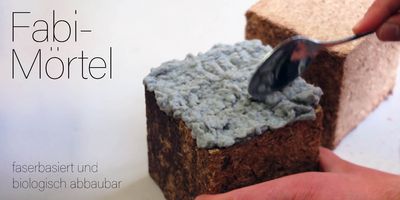
Fabi-Mörtel (2024–2026)
Thanks to legal requirements, buildings have become significantly more energy-efficient over the past few decades, which is why building materials are playing an increasingly important role in life-cycle assessments. Against the backdrop of climate change, old traditional building materials such as clay, wood and straw are being further developed into highly efficient construction methods to replace environmentally harmful building materials based on finite resources. To ensure a rapid transition from research to construction practice, common building methods and formats must be taken into account when developing new building materials. In this context, masonry plays the largest role in residential construction, accounting for around 70%. If this is to become more environmentally friendly, it is desirable to replace mineral bricks and blocks preferably with renewable raw materials. The ‘StrohGold’ research project, funded by Zukunft Bau, holds great potential for developing blocks made from straw. In order to be able to use such and similar building products and to achieve the transition to environmentally friendly building materials, a compatible mortar based on renewable, biodegradable raw materials is necessary. Like conventional mortar, it is intended to absorb vertical pressure and horizontal shear, thereby significantly enhancing the performance of new masonry building materials made from renewable raw materials in terms of load-bearing capacity and bracing. Bonding the bricks to form a wall ensures load transfer and wind resistance, whilst also offering further beneficial building physics properties. These include, in particular, the indoor climate, thanks to hygroscopic and thermal behaviour adapted to the renewable masonry materials. Problem-free, low-waste recycling and excellent life-cycle assessment values are further advantages of such a mortar. On the path towards a construction industry that relies more on renewable resources and thus acts as a CO2 sink, the new mortar represents an important piece of the puzzle that has not yet been researched.
The research project is funded by the federal innovation programme “Zukunft Bau” and is being carried out at the Professorship of Constructive Design and Structural Design by Katharina Elert M.Sc. and Julian Pracht M.Sc..
Bauhaus Participation Lab (2023–2026)
The Bauhaus Participation Lab (BPL) is an innovative methodological approach to the constructive involvement of citizens in local planning processes. It is based on responsive parametric planning models for the rapid and interactive generation of planning variants, as well as methods for jointly exploring and discussing spatial variants in mixed social reality. By combining both technologies, the BPL aims to facilitate the negotiation process between different stakeholder groups in urban development projects. To this end, techniques for the intuitive and joint navigation of planning variants by large groups, methods for comparing, evaluating and discussing planning variants, as well as simple interaction mechanisms for generating and modifying planning proposals, are to be developed specifically for target groups. These technologies are intended to motivate and empower citizens to participate actively in the planning process by promoting an understanding of planning problems and their spatial solutions, offering new opportunities for expressing opinions, and encouraging the submission of creative proposals. The technologies are to be tested in several participatory workshops as part of the “BahnstadtWeimar” development concept. As a new transport hub, Bahnstadt will form a key component of the mobility transition in Weimar and, due to its location and function, will appeal to a large number of people and target groups. The findings from the participatory workshops will be used for the iterative further development of the technologies and the formulation of recommendations for the use of digital tools in participatory processes.
Funded by the Federal Ministry for Education and Research (BMBF) under the funding programme “The Digital Municipality (DiKom): Supporting interactive, participatory and data-driven planning processes”
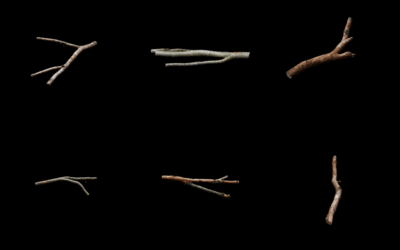
IrreguLab (2024–2026)
The “IrreguLab”, which is funded with approximately €390,000 from the Foundation for Innovation in Higher Education from 2024 to 2026, is an inter-faculty and transdisciplinary teaching and learning laboratory that aims to address one of the major challenges of our time: the scarcity of vital resources. The aim is to develop innovative approaches that tap into previously unused material stocks. As an example, the project focuses on a raw material that is virtually in abundance in Thuringia, the federal state with the highest timber harvest: irregularly grown waste wood. Students in the fields of Architektur (Architecture), Produktdesign and beyond are developing concepts, strategies and methods for processing and utilising this wood. To this end, digital tools and processes such as 3D scanning, digital data processing, as well as CNC-controlled and augmented reality-supported fabrication will be employed. This allows the otherwise unused raw material to be processed precisely and efficiently, resulting in original, material-appropriate and, above all, resource-friendly design and manufacturing approaches. The project offers innovative formats for coursework and learning, such as augmented reality design-build workshops and Installations, and develops specific knowledge transfer and exchange formats. These offer students the opportunity, on the one hand, to network with local and regional stakeholders from the forestry, timber industry and craft sectors, and, on the other hand, to share the visions developed here with a wider public.
The IrreguLab is a collaboration between Jun.-Prof. Dr. Thomas Pearce (Emerging Technologies and Design) with Lukas Kirschnick M.Sc. (Structural Design and Structural Engineering) and Prof. Dr. Jan Willmann (Theory and History of Design).
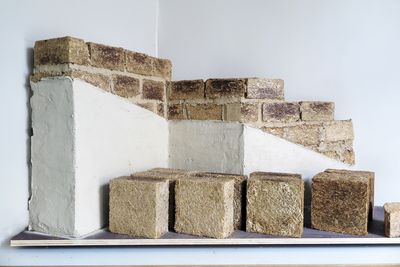
StrohGold – Development of a load-bearing lightweight straw construction method (2022–2024)
Around 20 to 30 per cent of straw in Germany goes unused and therefore represents a previously untapped resource. Against the backdrop of increasing raw material shortages, rising prices for building materials and, not least, the climate crisis, it makes sense to seek out affordable, locally available and renewable resources. The aim of the project is to develop a load-bearing wall building material based on straw, thereby utilising this agricultural by-product for the production of building materials. The load-bearing capacity of the new building materials should allow for buildings of up to three storeys, ideally without exceeding the usual wall thicknesses of approx. 50 cm. In addition, the team is investigating whether its thermal insulation properties make a monolithic wall construction possible. In developing the material formulation, great importance is attached to a low environmental footprint and biodegradability or, where necessary, the ability to separate the material by type.
The research project is funded by the federal innovation programme “Zukunft Bau” and is being carried out at the Professorship of Constructive Design and Structural Design by Katharina Elert M.Sc..
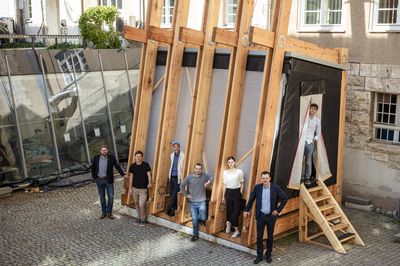
Bauhaus Energy Hub (2023)
Sowohl Planung als auch Bau wurden durch das interdisziplinäre Engagement der Studierenden getragen. Während der Planung galt es dabei unter anderem folgende Fragen zu beantworten: Wie können nachhaltige Baumaterialien zum Einsatz kommen? Wie kann das Gebäude klimaneutral und energieautark ausgestaltet werden? Wie kann der BEH als mobiler Holzbau ausgebildet werden, um auch an anderen Orten erprobt und erlebt zu werden? Wie kann das Gebäude die Kommunikation des umweltgerechten und ressourcenschonenden Bauens realisieren?
Der BEH versteht sich auch als Bauexperiment zur Erprobung neuer Nachhaltigkeitskonzepte bezüglich Baumaterialien, Anlagentechnik und ressourcenbewusster Bauplanung. Gleichzeitig sollen die Experimente als didaktisches Lehrstück in der akademischen Ausbildung nachvollziehbar sichtbar gemacht werden. Diesem Umstand trägt die architektonische Konzeption ebenso Rechnung: durch das außenliegende Holztragwerk ist die Funktionsweise des statischen Systems klar lesbar. In Analogie zu dieser konstruktiven Transparenz wird auch die Anlagentechnik mit ihren Kollektorflächen (Solarthermie und Photovoltaik), Rippenrohren zur Nachtauskühlung und Puffertanks offen gezeigt. So kann das Gebäude als Anschauungsbeispiel in der Lehre und für interessierte Besucher*innen genutzt werden.
Im weiteren Planungs- und Bauprozess sollen die Haustechnik, die das Gebäude energieautark werden lässt, sowie der Innenausbau im Detail konzipiert werden. Hierzu tauschen sich die Studierenden direkt mit Produzenten von Photovoltaik, Solarthermie, Wandheizung und -kühlung aus. Zudem konzipieren die Studierenden entsprechende Inneneinrichtung zur flexiblen Nutzung des Raumes als Reallabor und Ausstellungsraum. Der Finalentwurf der in diesem Semester zu erstellenden Ausführungsplanung dient als Grundlage für den weiteren Bau im Sommersemester 2024.
Weitere Informationen: uni-weimar.de/beh
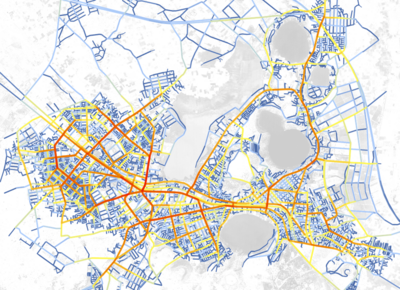
INUMO - Integrated Urban Mobility (2021 - 2025)
Population growth, rural-urban migration and rapid urbanisation pose major challenges to urban and regional development in Sub-Saharan Africa. Along with the planning of urban expansions and cities, mobility and transport concepts are required for resilient development as the physical transport infrastructure spatially interlinks the various urban elements. Especially in Ethiopia, where the motorisation rate is still very low, an intelligent configuration of the urban structure allows to establish smart concepts that direct paths and accordingly the flow of people or goods in such way that distances can be minimized. While reducing traffic, this may achieve increased mobility at the same time.
With the goal to leverage the potential of digital methods for sustainable urban mobility planning in Ethiopia, INUMO takes an interdisciplinary approach between the fields of traffic planning, computer science and urban planning in order to develop and test new methods for integrated urban mobility. The creation of an interactive scenario development method (INUMO Toolbox) will allow professionals from multiple disciplines related to urban development to efficiently generate and optimize different urban mobility concepts and discuss them by receiving immediate feedback on their sustainability and resilience.
In Module 1 (research) our international team of scientist and instructors will work on the development of a digital toolbox leading to methods of interactive scenario development for urban mobility concepts. In Module 2 (postgraduate education and training), these methods and their development process are integrated in postgraduate education of urban & traffic planners, fostering enhanced knowledge transfer from research to education. Existing paradigms in traffic planning will be reconsidered against the background of the Sub-Saharan context, providing rich opportunities for exchange and fostering mutual understanding with a view to developing solutions based on global goals (SDGs).
Neufert 4.0 - Artificial intelligence methods for generating design heuristics for user-centered residential housing (2022-2024)
The basis for this is a database with approximately 35,000 apartment floor plans. In addition to the geometry of the apartments, this database contains semantic information on building components, rooms and the urban context as well as detailed information on user-centered qualities (daylight, visibility, furnishability, path relationships). With this extensive database, correlations between housing geometry, urban context and use-related qualities are identified. For this purpose, different machine learning methods (regression models, Bayesian Networks, Generative Adversarial Networks) are used and tested for their suitability for the generation of design heuristics. Furthermore, visualization methods are developed to present the found correlations in an understandable way. In workshops with practicing architects, these methods are tested for their suitability when used in concrete design situations. The result of the project is a methodology that allows the flexible derivation of heuristics for concrete design tasks for (1) the description of the requirements of dwellings (in which framework are certain requirements regarding e.g. room size, lighting or visibility are realistic, do contradictory requirements exist?) and (2) the arrangement and dimensioning of building components and rooms in order to achieve certain qualities (e.g., where should the entrance be placed in a narrow apartment in a dense urban context in order to place a certain number of well-lit rooms?). The methodology developed will provide important insights into the application of artificial intelligence in architectural design and will provide open up new approaches to residential design research.
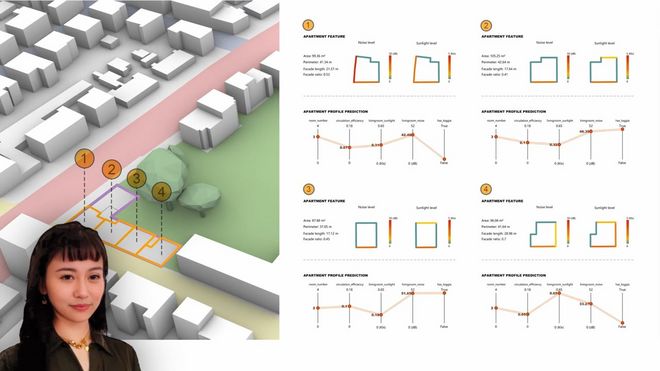
Neufert 4.0 - Project outline
Click the Play button to load and view external content from Vimeo.com.
Automatically load and view external content from Vimeo.com (You can change this setting at any time via our »Data protection policy«.)
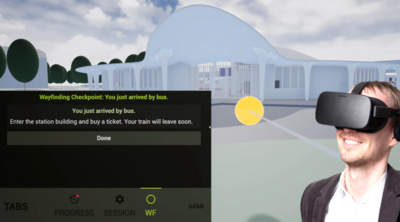
OpenVREVAL (2021 - 2023)
Buildings are very cost and resource intensive objects. Their longevity and limited changeability require very careful planning. In addition to technical, ecological and economic aspects, aspects of building use in particular must be taken into account. However, such human-centered aspects are difficult to quantify. For lack of methods to objectively assess the user perspective, planners usually rely on their intuition. However, if the actual behaviour of the future users does not match the anticipated behaviour, this can lead to dissatisfaction with the respective building.
The aim of the project OpenVREVAL is to develop a virtual reality (VR) based evaluation methodology that makes it possible to make valid statements about the behaviour and emotions of different user groups already in the early planning phases. For this purpose, an open framework for the creation of questionnaires and interactions in VR is being developed. This framework should allow architects to quickly record use- and experience related criteria from a large number of potential building users for their specific case.
After completion of the project, planning variants can be systematically evaluated with regard to user experience & behaviour and the results of the evaluation can be visualised and analysed easily. In practice, this should serve as a basis for discussion to improve the design of buildings. Furthermore, it enables citizens to be actively involved in planning processes. This is a decisive factor for the creation of sustainable building concepts. As a long-term vision for the application of the developed method, a "user-friendliness certification" is conceivable. Furthermore, it is possible to use the collected data to create predictive models using artificial intelligence.
DigiWo (2018 - 2020)
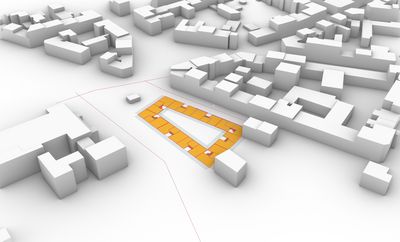
The planning of a multi-family-residential building can be characterized as a multi-objective optimization problem, as multiple criteria must be considered and negotiated with each other. The output of this process - the building design - has a great impact on the social, economic, and ecological performance of the building for a long time. Therefore, it is crucial to find the optimal solution with the best trade-off between the performance criteria. The challenges that the planner faces during the planning process are (a) a large number of the design options and (b) that the fitness criteria (goals) vary from project to project and even during the work at one design. Currently, the process of the manual solution search is highly time-consuming, and hence, it is usually not possible to guarantee that the "true" optimal solution is found. The goal of this project is to develop a method for efficient automatic generation of design options for multi-family-residential buildings. The focus of the project is the cross-scale generation of designs, from the building envelopes to the detailed floorplans.
NAVAPA
Nachhaltige Verbundbauteile aus Papierwerkstoffen
Das Forschungsprojekt NAVAPA widmet sich der Fragestellung, inwieweit gefaltete Wabenplatten aus Papierwerkstoffen als tragende Bauteile für Wandkonstruktionen zum Einsatz kommen könnten. Derzeitige Leichtbauwände für den Innenraum bestehen in der Regel aus einem Stahlblechprofil und einer Beplankung, die mittels Schrauben kraftschlüssig zu verbinden sind. Das erlaubt zwar eine relativ genaue Anpassung an den jeweiligen Ort, benötigt jedoch viel Arbeitszeit und die Beschaffung vieler Einzelteile. Der Verbund von Stahl und Gipskarton ist im Fall eines Rückbaus nur schwer wieder zu lösen.
Beide Problemstellungen können minimiert werden, indem vorgefertigte Wandbauteile die Beplankung und das Tragwerk in einem Bauteil kombinieren. Die Metallbauteile werden dabei gänzlich durch gefaltete Bauteile aus papiernen Wabenplatten ersetzt. Der hohe Vorfertigungsgrad minimiert den Montageaufwand.
Professur Entwerfen und Tragwerkskonstruktion
April 2017 - September 2019
ESUM
Analysing trade-offs between the energy and social performance of urban morphologies
Eine Zusammenarbeit zwischen der Professur InfAR // Planungssysteme, sowie dem Chair of Information Architecture der ETH Zürich; finanziert durch die DFG und FNSNF.
Dieses Projekt befasst sich mit der Stadtraumwahrnehmung. Ein komplexes Wechselspiel zwischen permanenten Faktoren (z.B. der Stadtgeometrie und dem Straßennetzwerk) und dynamischen Aspekten (z.B. wechselnden Lichtverhältnissen und Geräuschen) beeinflusst wie wir uns fühlen (z.B. körperlich reagieren) und Raum bewerten (z.B. einen Stadtteil als angenehm erfahren). Studien in realen und virtuellen Stadträumen liefern wissenschaftliche Erkenntnis für ein Vorhersagemodell zur Stadtraumwahrnehmung, das Planungsentscheidungen unterstützen kann.
Professur InfAR
Juli 2014 bis Juli 2017
ILCO
Methoden zur systematischen Variantenexploration in frühen Phasen der Planung unter Berücksichtigung von Lebenszyklusaspekten
Das Projekt entwickelt und testet halbautomatisierte, computergestützte Methoden zur Variantenexploration, um bereits in frühen Planungsphasen Gebäude hinsichtlich der ökologischen Nachhaltigkeit effizient optimieren zu können.
Professur Konstruktives Entwerfen und Tragwerkslehre sowie Professur InfAR // Planungssysteme
April 2015 bis März 2017
IN3 - Integrated Infrastructure (2017 - 2021)
Professur Informatik in der Architektur und Siedlungswasserwirtschaft der Bauhaus-Universität Weimar in
Zusammenarbeit mit dem Ethiopian Institute of Architecture, Building Construction and City
Development in Addis Abeba; finanziert durch das BMBF und unterstützt durch Flintstone PLC
sowie das Ethiopian Construction Project Management Institute (ECPMI) in Addis Abeba
2016-2017
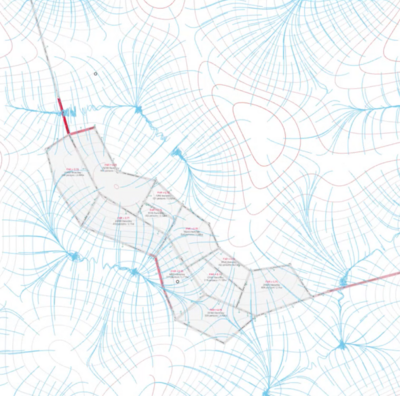
Dieses Projekt befasst sich mit der nachhaltigen städtebaulichen Planung ländlicher Räume in
Äthiopien. Dabei verfolgt das deutsch-äthiopische interdisziplinäre Team aus Architekten,
Ingenieuren, Städteplanern und Simulationsexperten drei Ziele: 1) die Entwicklung einer konkret
anwendbaren Planungsstrategie, die gestalterische, partizipative sowie technische Aspekte
integriert, um resiliente und nachhaltige Kleinstädte in Äthiopien umzusetzen; 2) die Ausbildung
von und der Austausch zwischen jungen Architekten, Ingenieure und Urbanisten aus Äthiopien
und Deutschland zu diesen Themen und 3) die Bildung eines lokalen Forschungs- und
Bildungsnetzwerkes zum Thema resilienter Kleinstädte auf dem Land.
MONOLITISCHE WANDKONSTRUKTIONEN
Untersuchung zeitgemäßer, monolithischer Wandaufbauten hinsichtlich bauphysikalischer,
ökologischer und ökonomischer Eigenschaften
Professur Bauphysik
Im Rahmen der Forschung wird untersucht, ob die verschiedenen monolitischen Außenwandkonstruktionen
tatsächlich positive Auswirkungen auf die thermische Behaglichkeit, Energiebedarf, Ökobilanz und Kosten
bezogen auf den Lebenszyklus von Gebäuden haben können.
PERSONALISIERTE LÜFTUNG
Bewertung der thermischen Umgebung und Raumluftqualität
Professur Bauphysik
Die Forschung zielt darauf ab, die Leistung von personalisierten kanallosen Lüftungssystemen und
Kanalbelüftungssystemen mittels empirischen Messungen und Computersimulationen zu vergleichen.
SCHLIEREN-VERFAHREN
Forschung an energieeffizienten Lösungen zur Verbesserung des Raumklimas
Professur Bauphysik
Das Schlierenverfahren ermöglicht Visualisierungen und Messungen von Raumluftströmungen.
Hierdurch wird die Entwicklung einer energieeffizienten und thermisch behaglichen Raumklimatisierung
begünstigt.