
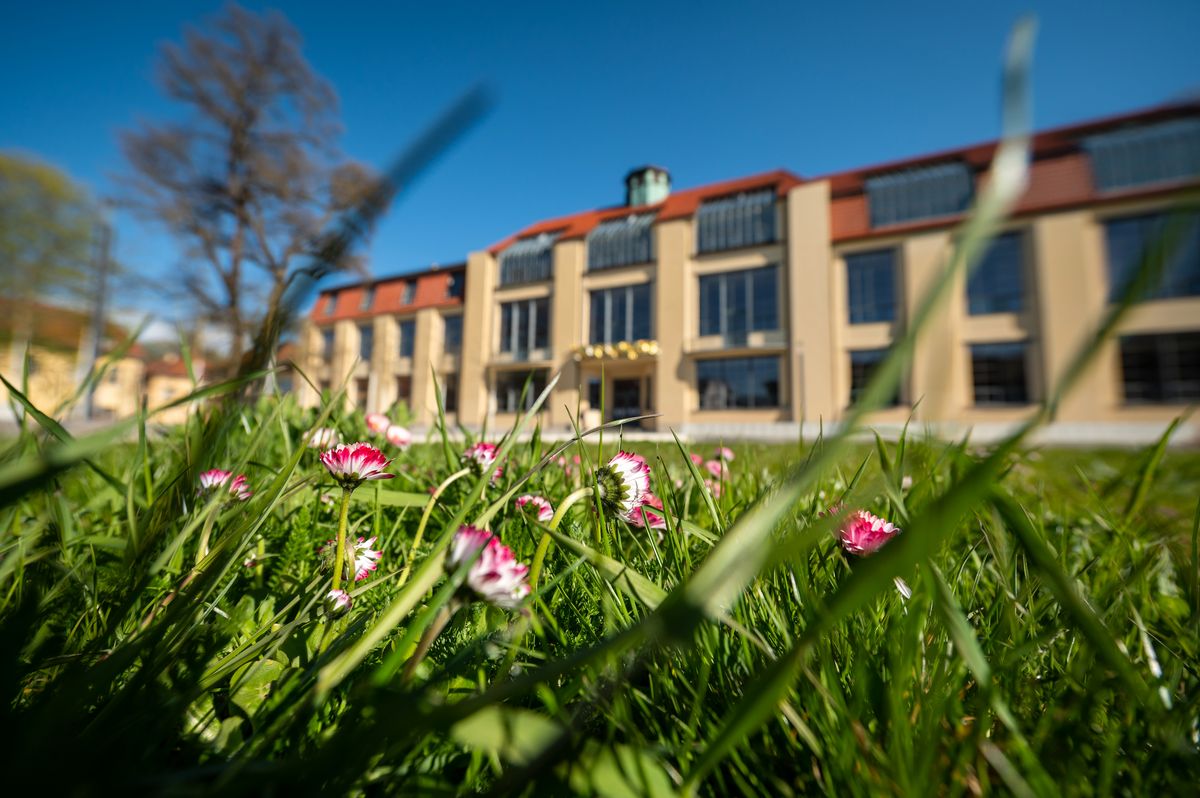

German Sustainability Award: Bauhaus-Universität Weimar Recognised as a Green Educational Institution
Sustainability is a top priority for the Bauhaus-Universität Weimar. Specific measures in teaching, research, and operations are designed to reduce climate and environmental impacts. In addition to the energy-efficient renovation of University buildings, the conscious use of resources is also taken into consideration. Research and teaching projects that focus on sustainability help to promote knowledge transfer in the region. These efforts were recognized by the German Sustainability Award Foundation with a nomination in the »Schulen und Hochschulen« category for 2026.
»Green« learning environments like the Bauhaus-Universität Weimar support environmental and climate protection thanks to »education for sustainable development« and a holistic approach that is broadly implemented. Established at the leadership level, anchored in research and teaching, and brought to life through the University community’s active participation, »sustainability is setting a positive example«, said the German Sustainability Award jury of their decision.
For the Bauhaus-Universität Weimar, the German Sustainability Award nomination is both an honour and a responsibility: It encourages the University to continue expanding its commitment to sustainability and to strengthen its position as a leader in socio-economic transformation in higher education.
Transformation in Research, Teaching, and Operations
The Bauhaus-Universität Weimar has launched numerous initiatives and measures to anchor sustainability in research, teaching, knowledge transfer, and operations in recent years.
This already starts on the way to campus: University members in Weimar travel in a climate-friendly way. Whether on foot, by bus, or by bike. Initiatives like »CITY CYCLING« help promote a sustainable mobility concept that is scientifically supported and further developed by the Professorship of Transport System Planning. Degree programmes like »Umweltingenierwissenschaften (Environmental Engineering)« and »MediaEcologies« address the technical challenges posed by climate change and critically examine society’s media-influenced environmental awareness. Experiments are carried out with renewable raw materials, streamlines structures, modular materials, and multifaceted applications, including an exhibition stand that also functions as a stage.
Since 2019, the University has regularly published environmental reports that monitor ongoing measures. Guidelines are currently in development for a climate-adapted, bio-diverse, and welcoming campus as part of the externally funded »TRAFO2030« project. This is one of many steps toward EMAS certification, the official EU seal of approval for voluntary environmental management.
As the lead partner of the BAUHAUS4EU European University Alliance, the Bauhaus-Universität Weimar also offers its creative vision for a resilient, sustainable, and inclusive future to an international network. The goal, according to Dr. Tonia Schmitz, is to collaborate with nine other partner universities across Europe and explore how universities can contribute to the sustainable development of their institutions and regions.
About the German Sustainability Award
The German Sustainability Award, founded in 2008, is the highest award of its kind in Europe. In the »Schulen und Hochschulen« category, educational institutions are recognised for both teaching sustainability as well as anchoring it in their research, operations, and social engagement. This nomination places the Bauhaus-Universität Weimar in a small category with about ten educational institutions from across the country who understand sustainability as a comprehensive task in research, teaching, operations, and social responsibility. An independent expert panel selects the winner. Key criteria include innovation, scalability, exemplary impact, and long-term responsibility. The Award is partnered with the German Council for Sustainable Development, the advisory body for the German federal government’s sustainability policy. The Awards ceremony takes place every year in December.
Sustainability as a Continuous Process
The nomination came about with the submission of the »Die Krone der Erschöpfung« student project by Philipp Kowalski. The spatial installation translates scientific data on canopy thinning in German forests – an important indicator of their health – into a sensory experience, exemplifying the University’s design-based research approach to making complex ecological relationships accessible to the public.
When a student project is submitted, the entire university is considered for a nomination: Kowalski’s submission therefore initiated a process where the Bauhaus-Universität Weimar’s commitment to sustainability was evaluated. »The fact that the nomination came from one of our students makes this recognition especially meaningful; it shows that sustainability isn’t just a strategic goal, but something we actively practice throughout the entire University community. The nomination also inspires us to keep going. Sustainability isn’t a project to be completed – it’s a continuous practice«, explains Dr. Tonia Schmitz, Director of the BAUHAUS4EU University Alliance and former Director of the Staff Unit for Sustainable Development.
Questions can be directed to Dr. Tonia Schmitz, Director of the BAUHAUS4EU University Alliance and former Director of the Staff Unit for Sustainable Development at the Bauhaus-Universität Weimar, by e-mail: tonia.schmitz[at]uni-weimar.de.