
News

Mortar boards with a new form of geopolymer-based coating. Photo: Bauhaus-Universität Weimar/ Professorship of Construction Chemistry and Polymer Materials

Hannover Messe 2025: The Bauhaus-Universität Weimar Presents Building Materials of the Future

From masonry made out of »Mikrowellenstroh« (microwave straw) and snail slime, to self-healing intelligent concrete – the Bauhaus-Universität Weimar will be represented at this year's industrial trade fair in Hanover with four world premières from the Faculty of Architecture and Urbanism and the Faculty of Civil and Environmental Engineering. The exhibits will be on display from 31 March to 4 April 2025 at the joint »Forschung für die Zukunft« stand, which brings together pioneering research projects from the states of Thuringia and Saxony-Anhalt.

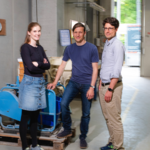
Test drive on campus: Dr. Horst Henrici tests out the new vehicle. Photo: Marit Haferkamp

Transporting Heavy-Duty Technology with Ease: Media Technical Service Receives Innovative Cargo E-Bikes

An unusual vehicle is rolling around campus at the Bauhaus-Universität Weimar: a four-wheeled cargo bike that looks more like a small car than your traditional bicycle. On Thursday, 20 March, the bike officially started operation with Chancellor Dr. Horst Henrici handing over the electric transport vehicle to the Media Technical Service (MTS). The e-bike will help technology to be transported between venues more easily and sustainably.

From initial drafts to material to construction process - innovative 3D printing processes have opened up new possibilities for architecture and construction. Bauhaus-Universität Weimar, Photo: Thomas Müller

What Potential Does 3D Printing Contribute Hold for the Construction Industry?

3D printing opens up completely new possibilities for architecture and construction. Nearly 100 scientists from the fields of civil engineering, architecture, and materials science will share their expertise on the extent to which 3D printing can be used to improve construction during a symposium held at the Bauhaus-Universität Weimar on 31 March and 2 April 2025.

Early-career researchers Maria Hartmann (left) and Gloria Maria Kohlhepp (right) are working on developing the system’s technology through long-term trials under real conditions. Bauhaus-Universität Weimar, photo: Thomas Müller

Grey Water for a Green City: Innovative Reallabor in Weimar

Rising temperatures and poor air quality make the effects of climate change noticeable in urban living spaces. Façade greening could revitalise urban spaces while also improving microclimates. But how can modern urban greenery be watered in a resource-friendly way? Using grey water is one approach being researched in Weimar. In order to scientifically test the long-term effects, the Thüringer Aufbaubank is granting the joint »Reallabor GrayToGreen« project, led by the Bauhaus-Universität, Weimar, nearly 770,000 euros in funding.

RENAT.BAU - Ressourcenmanagement für nachhaltiges Bauen. Bauhaus-Universität Weimar, Foto: Dana Höftmann

23. Thüringer Werkstofftag 2025

Am 20. März 2025 findet von 9 bis 17 Uhr im Stadthaus Hermsdorf der 23. Thüringer Werkstofftag unter dem Motto »Neue Materialien – Neue Chancen!« statt. Die Veranstaltung bietet Forschenden eine zentrale Plattform, um neueste Entwicklungen in der Material- und Werkstoffforschung zu präsentieren und zu diskutieren. Auch die Bauhaus-Universität Weimar ist mit einem Vortrag und vier Posterbeiträgen präsent.