


News

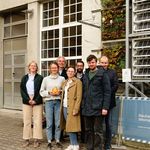
Am FIB werden Grundlagenforschung sowie angewandte Forschung und Entwicklung auf dem Gebiet Baustoffe, Sanierung und Recycling mit den Schwerpunkten Zement, Mörtel, Beton, Gips, Polymere und Holz durchgeführt. Bauhaus-Universität Weimar, Foto: Guido Werner

Hidden Champion: Wie der Standort Weimar die Baustoffforschung seit Jahrzehnten prägt

Mit über 60 Mitarbeiter*innen und Drittmitteleinnahmen in Millionenhöhe ist das F.A. Finger-Institut für Baustoffkunde (kurz: FIB) die aktuell forschungsstärkste Einrichtung der Bauhaus-Universität Weimar. Gegründet 1995 reichen seine Wurzeln bis in die 1940er Jahre zurück, als Namensgeber Friedrich August Finger das neuartige Forschungs- und Lehrgebiet aufbaute. Gemeinsam mit dem Institut für Angewandte Bauforschung (IAB) und der Materialforschungs- und Prüfanstalt (MFPA) soll der Innovationsstandort Weimar ab 2026 zum Bundesbauforschungszentrum ausgebaut und klimaneutrales Bauen aktiv vorangetrieben werden. Bei einem Festakt zum 30. Jubiläum werden dieser und weitere Meilensteine des FIB gewürdigt.

 The F.A. Finger Institute for Building Material Engineering (FIB) conducts research and development on building materials, renovation, and recycling. The focus is on cement, mortar, concrete, gypsum, polymers, and wood. Bauhaus-Universität Weimar, photo: Guido Werner

Hidden Champion: How Weimar Has Been Shaping Building Materials Research for Decades

With over 60 employees and millions of euros in third-party funding, the F.A. Finger Institute for Building Materials Engineering (or FIB) is currently the most important research facility at the Bauhaus-Universität Weimar. Founded in 1995, the Institute’s roots go back to the 1940s, when Friedrich August Finger, the man after whom it was named, established this innovative field of research and teaching. Together with the »Institut für angewandte Bauforschung« (IAB) and the Materials Research and Testing Laboratory (MFPA), Weimar’s innovative location is going to expand to become a Federal Construction Research Centre. These and other milestones of the FIB will be honoured at a ceremony marking its 30th anniversary.

© IAB / Thomas Müller

Starker Impuls für den Bauforschungsstandort Weimar: Bund und drei Länder beschließen Gründung des Bundesbauforschungszentrums

Es ist ein großer Schritt in Richtung einer zukunftsfähigen und nachhaltigen Bauwirtschaft. Am heutigen Montag, 24. November 2025, haben Vertreter des Bundesministeriums für Wohnen, Stadtentwicklung und Bauwesen (BMWSB) sowie der drei Bundesländer Thüringen, Sachsen und Baden-Württemberg ein Eckpunktepapier unterzeichnet, das die Gründung eines Bundesforschungszentrums für klimaneutrales und ressourceneffizientes Bauen (BFZ) besiegelt. Dafür investiert der Bund in den nächsten Jahren insgesamt 52,5 Millionen Euro.

© IAB / Thomas Müller

Significant Momentum for Weimar as a Centre for Building Materials Research: Federal Government and Three States Decide to Establish Federal Construction Research Centre

This decision represents a major move towards a sustainable future for the construction industry. Today, Monday, 24 November 2025, representatives from the Bundesministeriums für Wohnen, Stadtentwicklung und Bauwesen (BMWSB) and the three federal states of Thuringia, Saxony, and Baden-Württemberg signed a key issues paper confirming the establishment of a »Bundesforschungszentrums für klimaneutrales und ressourceneffizientes Bauen (BFZ)« (Federal Research Centre for Climate-Neutral and Resource-Efficient Construction). The federal government will invest a total of 52.5 million euros in this project over the next few years.

Photo: Raphael Obertreis

Power Transition: Nationwide Survey Shows Trent Towards Alternative Energy Solutions in Heavy-Duty Transport

Transport and logistics companies are increasingly turning to alternative energy sources such as electricity and hydrogen. Alternative power systems for heavy-duty transport will dominate in the mid- to long-term – despite high investment costs and the current lack of infrastructure. These were the findings in a recent study carried out by the Bauhaus-Universität Weimar. The study was conducted as part of the h2-well Markthub«, which involved 143 companies nationwide.