Bonding can be used in timber engineering to transfer high loads permanently and without slippage. In addition to industrial use, for example in the manufacture of laminated timber products, timber-wood joints (stock joints, universal finger joints, etc.) but also connections (glued-in steel bars or perforated steel sheets, etc.) are realized using adhesive bonding. The adhesive joint thickness is generally limited to less than 2 mm. Due to the chemical formulation of the adhesives used and/or to ensure full-surface bonded joints, curing must in many cases be carried out by applying pressure perpendicular to the bonded joint.
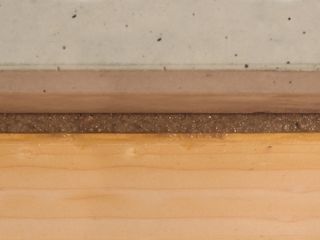
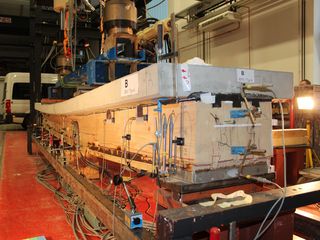
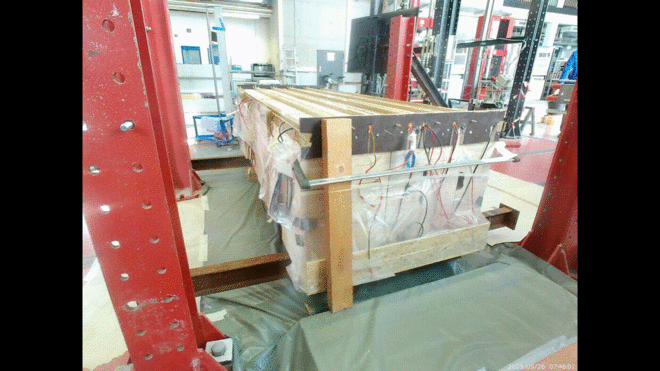
Adhesive bonds using mineral-filled polymer mortars based on epoxy resins are an alternative for increased tolerance compensation requirements and in cases where it is not possible to apply pressure. Following on from previous investigations at the IKI (Chair of Timber and Masonry Construction), the focus of the research area is on the investigation of hybrid material composites between wood and other materials such as concrete, metallic or fiber-reinforced materials. The fields of application for friction-locked, joint-filling adhesive bonds that are conceivable in construction practice are diverse and range from non-slip assembly joints and reinforcement solutions to superstructure structures for road bridges in timber-concrete composite construction.
Impressions from topic-related research works