
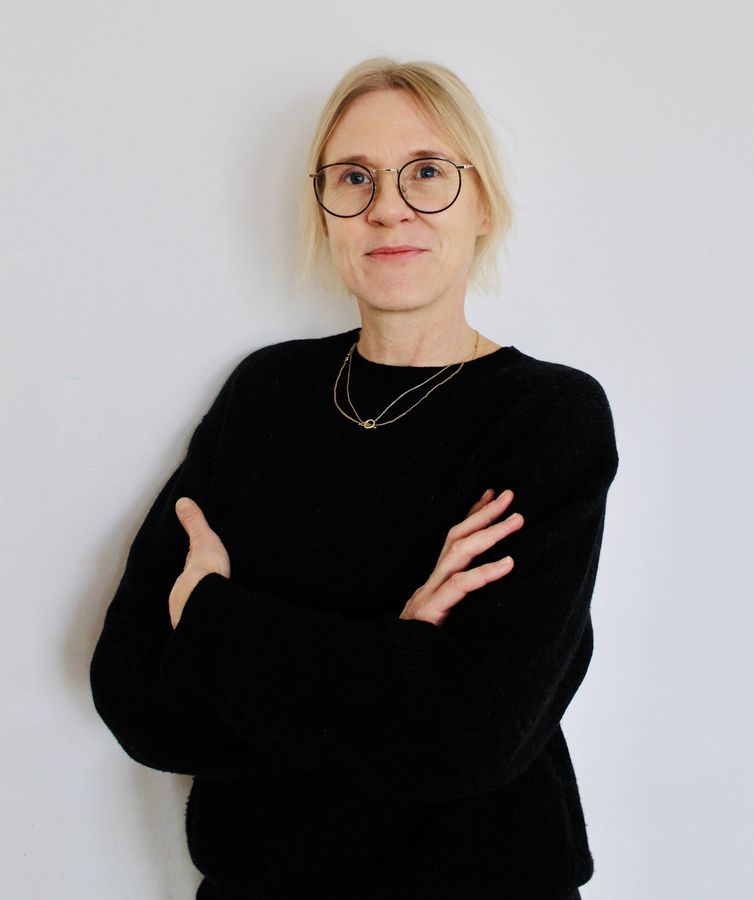

Arriving Where You Have Already Been. Frau Prof. Dr. Rebekka Ladewig is the New Professor of History and Theory of Cultural Techniques.
Rebekka Ladewig knows the Faculty of Media well; from 2018 to 2020, she held the Professorship of History and Theory of Cultural Technologies on a temporary basis. She was appointed to her permanent professorship on 1 February 2026. Inbetween, she held visiting professorships at the University of Vienna, HfG Offenbach, and HfG Karlsruhe, as well as fellowships and research residencies at the Bauhaus Research School Weimar, IFK Vienna, and Oxford University. She also led a research project funded by the VolkswagenStiftung on the visual and cultural history of the arrow.
Ladewig holds degrees in Cultural Studies, Art History, and Philosophy from the Unversity of Florence, University of Lüneburg, and Humboldt University Berlin. She completed her doctorate at Humboldt University in 2012. Her book »Schwindel« (Mohr Siebeck, 2016) reflected the characteristically cross-disciplinary features of her approach, tracing the history of knowledge of orientation on the basis of experimental scenes of vertigo. The focus of the study is on the productive moments –– when perception and knowledge are challenged, orientation is renegotiated, and the body and technology confront each other.
More recently, Ladewig has edited books on the concept of milieux, hut- and capsule-architectures, and the sense of touch in the digital age. She also edited the first German translation of Michael Polanyi’s magnum opus Personal Knowledge (2023). Since 2024, she has been a member of the DFG-funded »Wissensgeschichten des unverfügbaren Selbst« network and a common room member of St Cross College at Oxford University.
We asked Ladewig about the scope of the professorship.
Tina Meinhardt (TM): Dear Rebekka, welcome back to the Faculty of Media at the Bauhaus-Universität Weimar and congratulations on your appointment as the faculty’s Professor of History and Theory of Cultural Techniques. The idea of ‘cultural techniques’ describes everyday practices like reading, writing, navigating, counting, and scrolling. What makes these practices more than just skills? And what makes them worth studying academically?
RL: When the concept of cultural techniques was introduced into Cultural and Media Studies in the late 1990s, it was primarily associated with a shift from the study of individual or mass media to the embodied and operative processes that are at the basis of these media — processes that generate them as media in the first place and stabilise their functioning.
This theoretical approach centres around the concept of ‘operational chains’, which has its origins in 20th-century French anthropology. Based on the work of Marcel Mauss and developed further in various fields of material culture, this concept enables the study of the interplay between bodies, materials, and signs, and their culture-generating effects.
In the same sense, practices of counting, writing, or scrolling can be understood as processes through which the world is produced and organised in an orderly and manageable manner: Counting creates units; writing stabilises meaning; scrolling generates algorithmically organised information. The culturally-productive effects of what we might imagine to be ‘just’ skills should not be underestimated. The approach of cultural techniques can ask how and under what historical conditions such diverse practices as navigating a technical interface or shooting an arrow into the distance relate to concepts of design, and how these practices constitute and transform spaces of information and data environments. Cultural techniques influence our perception of objects in the world and ourselves as subjects. The representations that people make of the world – like maps, for example – have always been linked to power relations, the history of which has to be understood in order to critically analyse the present.
TM: Your research and publications cover a broad range of topics, from vertigo and disorientation to tacit knowledge and the cultural history of the arrow. What overarching themes or methodological approaches run through your work?
RL: My research combines media and cultural theory, anthropology, aesthetics, and epistemology with feminist and decolonial thinking and science and technology studies. The transdisciplinary approach emerges from the material I work on and, of course, from the research questions I pose.
As for overarching themes, that’s a different question. Connections and comparisons can definitely be drawn, as I have argued in my writing, for example between the history of the rocket and the cultural history of the arrow. What is most interesting to me about the phenomena of orientation and implicit knowledge is how inconspicuous and yet utterly effective their operations are. In contrast, vertigo is a state in which familiar frames of reference become unstable, not only physiologically or medically, but also epistemologically and culturally.
What probably best summarises all of these projects is their focus on specific constellations of bodies, techniques, and knowledge, the ways in which they bring each other into being, and their connections to material and visual culture.
TM: Michael Polanyi’s concept of tacit knowledge – that we can know more than we can tell – is becoming relevant again thanks to AI systems rapidly formalising what was long considered impossible to formalise. What gets lost in the process? And how can the history of knowledge and cultural techniques contribute to the debate, which has taken on such urgency, particularly in higher education and creative practice?
RL: What I find particularly interesting is the shared historical origins of the idea of tacit knowing on the one hand and AI on the other. Michael Polanyi developed his theory of knowledge in the late 1940s in dialogue with Alan Turing, his colleague at the University of Manchester, who laid the foundations for artificial intelligence with the eponymous test, the famous ‘imitation game’. While Turing was working on translating thought processes into formal, machine-readable operations, Polanyi was interested in bodies of knowledge that eluded such formalisation – knowledge that is embodied, experience-based, ingrained in personal beliefs and assumptions.
Today, AI applications carry out operations that Turing could only dream of; operations that Polanyi referred to, at the time, as paradigmatic examples of tacit knowledge. In medical diagnosis, for instance, automated image analysis now supplements specialist medical expertise, the latter being something Polanyi clearly distinguished from formalizable, rule-based knowledge – what we would describe as a doctor’s expertise. And facial recognition, something Polanyi identified as a uniquely human ability, has now become a familiar feature of methods of biometric identification. Perhaps too familiar in fact, when you consider that this technology regularly leads to algorithmic bias in the field of police surveillance. What the algorithm lacks is precisely that relationship to the world which is what Polanyi called implicit knowledge. This knowledge involves the body, communities of practice, and physical environments all at once. It therefore resists formalisation, at least in the form of practical knowledge.
In academic and creative practices, however, the pressing question arises of how the cultural techniques of learning, writing, or designing are changing with AI. When the process of writing is delegated to AI, the thought process changes too. When image generation is automated, the relationship between idea, design, and execution shifts. This is precisely where epistemological perspectives and the approach of cultural techniques meet and interact productively, for example where cultural techniques of writing are being transformed by new techniques of chatbot prompting.
TM: You will also be taking on a major role in the new English-language Media Ecologies Masters degree programme in the Faculty of Media. The programme explores the relationships between media and the environment, and explores, among other topics, how media shape and produce our understanding of modern environments and environmental crises – from satellite images of the blue planet to climate diagrams – and how they become environments themselves. Where do you see the connection to your own research, and what do you hope to contribute to the degree programme in terms of content?
RL: The new Media Ecologies MA programme at Weimar is a really exciting development for Media Studies as a field and I’m very much looking forward to being involved in this programme. The questions and topics addressed in the programme are directly related to various aspects of my research, from my work on milieux to my new project on ‘Letzte Dinge’ (last things).
I’m especially interested in the evolving relationship between the mediality of environments and the environmental nature of media. Digital, datafied media environments, which have become our living environments, are unimaginable without the cultural techniques of counting and calculating. Other aspects I want to look at are the material and political demands of these media. Media need infrastructure, raw materials, supply chains, and local forms of knowledge that are historically connected to power relations. The iconic 1972 ‘blue marble’ photo of the earth didn’t come out of the blue, so to speak; it was a product of the technological, economic, and geopolitical constellation of the Cold War. The relationships between media, ecology, and colonialism form another trajectory that I’m hoping to introduce into the programme.
TM: You’re already quite familiar with Weimar and the faculty from your time as a visiting professor. What has changed since then and what new or different approaches are you hoping to explore? Are there any seminars, concepts, or collaborations – perhaps even in cooperation with other faculties at the Bauhaus University – that you haven’t been able to implement yet? What did you take from your time in Weimar that you will be bringing back with you?
RL: Although I do know Weimar quite well, it is different to return here as a tenured professor. Weimar is a unique place where expertise in the arts and design, architecture and engineering, and cultural and media studies can be found alongside a cultural heritage that is itself multifaceted and complex. This environment opens up many possibilities.
I’m looking forward to learning more about the cultural and research landscape in the coming months, and to discussing potential collaborations with colleagues from the other faculties. This also extends to local and regional museums, heritage sites, and other cultural institutions, with whom I hope to build collaborations in my teaching and research.
Supporting early-career researchers is particularly important for me. I’m looking forward to the regular doctoral colloquiums and to building up the research team in cultural techniques. One major grant application has already been submitted, and there are others to follow, so we’re keeping our fingers crossed.
TM: What do you want students to be able to say about cultural techniques in five years’ time? And what do you think they should be able to do with their knowledge? What thinking tools do you want to equip your students with? What, in your opinion, constitutes good teaching in this field?
RL: Improving the student experience through inclusive teaching and learning has been at the heart of my approach for a long time. In addition to jointly organised field trips, guest lectures, and student workshops, my teaching philosophy includes, above all, awareness of and openness to student interests. I try to integrate student ideas into course content, and ensure that discussions are always open and free from discrimination. These are prerequisites for collaborative learning.
In terms of content, my first priority is to spark students’ enthusiasm and underline how theoretical work is a long-term endeavour that involves developing and combining various skills. These skills include developing a depth of knowledge of the field so that contemporary topics can be historically situated; gaining a proficiency with theory that can be used to analyse a broad range of phenomena and relate them to one another; and nurturing the patience needed to unravel complex connections. Curiosity is perhaps the most important skill, and a key part of preparing students for their future careers whether in further research or professional practice.
You asked me what students should be able to say about cultural techniques in five years’ time? I hope that students will say that the field addresses the political as well as the cultural aspects of Media Studies. In the past, the field’s primary focus has been on western techniques of image, script, and number. At this point in history, a broader perspective is needed. Expanding the temporal and geographical scope of the study of cultural techniques to include for example Indigenous, stateless or non-literate societies would be a first step. So too would be a focus on how Europe’s colonial past shapes knowledge in the present. I’m excited to see how the field is developing in these directions. We can meet again for another chat in five years’ time, and see how much has been achieved.
TM: Thank you for your fascinating answers!
Further information can be found on the Professorship website: Bauhaus-Universität Weimar: Welcome