
First Phase Report – Fellowship Forschungswerkstatt 2025/26

“From Process to Aesthetic: Recontextualizing Modernism in South Asia through Cinema, Print and Object-Oriented Ontology”
In the first phase, our project has focused on tracing how modernist aesthetics travelled into everyday imagination in post-independence South Asia not only through architecture, but significantly through media such as film, magazines, advertisements, and visual print culture. Using an interdisciplinary approach between media philosophy and architectural history, we explore how modernist objects became symbols of aspiration, design vocabulary, and cultural identity in the domestic sphere.
1. Research Progress
Between July–October 2025, we conducted extensive archival research in India with the goal of collecting primary visual material and media references for analysis. We visited:
a) Lalit Kala Akademi (New Delhi) – surveyed design catalogues, post-independence art journals and visual documentation and National Film Archive of India – NFAI (Pune) – accessed film journals, stills, production design references, and cinematic material focusing on domestic interiors.
b) British Library and National Art Library, V&A (London) – archives on magazines, design archives, and material focusing on Print media correspondences.
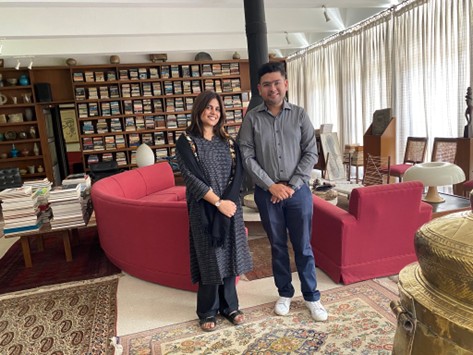
c) Private Archive of Design Magazine (1957–1988) at 11 Amrita Sher-Gil Marg, New Delhi, courtesy of the Patwant Singh’s family. We received permission for academic use and digitisation, gaining rare material unavailable in other public repositories.
The collected corpus now forms the foundation of our visual lexicon of modernist domestic objects, to be expanded and systematized in the second phase of the project.
2. Dissemination & Academic Engagement
a) Sneha Singh presented at the international conference Times in Between (Bucanevis, Trieste, Italy, Dec 2025).
b) Pappal Suneja presented at European Society of Periodical Research at Málaga, Spain (2-5th Sept 2025) and participated in the Conference Socialism on the Bench Global Socialism and Non-Alignment, Pula (18-19th Sept 2025).
c) Together, Sneha Singh and Pappal Suneja presented the project at the IAAW South Asia Research Colloquium at Humboldt University Berlin (5th Dec 2025), introducing our theoretical frame and preliminary findings.
d) Our project website is now in the final stages of being constructed and operational.
3. Upcoming Activities (Jan–May 2026)
a) We are currently preparing an International Round Table (April 2026) with invited scholars working on visual modernity, design history, and South Asian media.
b) In March 2026, we will present our research explorations at Université Lumière Lyon 2, as part of the Bauhaus4EU exchange collaboration at Passages Lab under the supervision of prof. Martin Barnier.
c) The next phase includes:
i) Systematization of archived material & digital database development
ii) Comparative analysis of film/print representations
iii) Preparation of an article for ABE Journal – Documents/Sources section
iv) Final review and reporting before project completion in May 2026
In conclusion, the project is progressing well in research, archival findings, and dissemination. In the upcoming months will focus on analytical consolidation and publications.
First Press Release, January 2026
How did modernist design ideal spread beyond Europe? And what did they come to mean in South Asian media cultures? This question forms the foundation of the »From Process to Aesthetic: Recontextualizing Modernism in South Asia through Cinema, Print, and Object-Oriented Ontology« (2025–26) research project. Funded by the Bauhaus-Universität Weimar’s research workshop initiative, the project focusses on architecture, media, and material aesthetics and consistently examines modernism from a postcolonial perspective.
Sneha Singh and Pappal Suneja, doctoral candidates in the Professorship of Media Philosophy and the Faculty of Architecture and Urbanism respectively, are leading the project. In their interdisciplinary research, the two have combined media analysis, architectural history, and speculative materialist theory. The central question is how built forms, objects, and visual motifs not only expressed but functioned as active agents in the development of postcolonial ideas of modernity, in particular outside of a European context.
Building upon theoretical approaches such as object-oriented philosophy (Harman, 2018) and new materialism (Bennett, 2009), the project deliberately goes beyond anthropocentric interpretations of architecture. It focusses on the interplay between matter, aesthetics, and representation to reveal how the experience of modern spaces in South Asia was redefined. Through ongoing archival and image research in India – including in national film and print archives – the team is investigating a phenomenon it describes as »vernacular modernism«: a locally anchored reinterpretation of global modernist aesthetics.
Digital Discussion Sessions: »From Process to Aesthetic: Mediating Modernity across Cinema and Print«
A central component of the project is an international online expert panel, which will take place from 23 to 24 April 2026:
Day 1 (23 April 2026) 17:00–19:00 CEST
(8:00–10:00 a.m. on the U.S. West Coast and 11:00–13:00 on the U.S. East Coast)
Day 2 (24 April 2026) 10:00–12:00 CEST
(Oriented toward participants based in Europe, India, and Australia)
Scientists, researchers, and practitioners working at the intersection of architecture, media, aesthetics, and postcolonial modernities are invited to participate. If you would like to participate, please register in advance at: sneha.singh[at]uni-weimar.de. After registering, participants will receive the access data.
Participation as an expert in the round table discussion is subject to separate conditions: Interested scholars should register directly by email and are asked to submit a title for their contribution and a short biography. In addition, an extended abstract (1,200–1,500 words) is required, which will be included in the planned workshop proceedings.
The goal is to strengthen interdisciplinary dialogue and discuss how cinematic and print media both depicted and actively influenced the experience of modernity in the postcolonial world. Participants will present their current research findings in short contributions. This will be followed by open discussions on methodology, archives, and conceptual approaches for rethinking the transnational heritage of modernity.
About the Project
The »From Process to Aesthetic« project is funded as part of the Bauhaus-Universität Weimar’s Research Workshop Fellowship. This format allows the University to support particularly innovative and, in the best sense of the word, high-risk research projects. The goal is to promote encounters, exchange, and collaboration and to establish spaces for interdisciplinary dialogue and scientific and artistic networking.
Pappal Suneja and Sneha Singh already presented their project during several research stays and engagements, including at the IAAW South Asia Research Colloquium at Humboldt-Universität zu Berlin on 5 December 2025. In a seminar titled »Mediating Modernism: Cinema and Print as Agents of Design Transformation in Postcolonial South Asia«, they presented their theoretical foundation and primary research results.