


News

You can also follow our project and current lecture announcements on Facebook and Instagram.

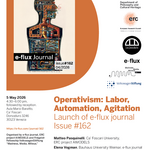
Out now: e-flux Journal 162, Operativism: Labor, Automation, Agitation

e-flux Journal special issue 162, "Operativism: Labor, Automation, Agitation", is out now. Edited by Matteo Pasquinelli and Elena Vogman and with contributions by Elena Vogman, Matteo Pasquinelli, Harun Farocki, Tom Holert, Olexii Kuchanskyi, Alla Vronskaya, Aleksei Gastev, Evgenii Petrov, Aleksandra Selivanova, Devin Fore, Kalindi Vora, and Neda Atanasoski.

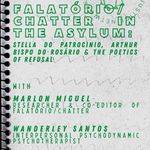
Book Presentation: Stella do Patrocínio's "Falatório/Chatter"

Join us for the presentation of Stella do Patrocínio's "Falatório/Chatter", edited by Iracema Dulley and Marlon Miguel!
Marlon will be joined by Anna Carolina Zacharias, Carolina Rodrigues, Diana Kolker, Natasha Felix, Sara Ramos, and Sofia Sk for a roundtable discussion on Stella do Patrocínio's life and work.
The event will take place on Monday, 30 March 2026, 16:30 at Paço Imperial in Rio de Janeiro, Brazil.

Talk by Camilla Caglioti: "Frantz Fanon's Social Therapy and Its Legacies: Politics, Phenomenology, and Deinstitutionalization", 9 February 2026

Camilla Caglioti will present “La social-thérapie de Frantz Fanon et ses héritages : politique, phénoménologie et désinstitutionalisation” on Monday, 9 February, 18:00–20:00 at the ENS Paris (Salle Émile Borel). The talk takes place within the research seminar "Histoire et épistémologie de la psychopathologie", dedicated to the historical and philosophical study of psychopathology.

Thinking Sumud and Clinical Work in extremis with Samah Jabr, Panel Discussion @ spore initiative Berlin, on Januar 28, 2026, 19.00-20.30

For over two decades, Palestinian psychiatrist Samah Jabr has critiqued the inability of these models to analyse, diagnose, and offer care within the permanent state of violence endured by Palestinians. Simultaneously, she insists on psychiatry’s “humanizing” task, calling for its radical redefinition. In a context structured by oppression, she argues that clinical “neutrality” is not only impossible but complicit. Instead, she roots her practice in Sumud (steadfastness), framing therapy as an act that supports dignity, fights helplessness, and strengthens collective bonds.

Kracauer Lecture by Elena Vogman: "Geo-Psychiatry: Somatic and Cinematic Milieus of Cure" on December 2, 2025

Joins us for Elena Vogman's Kracauer Lecture on "Geo-Psychiatry: Somatic and Cinematic Milieus of Cure" on Tuesday, December 2, 2025 at 6pm at Goethe-University (Frankfurt am Main).

Exploring the film and media archives of institutional psychotherapy, Elena traces the relations between therapeutic and environmental aspects of its experimental practices. In contrast to the objectifying scientific or forensic uses of film in psychiatric contexts, these interventions proposed an environmental and participatory approach to mental health care, formative for direct cinema. Their method of géo-psychiatrie redefined "human geography" by fostering patients' capacity to actively participate in each other's cure.

Talk by Camilla Caglioti: "Sortir des murs, reinventer la ville, 'entrer dehors': Les photographies de Fabrizio Borelli aux archives du Santa Maria della Pietà à Rome" on November 20, 2025

Join us on Thursday, November 20 at 16:00 for a talk by Camilla Caglioti and Chiara Vitali, entitled “Sortir des murs, réinventer la ville, ‘entrer dehors’: Les photographies de Fabrizio Borelli aux archives du Santa Maria della Pietà à Rome.”

Co-authored and presented by Camilla Caglioti (PhD researcher of the project "Madness, Media, Milieus") and Chiara Vitali (Museum Curator at the Institut national du patrimoine and PhD researcher in Art History at Paris 1 Panthéon-Sorbonne University), this talk is part of the international conference "Pictures of Madness: Uses of Photography in Psychiatry (19th–21st centuries)", taking place in Paris on November 20 and 21 at the Maison Suger–FMSH (16 rue Suger, 75006 Paris).

Review of "Psychotherapy and Materialism: Essays by François Tosquelles and Jean Oury" by Janna Graham on e-flux notes

‘Alienation here is understood not as an individual phenomena but as based on social relations born from the “inter-projection” of private property. […] It is with this notion of alienation in mind that Tosquelles rejects a therapeutic practice based on an interiorized understanding of consciousness, arguing instead that the “the patient’s concrete society is itself the sick individual.” Treatment must consist in the “dis-alienation of the total fact of madness: the sick person, the asylum, and the psychiatrist at once.”’