


Project title:
H23D-cell - Geometrically scalable cell concept for 3D-printed hydrogen fuel cells and electrolysis systems
Funded by:
The project, which is funded by the Free State of Thuringia, is co-financed by the European Union through the European Regional Development Fund.
Project duration:
01.01.2026 - 30.06.2028
Project coordinator:
Prof. Dr. Mark Jentsch
Project partners:
In addition to the Energy Systems Group at the Bauhaus University Weimar, the project involves the industrial partners kcd Kunststoffe, Additive und Beratung GmbH in Weimar, PORTEC GmbH in Zella-Mehlis, and IMG Electronic & Power Systems GmbH in Nordhausen.
Team members involved in the project:
Artjom Kolwa M.Sc., Dipl.-Ing. Christian Gebhardt-Scholz
Project outline
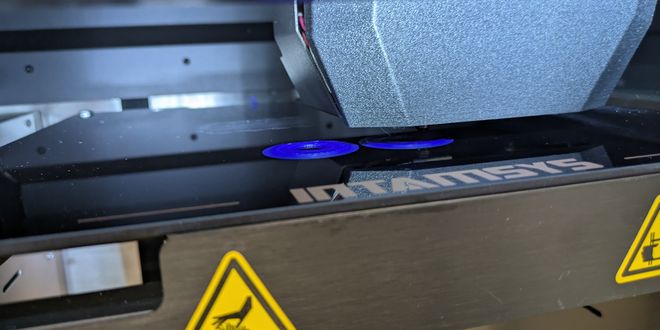
The H2³D-cell collaborative project focuses on the development of a geometrically scalable cell concept for hydrogen fuel cells and electrolysis systems using additive manufacturing via 3D printing. At the Bauhaus-Universität Weimar and the three locations of the industrial partners kcd Kunststoffe, Additive und Beratung GmbH (Weimar), PORTEC GmbH (Zella-Mehlis), and IMG Electronic & Power Systems GmbH (Nordhausen), work is being conducted jointly to develop compact electrochemical cells based on proton exchange membrane (PEM) technology. The work involves the development of a conductive, corrosion-resistant thermoplastic-based compound and its use for 3D printing of bipolar plates, which are a central component of fuel and electrolysis cells by ensuring the electrical connection of the individual cells, efficient gas distribution across the entire surface of the cell, gas- and liquid-tight separation between adjacent cells, the dissipation of process heat, and the sealing of the cell from the outside. The manufacturing process for the bipolar plates is specifically adapted to the requirements of scalability. Together with a membrane electrode assembly (MEA), the bipolar plates are then used to manufacture individual fuel cells or electrolytic cells, which are to be assembled into a two- or three-cell stack. This is complemented by a power electronics management system that can operate bidirectionally and enables the control of individual fuel cells or electrolytic cells. These developments are supported by corresponding simulation studies and laboratory analyses to compare the theoretically determined performance data with measured values. The targeted cell technology, which simplifies manufacturing processes and allows for rapid and flexible scaling to specific applications, opens up new market opportunities in hydrogen technology.