

Project title:
H2FlexiDekarb - Making the electricity supply in Thuringia more flexible to enable decarbonization: Regional integration with hydrogen technologies and the associated grid infrastructure
Funded by:
Free State of Thuringia
European Union
Project duration:
01.01.2026 - 31.12.2028
Project coordinator:
Prof. Dr. Mark Jentsch
Project partners:
In addition to the Chair of Energy Systems at Bauhaus University Weimar, the project involves the Department of Business Law at Schmalkalden University of Applied Sciences and the Department of Electrical Power Supply at the Technical University of Ilmenau.
Team members involved in the project:
Benjamin Breuer M.Sc.
Project outline
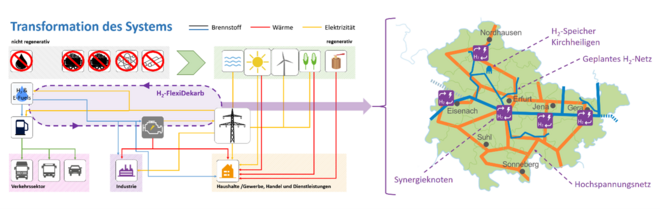
As shown in Figure 1, the legally mandated requirements for decarbonizing Germany’s energy supply by 2045, established as part of climate protection efforts, pose significant challenges for the existing electricity and gas supply infrastructures. Fluctuating renewable energy sources must be integrated into the electricity grid, baseload-capable hydrothermal power plants must be sensibly replaced, and electricity storage facilities and capacity reserves must be established, while at the same time the supply of natural gas is phased out and existing gas grid infrastructures must be converted to hydrogen.
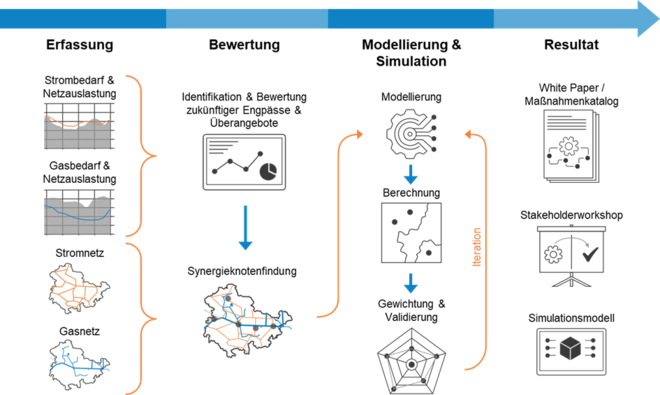
The project aims to develop a dynamic model for a combined electricity/H₂ infrastructure in Thuringia and, using various grid operation scenarios, to validate how the necessary flexibility can be achieved from a technical, organizational, and energy-regulatory perspective in light of national decarbonization targets. The planned approach is illustrated in Figure 2.
The results will include not only conclusions regarding necessary regulatory adjustments but also the development of a combined operational management concept for interconnected and isolated grid operation as well as grid restoration, including recommendations for implementation.