
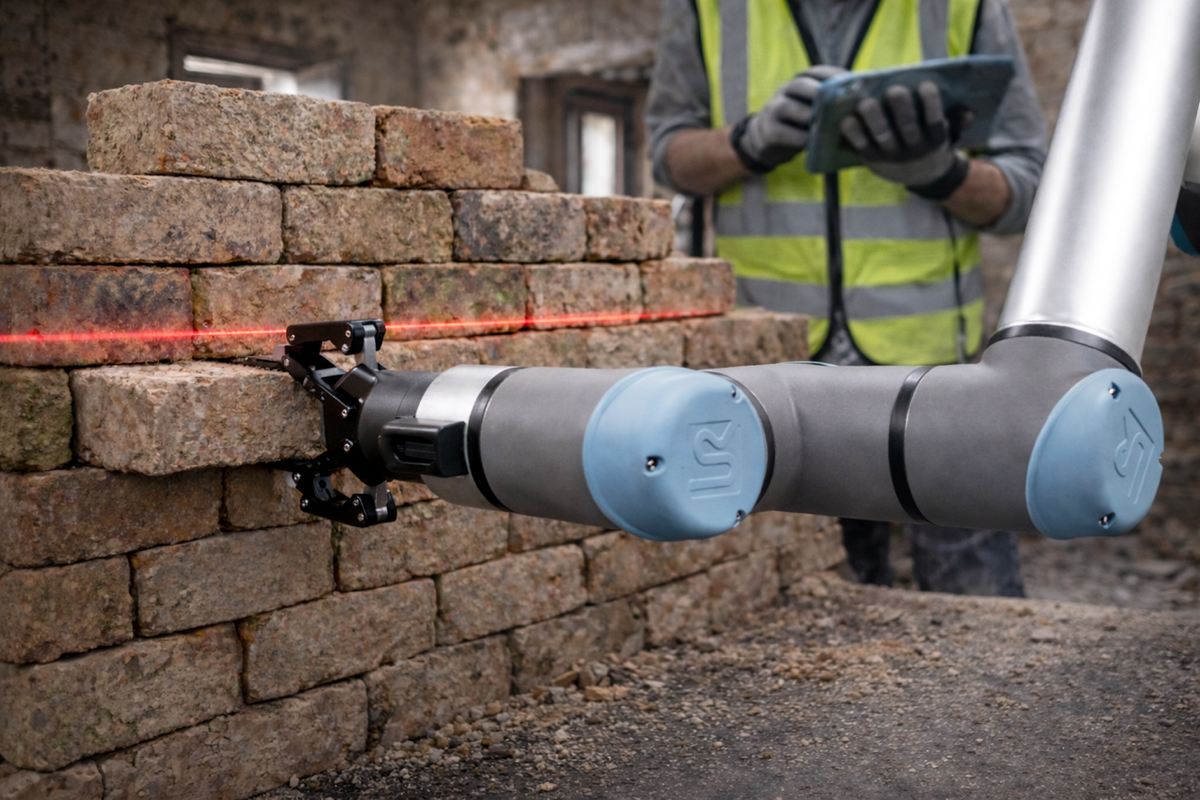

Smart Building and Renovating: Bauhaus-Universität Weimar Tests Robotics in Skilled Trades
Small and mid-sized skilled trades businesses are facing growing challenges; repurposing and renovating existing buildings is becoming increasingly complex, time pressure is mounting, and there is a growing shortage of skilled workers. Digital tools and robotics are promising relief. But how can new technologies be used in a way that they actually help craftspeople in their everyday life? This is the question being asked by the interdisciplinary research team at the Bauhaus-Universität Weimar in the »Handwerk der Zukunft« project. The team will be receiving nearly one million euros in funding from the European Social Fund from 2026 to 2028.
Carrying out Digital Planning and Robotics
Technological innovations, such as digital inventory management, networked planning, and collaborative robotics, are becoming more and more affordable and accessible. This opens up opportunities, especially for small and mid-sized trades businesses. Examples include directly interlinking planning and execution, merging and accelerating corresponding work processes, and automating construction work. But the skilled trades can’t function without people, and all too often, strictly autonomous or machine-based construction methods fail to deliver. The aim of this research project is to focus on craftspeople and to develop digital innovation and application from the perspectives of these individuals in collaboration with planning offices and businesses.
Interdisciplinary Collaboration from Planning to Construction
In order to do this, architects, civil engineers, designers, and computer scientists at the Bauhaus-Universität Weimar are working closely together with planning offices and trades businesses. The are examining the complete process from inventory to planning to execution and are developing application-based concepts, in particular for existing buildings. A range of solutions to help companies introduce and implement digital technologies is set to be developed by 2028. These solutions will be flexibly integrated into existing work and construction processes. The approaches will be tested, expanded upon, and clearly demonstrated using collaborative industrial robots, among other things. Potential applications include analysing the condition of buildings, labelling wall openings, and removing materials.
Concrete Uses Instead of Abstract Solutions
In the world of construction, digital technologies often fall short due to a lack of standards and integration points, insufficient application skills, and in some situations a lack of knowledge within the companies themselves. This is precisely where the »Handwerk der Zukunft« project comes in: Rather than replacing people with digital processes and robotics, the needs, knowledge, and skills of craftspeople are the focus and form the foundation of the research project. To achieve this, the research team is analysing each of the necessary steps and developing practical interfaces and applications to show how digital processes and robotics can offer targeted support in the construction industry, especially when it comes to renovation and refurbishing projects.
Improved Efficiency, Reduced Workload, and Future Prospects for Businesses
Small and mid-sized businesses are particularly likely to benefit from the results. Digital processes and robotic systems can, for example, reduce physically demanding work, improve occupational health and safety, and enable even small teams to handle larger order volumes. In addition, precise data-based planning and construction processes can help reduce the potential for errors. They can also rework and plan material use more efficiently. This »assistive digitalisation« keeps businesses operational while increasing the profession’s attractiveness for young talent. The project is supported by numerous industry partners and a soon-to-be-established advisory board.
Project information
Project: Handwerk der Zukunft: Data-Driven Planning and Human-Robot Interaction in Existing Buildings
Total Funding: € 999,958.60, European Social Fund (ESF)
Duration: 2026–2028
Coordination:
Bauhaus-Universität Weimar
Jr. Prof. Lars Abrahamczyk,
Faculty of Civil and Environmental Engineering,
Professorship of Advanced Structures
Prof. Christian Koch,
Faculty of Civil and Environmental Engineering,
Professorship of Intelligent Technical Design
Prof. Jan Willmann,
Faculty of Art and Design
Professorship of Theory and History of Design
Materials Research and Testing Laboratory (cooperation partner)
Material and Product Qualification Work Group (Alexander Freyburg)
Prof. Carsten Könke (Head of the Department)
Industry Partners
WBB Aktiengesellschaft
Kummer Lubk + Partner Architekten Ingenieure Generalplaner PartG mbB
MKP GmbH
Tragwerk Software
hf Sensor GmbH
Thuringian Chamber of Architects
Media Contact
Jr. Prof. Lars Abrahamczyk
Faculty of Civil and Environmental Engineering
Professorship of Advanced Structures
Phone: +49 (0) 3643 / 58 41 03
E-Mail: lars.abrahamczyk[at]uni-weimar.de