
BAUHAUS.INSIGHTS: The Bauhaus Gamesfabrik – Where Gaming Is Serious Business
Since last year, the Bauhaus-Universität Weimar has been home to a new space that actively encourages experimentation and trial and error: the Bauhaus Gamesfabrik at Marienstraße 1. Set up like a cosy living room, complete with a sofa and big screen, it’s easy to spend hours here without even noticing how much you’re learning. The Bauhaus Gamesfabrik is an interdisciplinary project where students from the Faculties of Art and Design and Media explore the world of gaming together. Gaming is explored here in a practical way by having students develop their own games. The focus is not just on programming digital games, but also on experimenting with analogue game formats, from paper prototypes to playable concepts that can be developed into digital versions.
The format and concept have existed at the University since 2018. Since then, it has continued to evolve. The popularity of the project, led by artistic staff member Gianluca Pandolfo, is made clear by the student numbers. It’s nearly impossible to imagine our world without gaming and game development, and the image of the nerdy gamer is a thing of the past. Games promote cognitive and motor skills and developing them requires advanced technical knowledge and creative skills. We spoke with Gianluca Pandolfo and his colleague Milan Pingel about the future of gaming and their hopes for the future of the Department at the Bauhaus-Universität Weimar in the next few years.
Gianluca, you have strongly advocated in recent years for the Bauhaus Gamesfabrik to have its own, permanent space. What is the concept behind this space and what kinds of events are held there?
The Bauhaus Gamesfabrik identifies as an open community space for students, and is a place where creative work, exchange, and experimentation naturally come together. The space is accessible around the clock and provides an environment where students can create their own projects. It’s easy to get involved in playing and trying things out – whether it’s browsing specialist literature, relaxing on the sofa, or exploring the games library. At the same time, the Gamesfabrik is closely involved with teaching; seminars, workshops, and regular community events are held here. This includes, among other things, game jams, where games are collaboratively developed in a short period of time, and other events initiated and organised by University members. This creates a vibrant space that combines learning, practical experience, and community.
Like I mentioned earlier, gaming is becoming more and more significant in our society. Where does this development come from, and how can society benefit from it?
I think that the increasing significance in gaming is closely linked to a deeply human impulse: curiosity, passion for discovery, and the desire to play. Playing is deeply ingrained in us – regardless of age or context. Both digital and analogue games provide spaces where we can explore new worlds, try out different roles, and intuitively understand complex relationships. At the same times, games have enormous social potential: they bring people together, create shared experiences, and encourage cultural and linguistic exchange. Furthermore, games broaden our horizons and spark our imaginations. For me, games are also a form of art. The combine design, narration, interaction, and technology in a unique way. And this is precisely their social value: They foster creativity, empathy, and problem-solving skills, and open up new perspectives on the world.
What can students learn from developing computer games that is beyond the scope of traditional teaching formats?
When developing computer games, students learn things that are difficult to convey through traditional teaching formats. First and foremost is teamwork: Games are nearly always developed in interdisciplinary teams. This means people are leaving their comfort zones and working closely with their fellow students from other degree programmes – an important skill for their work life later. In the process, key skills like communication, project organisation, and dealing with different perspectives develop almost as a side effect. At the same time, networks and friendships are formed and extend beyond the course – a sense of community is essential. And then there’s the experimental nature of the work: Creating games is complex, but modern tools make it more accessible than ever. Students have the space to test out new ideas, develop formats, and indeed sometimes fail. This is exactly where significant value is added, resulting in innovative approaches that may also be socially relevant in the future.
The semester projects at the Gamesfabrik have students come together in interdisciplinary groups – in true Bauhaus form – to combine their individual strengths. You have students from Art and Design contributing their expertise in visual aesthetics, concept development, storytelling, and character development, alongside Media students complementing the project with skills in programming, animation, and interactive applications. What do students learn through collaboration in your teaching projects?
The main thing students acquire through interdisciplinary collaboration is key skills that go far beyond their fields of specialisation. This includes teamwork, project management, and time management skills – but above all, communication. One of the biggest challenges students face is conveying their own ideas in a way that they are understood by students from other disciplines. At the same time, there is a strong sense of collaboration that develops. We put a lot of emphasis on students treating one another with empathy and valuing the various perspectives within the team. By doing this, we also send the message that failure is an important part of the process – mistakes aren’t setbacks, but rather a foundation for learning and development. Another important aspect is getting to know other disciplines; students broaden their own horizons and develop new skills that come out of this collaboration. This allows both the project as well as each individual involved to grow.
What are the plans for the future of the Bauhaus Gamesfabrik, both at the University and beyond Thuringia on a national scale?
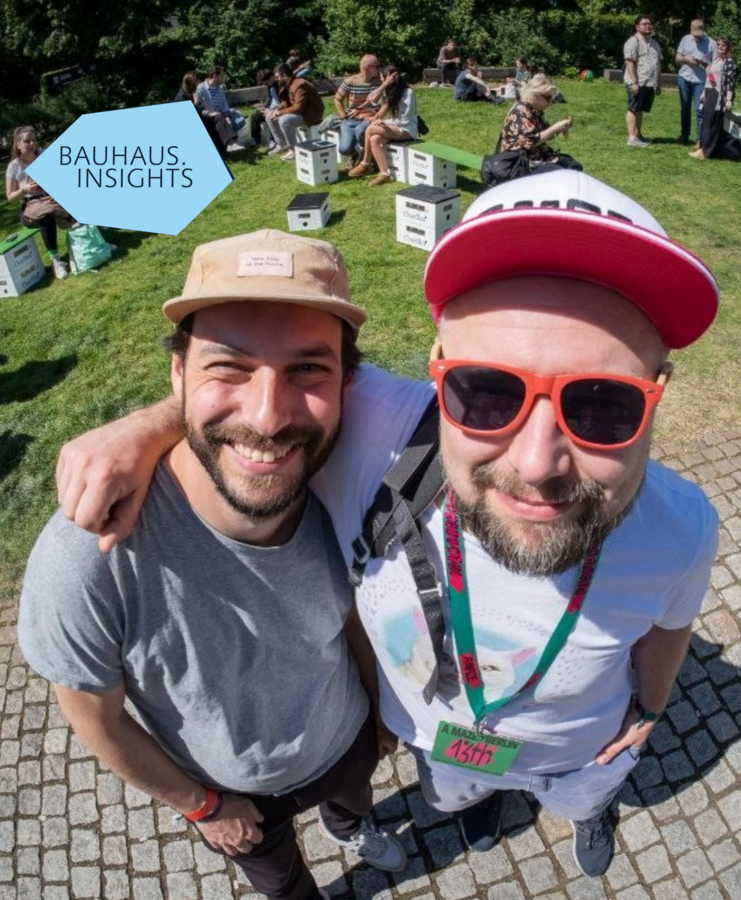
There are two directions we see the Bauhaus Gamesfabrik going: Firstly, we want to strengthen our role as a centre of excellence within the University and provide students with the best possible training. An important goal related to this is to support start-ups: The first projects from the Gamesfabrik have already resulted in the establishment of studios in Thuringia, and we’re hoping to see many more of these. At the same time, we actively support our alumni in finding their way into the games industry. I myself am deeply committed to expanding the regional games scene in Thuringia, and engaging with other partners and state politicians The goal is to establish long-term structures and strengthen the local industry. We are also well-connected on an international level: We take students to festivals like A MAZE. and visit Gamescon. These platforms allow us to make contacts, gain insight into the international scene, and increase the profile of our own projects.
Gianluca and Milan, thank you for the discussion!
The BAUHAUS.INSIGHTS questions for the Bauhaus Gamesfabrik were asked by Claudia Weinreich; Final edit by Luise Ziegler.