
Hier finden Sie eine Übersicht zu den angebotenen Lehrveranstaltungen. Weitere Informationen wie Kurstermine, Abgabefristen, Prüfungstermine und Raumpläne finden Sie auf dem BISON-Portal und am Aushang der Professur.
Primary Hazards and Risks
Lecturer: Dr.-Ing. J. Schwarz (EDAC) & contributions by Jun.-Prof. Dr.-Ing. L. Abrahamczyk
Primary hazards and risks deals with the definition of seismic and wind action while relating them to the design concepts and practical applications. The course emphasizes on the use of ground and wind recordings, building response data, practical realization and handling of data, different types of sensors and data acquisition instruments. Extensive training is provided in the interpretation of dynamic building response characteristics and the definition of input parameters for calculations.
ECTS / Credit Points: 6 ECTS
Langauge: English
Earthquake Engineering and Structural Design
Lecturer: Dr.-Ing. J. Schwarz (EDAC) & Jun.-Prof. Dr.-Ing. L. Abrahamczyk
Earthquake Engineering and Structural Design addresses the principles of earthquake engineering, natural hazards, and key risk parameters influencing structural performance. Students learn to process seismic input data, apply modern building codes, and develop design decisions for structures with varying building types and risk levels. The course emphasizes earthquake-resistant design concepts and critical evaluation of structural solutions. Through an integrated project, students assess structural capacity and performance objectives for multiple seismic hazard levels using state-of-the-art methods and modern software tools. Different modelling assumptions (e.g., material properties and geometry), structural configurations (e.g., bare frames, infilled frames, soft-story systems), and analysis approaches incl. linear, nonlinear, static, and dynamic procedures, are examined to evaluate their influence on overall structural behavior.
ECTS / Credit Points: 6 ECTS / 4 SWS
Language: English
Risk Projects and Evaluation of Structures
Lecturer: Dr.-Ing. H. Maiwald (EDAC), Dr.-Ing. J. Schwarz (EDAC), Jun.-Prof. Dr.-Ing. L. Abrahamczyk
Risk Projects and Evaluation of Structures focuses on disaster risk mitigation and the challenges of designing buildings for earthquake and wind loads. Students learn to apply current methods in natural hazard and risk assessment, integrating research with practical applications for urban and structure-specific risk analysis and planning. The course emphasizes analytical and empirical vulnerability assessment tools, evaluation of existing building typologies, and interpretation of structural performance under horizontal actions. Students are encouraged to document region-specific building types for the World Housing Encyclopedia.
ECTS / Credit Points: 6 ECTS
Langauge: English
Structural Performance Assessment
Lecturer: Jun.-Prof. Dr.-Ing. L. Abrahamczyk
Structural Performance of Masonry Buildings focuses on methods for assessing masonry structures under seismic actions. Students learn to evaluate structural quality, interpret seismic performance under horizontal loads, develop analytical models, and apply equivalent or simplified modelling approaches. The course covers equivalent frame modelling, local and global out-of-plane failure mechanisms, and seismic design and assessment principles in accordance with EN1996 and EN1998. Emphasis is placed on applying state-of-practice methods using modern software tools to model dynamic behavior, assess seismic response, identify design deficiencies, and evaluate the adequacy of strengthening measures, while introducing current research developments and opportunities for further academic work.
ECTS / Credit Points: 6 ECTS
Langauge: English/German
Einführung in die Bauweisen des KI - Holz- und Mauerwerksbau
Lehrer: Jun.-Prof. Dr.-Ing. L. Abrahamczyk, Dr.-Ing. Martin Kästner
ECTS / Credit Points: 4 ECTS
Sprache: Deutsch
Bauweisen des Konstruktiven Ingenieurbaus I
Lehrer: Jun.-Prof. Dr.-Ing. L. Abrahamczyk, Dr.-Ing. Martin Kästner
ECTS / Credit Points: 4 ECTS
Sprache: Deutsch
Design for Robotic Assembly
Lehrer: Prof. Dr. Jan Willmann, Jun.-Prof. Dr.-Ing. L. Abrahamczyk
Die Lehrveranstaltung beinhaltet verschiedene Einführungs-, Übungs- und Projektanteile bzw. Selbstlernbestandteile. Im Vordergrund steht die Vermittlung theoretischer Grundlagen robotischer Interaktion und Manipulation (mit besonderer Gewichtung auf maschinellen Assemblierungs-strategien) sowie die experimentelle und physische Anwendung durch gemeinsame Bauversuche und -auswertungen. Hierzu sind folgende Lehrsequenzen angedacht: Erstens, zweiwöchentliche Einführungs- und Diskussionssitzungen (Präsenz/Lab) zu ausgewählten theoretischen, metho¬dischen, technischen und praktischen Ansätzen im Bereich robotischer Assemblierung; zweitens, zweiwöchentliche Übungs- und Umsetzungssitzungen (Präsenz/Lab), z.B. robotisches Design, robotische Prozesskette, robotische Manipulation etc.; drittens, zusammenführende Projekt-präsentationen bzw. Kritiken (2 Veranstaltungen); viertens, weiterführende/vertiefende Auswertung, Verortung und Dokumentation (Selbststudium); und fünftens, zusammenfassende Gruppen-präsentation und/oder Demonstration an der Winterwerkschau o.ä. (weitere Details werden während des Semesters besprochen).
ECTS / Credit Points: 6 ECTS
Sprache: Deutsch
RoboTec
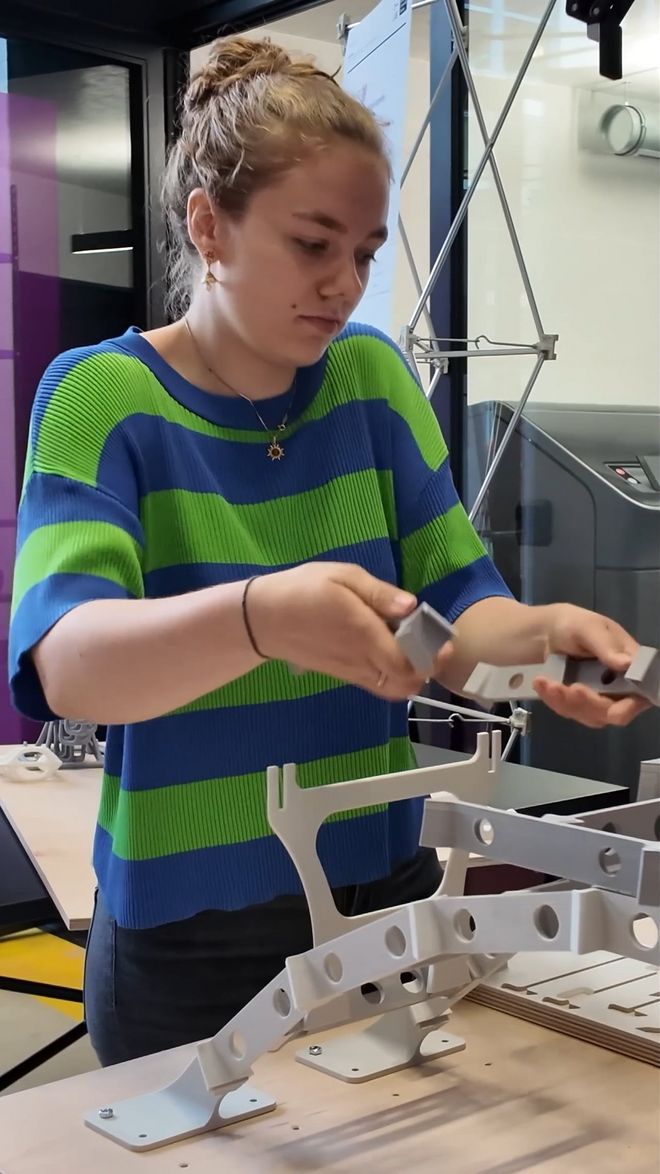
Rebecca und Niels erklären ihr RoboTec-Projekt
Click the Play button to load and view external content from Vimeo.com.
Automatically load and view external content from Vimeo.com (You can change this setting at any time via our »Data protection policy«.)