
News about »Beyond Now«

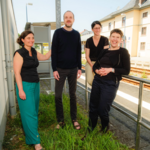
Elodie Vittu, Hendrik Sander, Barbara Schönig, and Daniela Zupan (from left to right), photo: Julian Linden

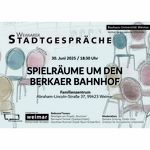
BEYOND NOW – »Weimarer Stadtgespräche« Show How Lively Urban Development Can Be Negotiated

Cities are under pressure – environmentally, socially, spatially, and financially. Despite this, they also provide opportunities for new forms of coexistence, for a fairer distribution of resources, for creative solutions in dealing with the climate crisis, and growth. This is where the »Weimarer Stadtgespräche« come in. For the past five years, these discussions have been uniting individuals from administration, academia, and civil society. Not in the ivory tower of theory, but in concrete places, with tangible topics and a clear goal: To consider urban development together.

Giuliana Marmo (left) and Martin Leibinger ask about the social, material, and ecological traces left behind by art projects and how they can be followed up on in their »Biennial of Care« project. Photo: Richard Schött

BEYOND NOW – Biennial of Care: Students Generate Awareness for the »After« of Art Projects

Exhibitions, biennials, and festivals: When art temporarily takes over spaces, intense and often elaborately staged encounters occur between art, audience, and venue. But what is left over once the art disappears, the audience moves on, and the space is emptied? What social, material, and ecological traces does art leave behind? And who is responsible for taking care of them?

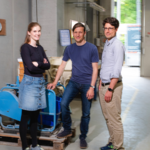
Luise Göbel, Fabian Ehle und Timon Echt (from left to right), Photo: Julian Linden

BEYOND NOW: How 3D Printing is Changing Construction

From a building component to a house using a 3D printer: Additive manufacturing offers huge potential for architecture and construction. But how is technology changing the craft? How do these new forms affect individuals and the environment? And what is behind all the hype? Dr. Fabian Ehle, M. Sc. Timon Echt and Jr. Prof. Dr. Luise Göbel want to shed light on this using 3D-printed objects made of concrete, making the manufacturing process tangible as part of the »Print4PR« project.

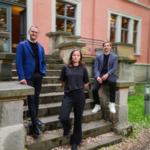
Markus Seifert, Maxi-Josephine Rauch und Jürgen Rösch (from left to right), Photo: Julian Linden

BEYOND NOW – Digitally Environments: Public Law, Effective Democracy?!

Our environment doesn’t stop at the front door or at the gate to the garden. It extends beyond city boundaries and into digital networks, reshaping itself with each click. It is both physical and digital, analogue and networked, a social space and at the same time a political playing field and ecological influence factor. In the »Digital Environments: The Role of Public Service Broadcasting in Transforming Digital Information and Communication Spaces« course, Jr. Prof. Dr. Jürgen Rösch (Faculty of Media) and Dr. Markus Seifert (University of Erfurt) examine whether and how public service broadcasting (ÖRR) can contribute to creating new spaces that are organised around the common good and promote democracy.

Foto: Julian Linden

BEYOND NOW: Between Firs and Fiction – Shaping the Thuringian Forest in the Face of Change

The Thuringian Forest is a myth, habitat, recreational area, and economic factor – but how much of it is left in times of climate crisis, urbanisation, and demographic change? What kind of future can be developed in this symbolic landscape in the former Green Heart of Germany? The »Landscape in the Anthropocene: Thuringian Forest - Between Imagination, Resources, and Reality« project is seeking to answer these questions, specifically in the Masserberg region.

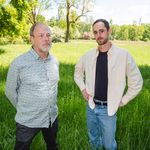
Klaus Fritze-Herbst (left) and Christian Doeller; Photo: Julian Linden

BEYOND NOW – PostCompost: Students Look at the Thuringian Forest Through an Artistic Research Lens

What happens when a forest changes? Students from the »PostCompost – Forest Reset« research project are examining the transformation of the Thuringian Forest with instructors Klaus Fritze-Herbst and Christian Doeller. Using artistic and scientific methods, the group is making it possible to understand how nature, landscapes, and habitats are evolving and reshaping themselves.