
Logo: Bauhaus-University Weimar
≡
  • Jump to main menu
  • Jump to page menu
  • Jump to breadcrumbs and menu
  • Jump to subpage menu
  • Jump to main content
  • Jump to contacts and information
  • Webmail
    • for students
    • for staff (OWA)
  • Moodle
  • Course Catalogue
  • Message Boards
  • DE
  • EN
Shortcuts
  • Webmail
    • for students
    • for staff (OWA)
  • Moodle
  • Course Catalogue
  • Message Boards
  • Academic Advising
  • BAUHAUS.JOURNAL ONLINE
  • Calendar
  • University Library
  • Language Centre
  • Sports Centre
  • International Office
  • Dining Menu
  • Emergency
  • Search people
  • DE
  • EN
Logo: Bauhaus-University Weimar Bauhaus-Universität Weimar
  • University
    • News
      • Bauhaus.Journal online
      • Newsroom and Communications+
      • Social Media
      • Calendar+
      • Message Boards+
      • Open-minded Thuringia+
      • Aid for Ukraine from the Bauhaus-Universität Weimar+
      • A Cleaner Campus: More Respect
      • Saving Energy at the University+
      • Bauhaus.Module
      • Academic Year
      • Current competitions
      • Elections at the Bauhaus-Universität Weimar+
      • Job Openings+
      • Fairs
      -
    • Profile+
    • Structure+
    • Studies+
    • Teaching+
    • International+
    • Research and Art+
    • Transfer
    • Partners and Alumni+
    • Bauhaus100
    • Student Representative Committees+
    • Doctoral Council
    • Services+
    -
  • Architecture and Urbanism
    • News+
    • Profile+
    • Structure+
    • Studies+
    • Research and Art+
    • International+
    • Partners and Alumni
    • Services+
    • Projekte
    +
  • Civil and Environmental Engineering
    • News+
    • Profile+
    • Structure+
    • Studies+
    • Research+
    • International+
    • Partners and Alumni+
    • Services+
    +
  • Art and Design
    • News+
    • Profile+
    • Studies+
    • Structure+
    • Research and Art
    • International+
    • Partners and Alumni+
    • Services+
    • Projekte+
    +
  • Media
    • News+
    • Structure+
    • Studies+
    • Research+
    • International+
    • Partners and Alumni
    • 25-year anniversary
    • Services+
    +
  • {{facultySearchbase[$index].title}}

nothing was found

WHAT WAS THE QUESTION?
  1. University
  2. News
  3. Bauhaus.Journal online
Contact and Information
  • Official Instagram account of the Bauhaus-Universität Weimar
  • Official LinkedIn account of the Bauhaus-Universität Weimar
  • Official Vimeo channel of the Bauhaus-Universität Weimar
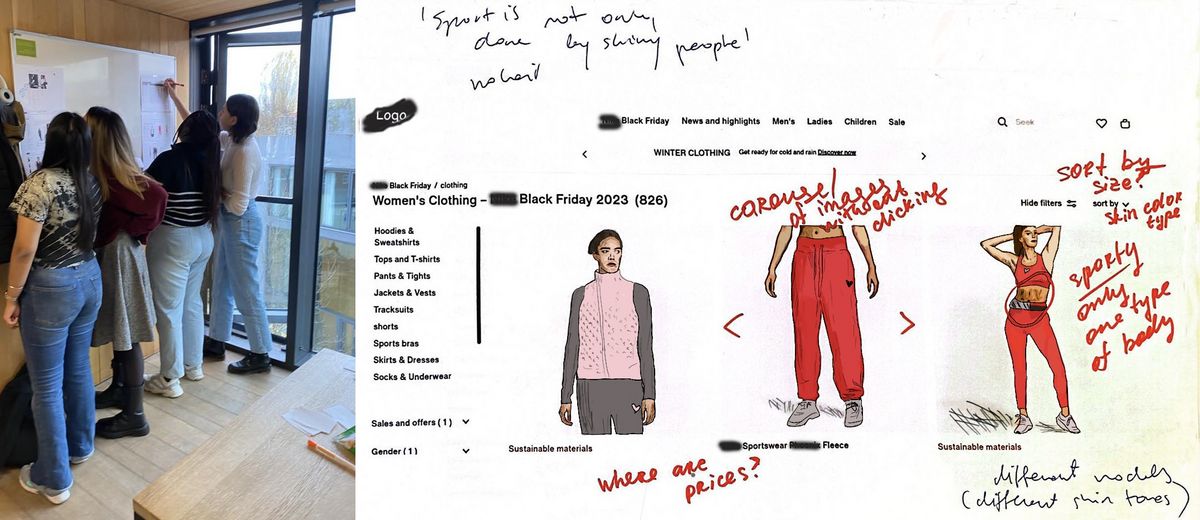
Participants make notes on screenshots from online platforms and highlight key areas of concern, such as a lack of pricing, limited images, and a small range of body types and skin tones. Image: Eva Hornecker
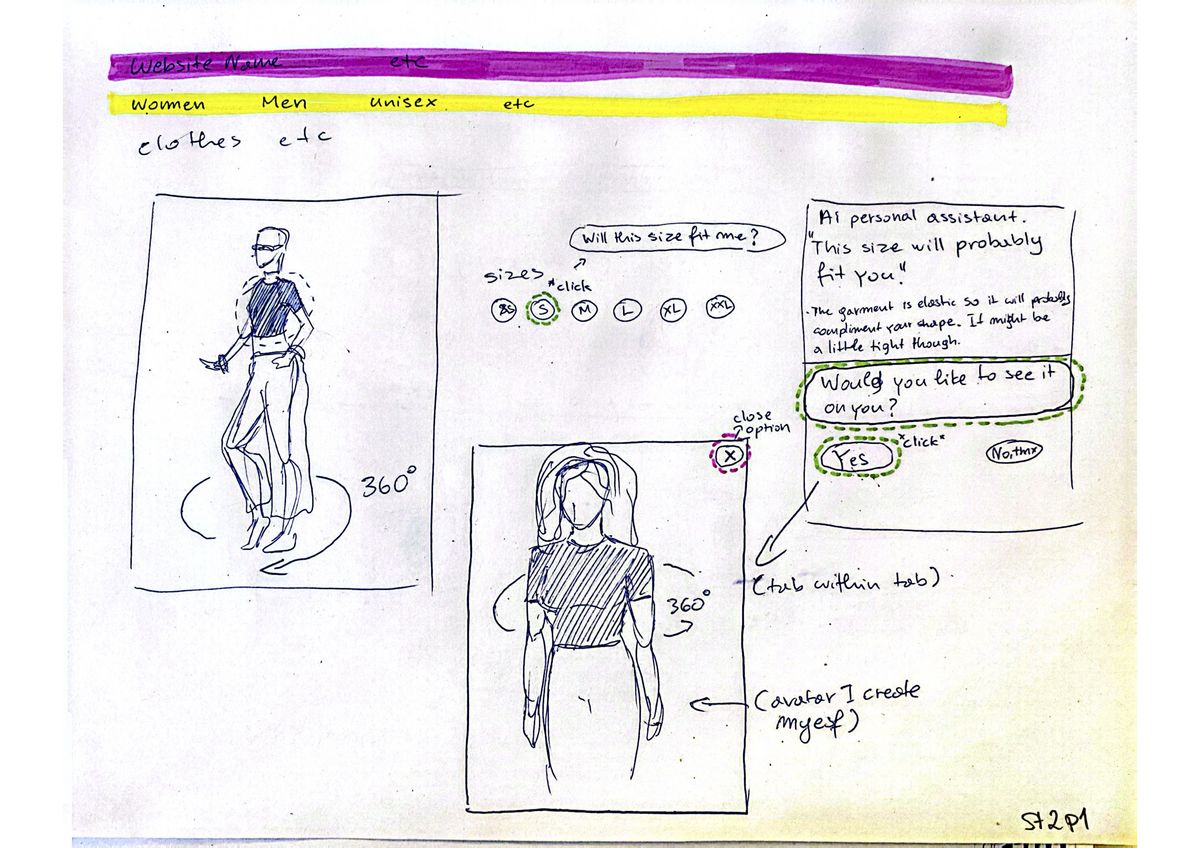
Sketch by a student: Features such as personalised size recommendations are added as is the ability to view clothing on one’s own avatar – ideas intended to reduce uncertainty and improve fit assessment. Image: Eva Hornecker
Published: 08 April 2026

When a Click Reflects on a Body: Weimar Researchers Show How Online Fashion Platforms Affect Women’s Self-Image

The dress on the screen has several sizes to choose from and can be added to the basket with a click – but there is a moment of hesitation: Will it actually fit? Will I feel good in it? Will it look the same as it does in the picture? Online fashion platforms affect women’s self-image more strongly than previously thought. A recent study at the Bauhaus-Universität Weimar has shown that digital shopping experiences have a profound impact on body perception with consequences that affect users, the economy, and the environment. The research will be presented and awarded at the prestigious CHI Conference in Barcelona from 13 to 17 April 2026.

Online shopping has been more than just a functional process for a long time now. For many women, it also involves mental and emotional energy and can negatively affect body image. The study was carried out by Prof. Eva Hornecker together with Margarita Osipova, Urszula Kulon, and Adithi Mahesh from the Bauhaus-Universität Weimar, and Marion Koelle from Hochschule RheinMain – University of Applied Sciences and Arts, and Olesya Kirillova. It has shown that shopping online for clothing is not just a technical interaction; it directly impacts people’s perception of their own body. Many women users feel they are not adequately represented or taken seriously in the process.

The study focusses on a perspective that has, until now, received little attention: the relationship between interface, body perception, and emotional response. The results have shown that when shopping online, female users continuously factor their own bodies into the decision-making process when it comes to fit, size, and style. At the same time, users are attempting to assess how a garment will feel in everyday life, how it will wear, how to care for it, and how it will pair with other items. If the reality doesn’t match the expectations, rather than blaming the product, users blame their own bodies.

Idealised Images Shape Platforms – Returns Are the Consequence

The analysis also shows that many platforms propagate implicit standards. These are based on standardised, often idealised body images and offer very little in the way of portraying individual differences. This can exacerbate insecurities and feed into negative body perceptions.

Women are the main users of online fashion platforms making up over 60 percent of users. And yet online shopping is typically understood as a purely functional task, with platforms optimised to maximise the amount of completed purchases. In reality, this often results in users ordering garments in multiple sizes and returning most of them. These returns generate extra costs due to shipping, inspection, and disposal. The also carry a significant environmental footprint.

More Diversity Improves Decision-Making

The researchers are therefore advocating rethinking the design of digital systems. Rather than treating the body as a secondary consideration, they suggest placing it at the centre of the design. A body-centred approach takes into account the diversity of body shapes, provides more transparency, and is more aligned with real-life needs. More realistic representations and improved fit assessment can help reduce bad purchases and returns, which addresses both the economic and environmental challenges.

A prototype developed during the study shows how these approaches can be implemented: Participants felt better represented, respected, and supported in their purchasing decisions. This improves both useability and overall user experience.

Award at the Renowned International CHI Conference 2026

The publication »I Felt Like I Need to Fit in Someone Else’s Body« will be presented in April 2026 in the ACM CHI Conference on Human Factors in Computing Systems. With over 6,700 submissions and an acceptance rate of about 25%, the Conference ranks among the world’s leading events in the field of human-computer interaction. The paper was also awarded an »Honourable Mention« and ranked among the top contributions.

The presentation at CHI 2026 will allow the research from Weimar to become part of the international discourse on how digital technologies should be designed to reflect social diversity rather than to unintentionally distort it.

Questions can be directed to Marie Kohlschreiber, Research Communication and Public Relations Representative, via e-mail marie.kohlschreiber[at]uni-weimar.de or by phone at 49 (0) 36 43 / 58 37 06.

Back All News
  • Official Instagram account of the Bauhaus-Universität Weimar
  • Official LinkedIn account of the Bauhaus-Universität Weimar
  • Official Vimeo channel of the Bauhaus-Universität Weimar
  • The Bauhaus-Universität Weimar uses Matomo for web analytics.
  • Print
  • Send by e-mail
  • Feedback this Page
  • Studies

    • Academic Programmes
    • Advising
    • Discover the university
    • Application
    • New Students
    • Course Catalogue
  • Information

    • Alumni
    • Employees
    • Researchers
    • Visitors and Guests
    • Academic Staff
    • Emergency Information
    • Press and Media
    • Doctoral candidates
    • Students
    • Businesses
  • Services

    • Message Boards
    • Campus Maps
    • Sitemap
    • Media Service
    • Data Protection Policy
    • Accessibility Statement
    • Legal Notice
  • Contact

    • Contact form
  • Contact
  • Data protection policy
  • Accessibility Statement
  • Legal Notice
  • Sitemap
  • Internal
  • TYPO3
  • The Bauhaus-Universität Weimar uses Matomo for web analytics.
© 1994-2026 Bauhaus-Universität Weimar
  • Contact
  • Data protection policy
  • Accessibility Statement
  • Legal Notice
  • Sitemap
  • Internal
  • TYPO3

Accessibility panel

Simple language

Information about the Bauhaus-Universität Weimar in German.

Set contrast Read more about this setting

Changes from color to monochrome mode

contrast active

contrast not active

Darkmode for the lightsensitive Read more about this setting

Changes the background color from white to black

Darkmode active

Darkmode not active

Click- and Focus-feedback Read more about this setting

Elements in focus are visually enhanced by an black underlay, while the font is whitened

Feedback active

Feedback not active

Animations on this Website Read more about this setting

Halts animations on the page

Animations active

Animations not active