
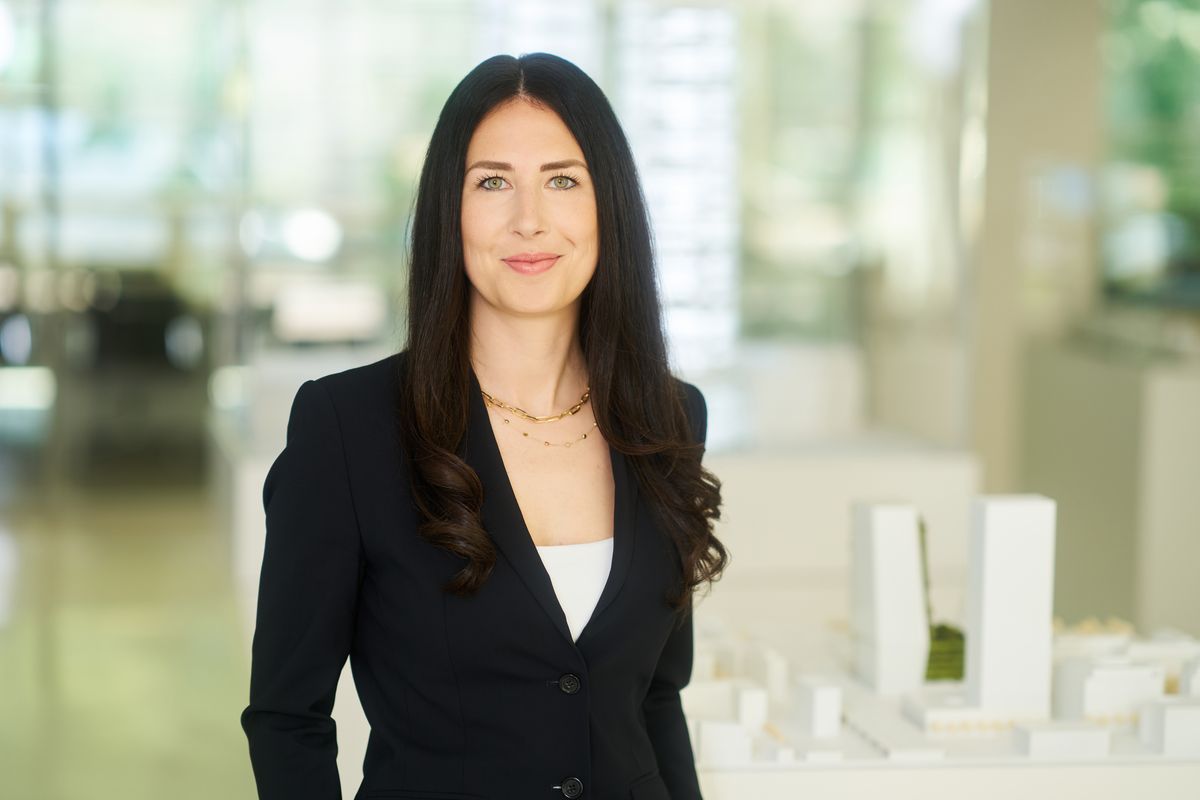
New Junior Professorship Bridges the Worlds of Architecture and Civil Engineering
Antonia Herten was appointed junior professor with tenure track for Project Development and Construction Economics on 1 October 2025. The Professorship is supported by the Faculty of Architecture and Urbanism and the Faculty of Civil and Environmental Engineering.
Jr. Prof. Herten studied Architecture at the Hochschule Konstanz University of Applied Sciences and the ETH Zurich. She then began her career at David Chipperfield Architects in Berlin, followed by e2a in Zurich, airchitekten in Kreuzlingen, Ferdinand Heide Architekten in Frankfurt am Main, and AFX Financial News in London, among others. After completing a Master’s degree in Management [Bau Immobilien Infrastruktur] (Management / Construction, Real Estate and Infrastructure) at the Bauhaus-Universität Weimar, she began working as a scientific employee in the Professorship of Architectural Management and earned her doctorate with her thesis on »Zwischennutzung in der Projektentwicklung. Immobilienleerstand und Brachflächen im Stadtraum«.
Thanks to her academic experience, numerous business projects combining architecture, real estate management/economics, and project development, she will be a valuable asset in teaching and research. In the following interview, Jr. Prof. Herten speaks about the challenges facing the construction industry, what is important to her in teaching and research, and why she is so passionate about interdisciplinary work.
What challenges is the construction industry currently facing and what do you see as future challenges?
The construction industry is facing a number of challenges ranging from the development of new, sustainable construction materials to innovative recycling concepts. At the same time, digitalisation is profoundly changing planning, construction, and logistics processes. This gives way to the question of whether it will be possible to proactively respond to economic and social developments, particularly in times of economic fluctuation. Within the context of demographic shifts, all of these aspects open up opportunities that should be taken advantage of for the future of construction.
Your doctoral thesis looked at the topic of temporary use – why is this such a pertinent topic?
In my thesis, I examined the reuse of vacant buildings and spaces, a topic that is more relevant today than ever. The full title of my thesis was »Zwischennutzung in der Projektentwicklung. Immobilienleerstand und Brachflächen im Stadtraum«. I didn’t just look at temporary projects, more importantly, I asked the general question of how we can resiliently deal with vacant properties in urban areas. These properties include department stores and office buildings, and are increasingly becoming a challenge for cities, both from an economic and a legal perspective. Temporary use of these spaces can be a major factor in project development, helping to reactivate spaces, establish sustainable use methods, and respond to economic and social conditions that have recently become significantly more challenging. In this sense, temporary use is much more than a stopgap solution: It can act as a tool that cities can use to respond to change and develop sustainable strategies.
What do you hope to impart to students through your teaching?
I want to equip students with a versatile methodological toolbox so that they have the ability to respond flexibly to the challenges they’ll face in their careers. This includes learning about the diversity of disciplines and engaging in collaborations with different partners through joint projects. This provides students with not only an insight into the individual levels – from real estate to cities – but it also gives them an understanding of transitioning between the micro and macro levels. It’s also important to me to generate enthusiasm for the profession and to prepare students as well as I can for their future careers.
What are some of the topics you want to pursue in your first years of research at the Bauhaus-Universität Weimar?
In my research, I am hoping to further examine the topics that came out of my dissertation, for example. I’m also interested in complex ideas that have been on my mind for years, such as the question of affordable housing and different forms of living. I’m also excited about the fact that there are already colleagues here who are also researching these topics, which means there’s opportunities for collaboration. At the same time, I also recognise the need to focus more closely on the digital transformation of construction and life cycle perspectives in the real estate industry. Sustainability and resilience are always going to be central themes in this sense. These topics give me the opportunity to expand my research profile and strengthen this relatively new discipline.
What are you most excited about in this position?
What is particularly appealing to me about this new professorship is its interdisciplinary focus; the task of combing various disciplines while maintaining a strong connection to practical application aligns perfectly with my own professional background. To me, interdisciplinary isn’t just a scientific challenge, it also reflects the reality of the real estate and construction industries where the various disciplines and partners need to work closely with one another. I want to actively contribute to this process.
This interview was conducted by Gabriela Oroz.