

New DFG Project: Compaction of granular soils due to high-cycle vibrations
The recently approved DFG project examines how long-term vibrations result in the accumulation of compaction and deformation in cohesionless soils. To this end, the project will combine shaking table and quasi-static triaxial tests in order to validate high-cycle numerical methods.
In geotechnical practice, vibrations occur in a wide range of technical applications. These vibrations are caused by rail and road traffic, heavy construction processes or the continuous loading of offshore structures by wind and waves, for example. Although these loads often have small amplitudes, the high number of load cycles causes continuous grain rearrangement, compacting cohesionless soils and altering their mechanical behaviour. The high-cycle accumulation (HCA) model has proven effective for calculating these long-term cyclic deformations without having to simulate each cycle individually. This model has primarily been validated for low-frequency loads to date. There is a lack of experimental data on the influence of initial relative density, amplitude, frequency and degree of saturation for vibrations with broader frequency and amplitude ranges and high numbers of load cycles.
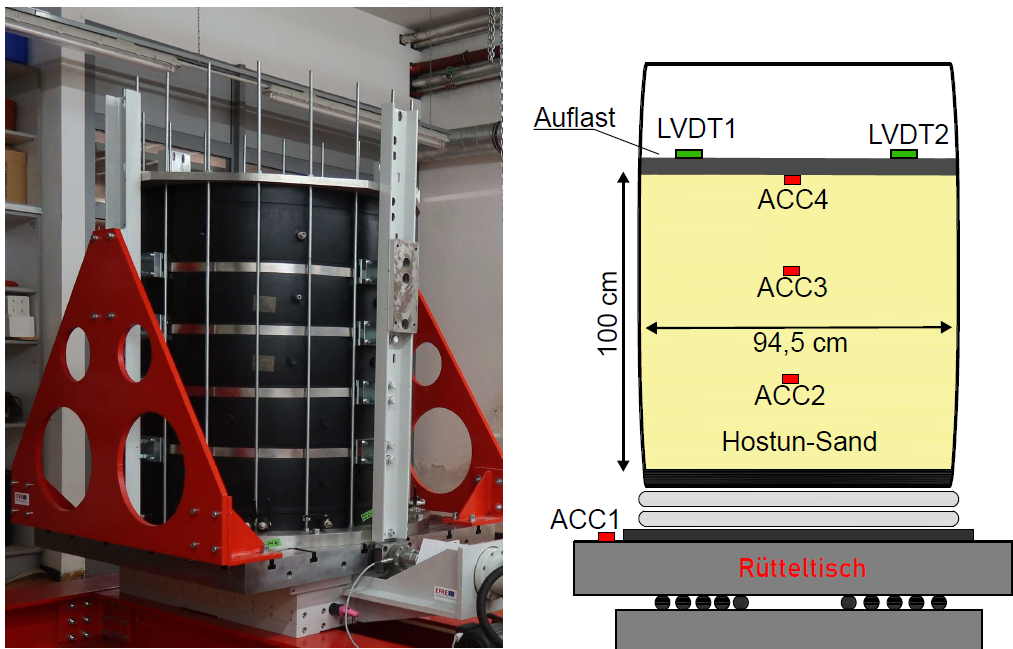
The main focus is on the experimental investigation of vibration-induced soil compaction in order to further develop the HCA model. During the course of the project, model tests will first be conducted on a shaking table to measure the settlement and compaction of sand under various scenarios. Since the internal deformations of the soil cannot be measured throughout its entire volume, these experiments will be numerically simulated in the next step using finite element (FE) software. The resulting three-dimensional strain distributions will then form the basis for laboratory investigations in cyclic triaxial tests under quasi-static conditions to examine the transferability between shaking table and triaxial tests. The material data obtained from these tests will be used to calibrate the high-cycle accumulation (HCA) model. The calibrated model will ultimately be used to numerically simulate the initial shaking table tests and evaluate how actual long-term settlements under complex vibrations can be predicted.
The calibrated model will ultimately be used to numerically simulate the original shaking table tests in the finite element software numgeo and to evaluate how actual long-term settlements under complex dynamic vibrations can be predicted.