
New publication in collaboration with the University of Bristol
In collaboration with the University of Bristol and the University of Melbourne, a new article has been published. It introduces a reproducible, hydro-mechanically coupled CEL (Coupled Eulerian-Lagrangian) framework to realistically simulate large deformations in water-saturated soils.
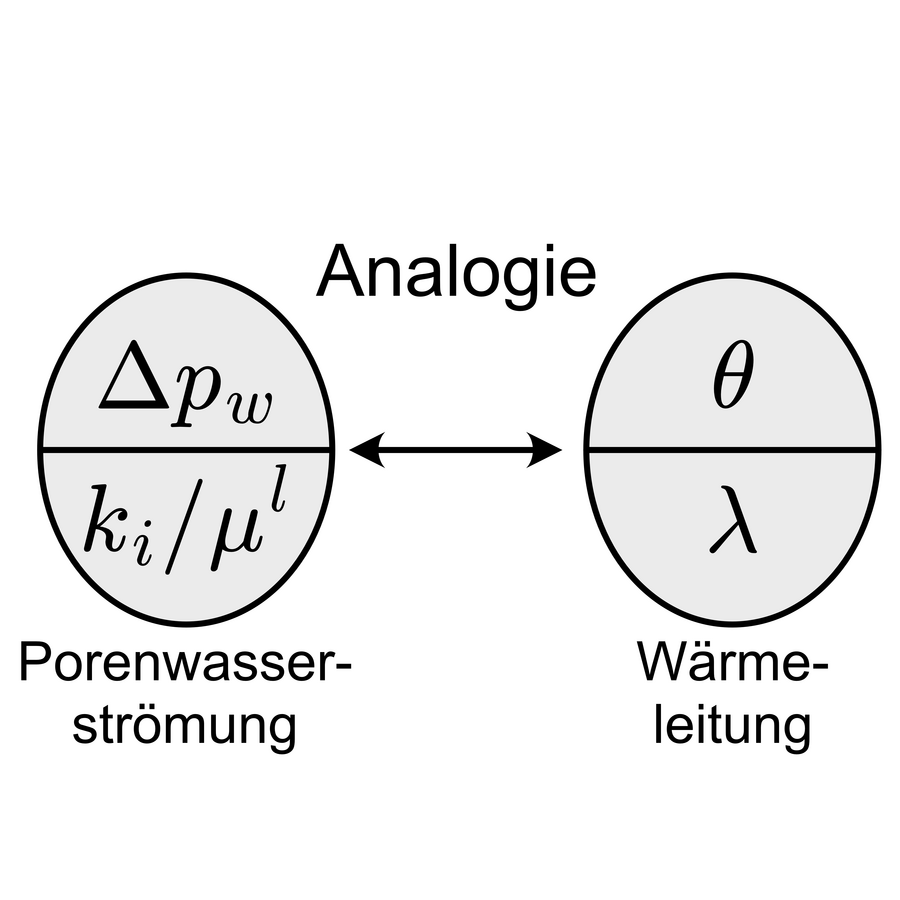
In the newly published article, the authors present an extension of the CEL method, specifically developed for the analysis of large deformations in water-saturated soils. Since conventional numerical approaches from structural mechanics often do not allow for direct calculations of pore water pressure in complex scenarios, the approach relies on a physical analogy between heat conduction and fluid flow. Consequently, the calculated temperature acts as a proxy for the resulting changes in pore water pressure. This principle was originally developed for the CEL method in Abaqus/Explicit by Harman et al. (2015) and subsequently systematically expanded by Staubach et al. (2020, 2021). Building on this foundational work, the advancements in the current publication have been developed into a reproducible framework. This outlines a structured workflow that makes the application of the necessary subroutines and the simulation of hydro-mechanically coupled CEL calculations, in general, more accessible in practice.
To demonstrate the reliability of this workflow, the hydro-mechanically coupled CEL framework was validated using three classic geotechnical examples: one-dimensional Terzaghi consolidation, consolidation under a circular shallow foundation, and Cone Penetration Testing (CPT) in soft clay (Cam-Clay) and dense sand (hypoplasticity). In all three cases, the numerical calculations showed excellent agreement with established analytical solutions and experimental data. The results demonstrate that the model can accurately capture both simple consolidation processes and complex, large-scale soil deformations. Thus, the publication provides a practical guide for simulating challenging soil-structure interactions where pore water pressure plays a crucial role in saturated systems.
The article is freely available at this link.