


Former student assistants
PhD students
Clara Sofia Fernández Rodriguez // Bio-digital fabrication with fungal mycelium in the context of speculative-feminist spatial practice
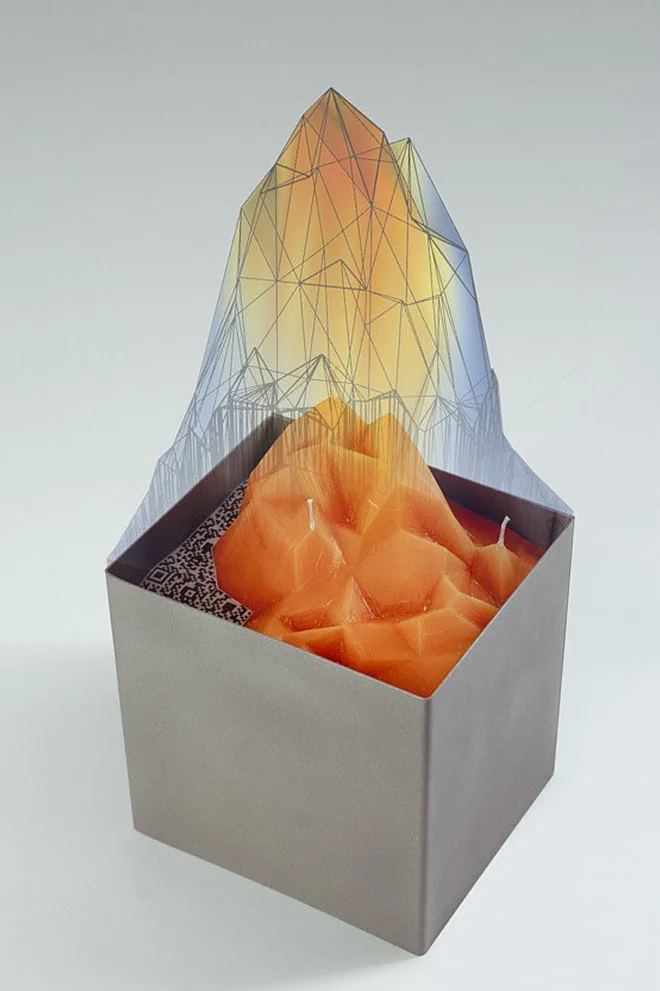
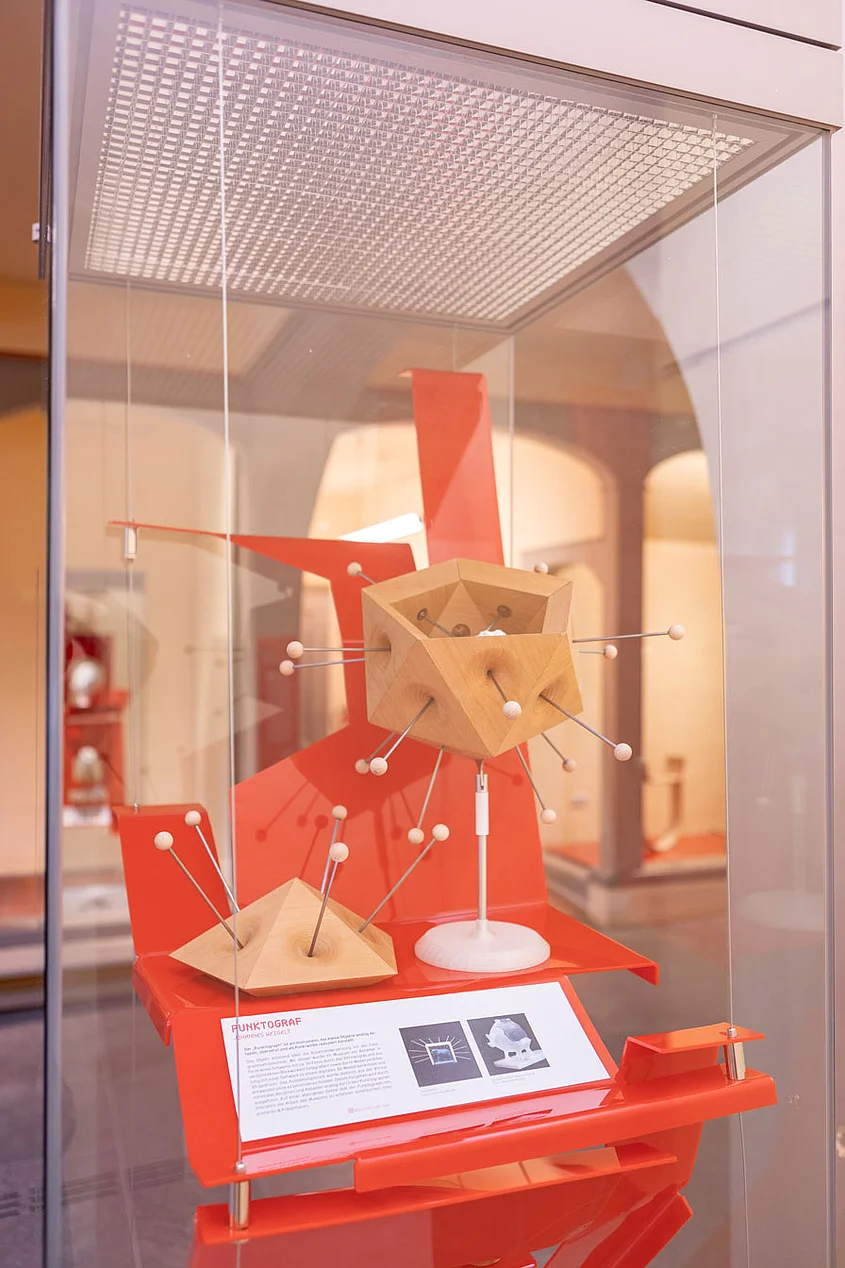
Martin Schmidt // Photoplastesis: On the Construction of a Parametric Camera for the Observation and Materialization of Point Clouds
Maren Klamser // Design for the Anthropocene: The Potential of Anthropogenic Materials with Special Consideration of Urban Mining Principles Using the Example of High-Quality Recycling of Brick and Masonry Debris
Franz Dietrich // Between Control and Aesthetics: Investigation of the Digital-Material Processuality of Textile Artifacts Using 3D Knitting Data Generation and Especially Hybrid Graph-Based (HGB) Methods
Applications for PhD positions are welcomed. Fields of research: digital fabrication, experimental design, material innovation, design through/for digital capture, design for performance, architectural prototyping, speculative design historiographies
Adjunct Lecturers and former staff members
M.Sc. M.f.A. Katharina Thurow
Artistic Associate
Dipl.-Des. Timm Burkhardt
Lecturer and Artistic Research Associate
timmburkhardt.com
Paula Strunden
Extended Reality Design
https://paulastrunden.com/
Sofia Fernandez
Parametric Design
https://www.uni-weimar.de/index.php?id=70086
Viviana Defazio
Performance
https://zkm.de/en/person/viviana-defazio
William Victor Camilleri
Design for Fabrication
E-Mail: w.v.camilleri[at]ucl.ac.uk
WiSe 24 Projekt // IrreguLAB Y. Tree Fork Structures from Furniture to Spaceframe
WiSe 24 Projekt // IrreguLAB Y. Tree Fork Structures from Furniture to Spaceframe
How can we transform "worthless" residual materials from wood processing into valuable, resource-efficient, effective, and attractive material systems and prototypes for design and architecture? To answer this question, irreguLAB puts to work technology, collaboration, experimentation, and, not least, a keen sense of design.
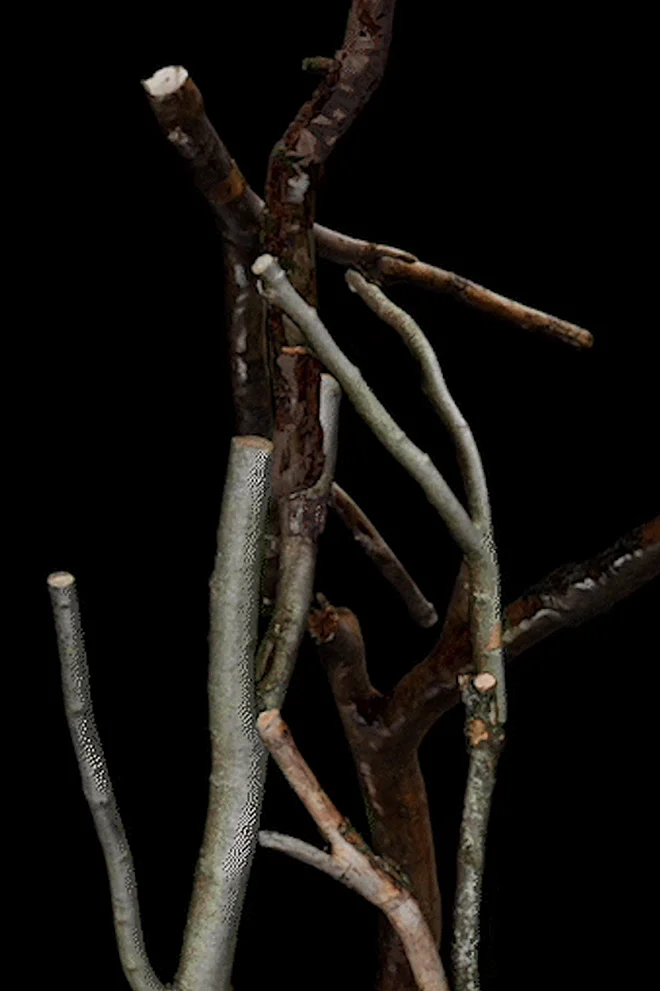
After working exclusively with crooked timbers in the last semester's project "irreguLAB I," this semester, an interdisciplinary team of students and staff from the faculty of Art and Design and the faculty of Architecture and Urbanism is dedicating itself to the next specific case: the tree fork, or the "Y." The aim is to design furniture and spatial structures as three-dimensional networks made from tree forks.
The project begins with an intensive, collaborative, three-week preliminary exercise, during which a table formed as a network of forks is planned and built. Design and technology workflows (scanning, modeling, simulation, fabrication) are learned in a rapid and playful manner. Initial experiments with digital fabrication are also conducted. Special emphasis is placed on learning skills in modeling (Rhino Sub-D, Fusion), programming (Grasshopper), and digital fabrication, as well as integrating these into "Design for Fabrication." These skills enable us not just to obediently follow what is found but rather to develop an independent, contemporary, and innovative design language with an experimental flair, one that can engage in dialogue with the found geometries and materials.
In the main task, students develop their own furniture designs and corresponding topological fork networks. The typology and scale of these designs (whether a stool, chair, table, shelving system, coat rack, partition wall, etc.) are left open. The scalability of such a topological approach ("Can the shelf or table be reimagined as a three-story building or a space frame?") adds a particular appeal. Short, workshop-like explorations at model scale alternate with longer, intensive trials of their full-scale, digitally-materialized implementation.
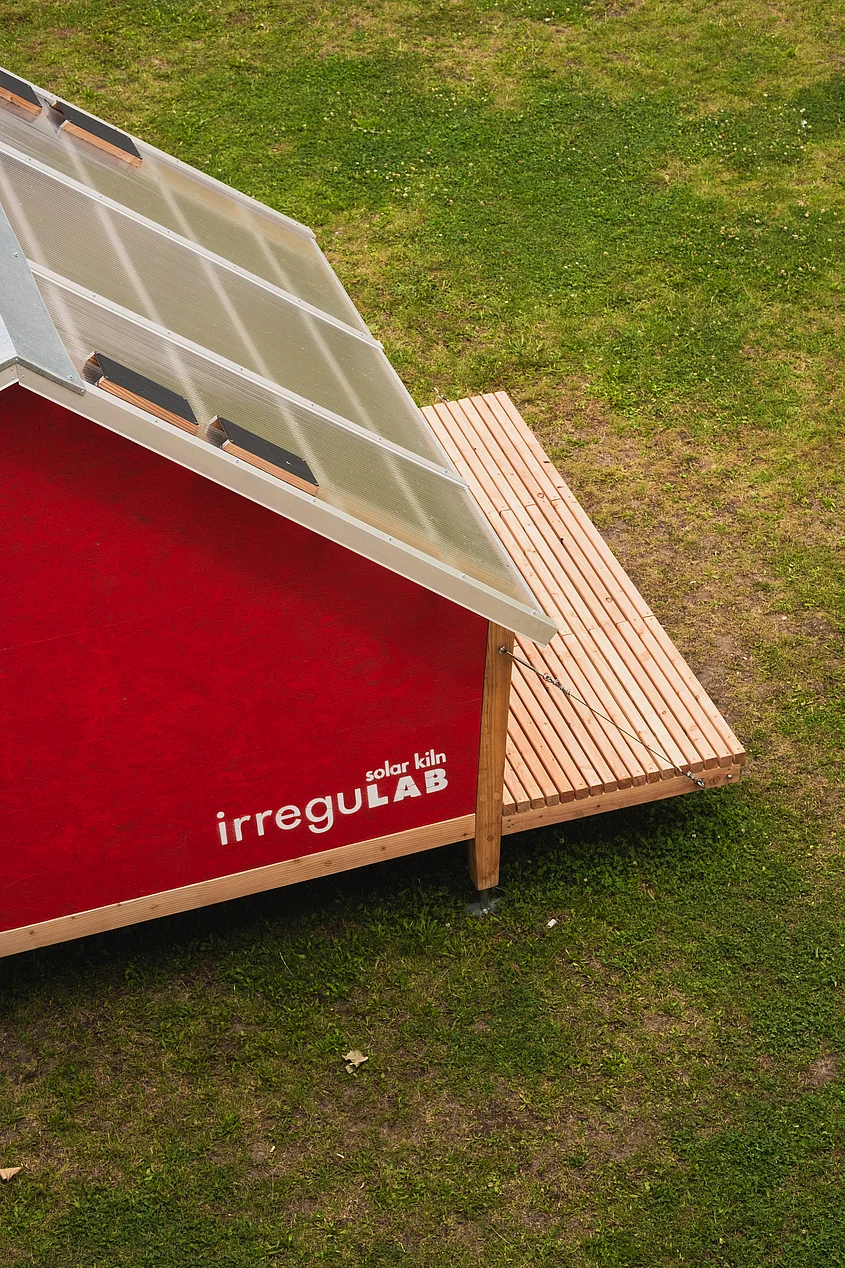
The project builds on the established infrastructure of irreguLAB: the forks are digitized through 3D scanning and cataloged in a shared database, which can be parametrically queried and is directly connected with non-standardized design workflows. The collected wood is debarked under high pressure and dried in a solar kiln on campus. The designs are implemented iteratively, prototypically, and in real scale, using multiple fabrication technologies. In addition to CNC milling, workflows are developed that intelligently materialize digital geometries and logics using analog tools. This includes the digital fabrication of templates, while simultaneously exploring, in a seminar attached to the project (Kirschnick & Su Ko: "Augmented Reality Assisted Woodworking"), the possibility of AR fabrication with a specially developed hand bandsaw device. The bottom line: it will be digital, it will be experimental, and it will be workshop-intensive!
The project is conceived in the spirit of research-based teaching and builds on the work of other researchers in the field of sustainable and digital-material design and architecture, who have advanced the idea of "inventory-constrained design" over the past decade, specifically using tree forks, such as LIMB (Michigan), Conceptual Joining (Vienna Academy), and Hooke Park (AA, London). Some of these design researchers, along with artists and wood historians, have been invited to give talks as part of the "irreguLAB Talks" series.
irreguLAB Y is the fourth in a series of projects, seminars, and specialist courses under the umbrella of irreguLAB, a teaching lab funded by the Foundation for Innovation in University Teaching, focused on digital design and fabrication using irregular materials.
WiSe 24 Fachkurs // Digital-materielle Oberflächen - Einzelansicht
WiSe 24 Fachkurs // Digital-materielle Oberflächen - Einzelansicht
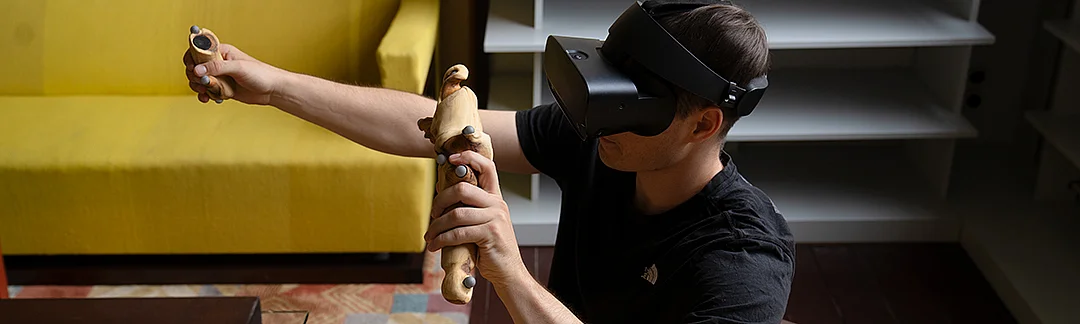
Designing and producing objects increasingly entails digital tools and processes. In this Skills Course, we will zoom in and ask ourselves how the presence of the digital can manifest in material surface design. We will operate at the interface of digital-material design.
By activating surfaces and allowing them to narrate, we will take on an experimental approach. How are textures created through manufacturing processes?
Which textures are inherent in the material? We will get to know analogue and digital tools and their combinations: CNC mill, Grasshopper, shaper tool, band saw, AR headset and hand tools,…
Our explorations will be collected and made accessible as collaborative library.
The Fachkurs supports the project module „irreguLAB Y. Tree Fork Structures from Furniture to Spaceframe”, so we will be working with wood.
SoSe 24 Projekt // IrreguLab 1: Non-Standard Seriality for Toddler Seating
SoSe 24 Projekt // IrreguLab 1: Non-Standard Seriality for Toddler Seating
Nowadays, a new generation of designers, driven by the need for circularity and resource efficiency, is exploring the incorporation of the „as-found“ in their design and making processes. However, the as-found needs a system. Emerging tools now allow us to digitize, systematize, and make accessible found components, materials, and resources for designers. The concept of „inventory-constrained design“ reflects the growing importance of sustainable design and contributes to reducing the environmental impact of design processes.
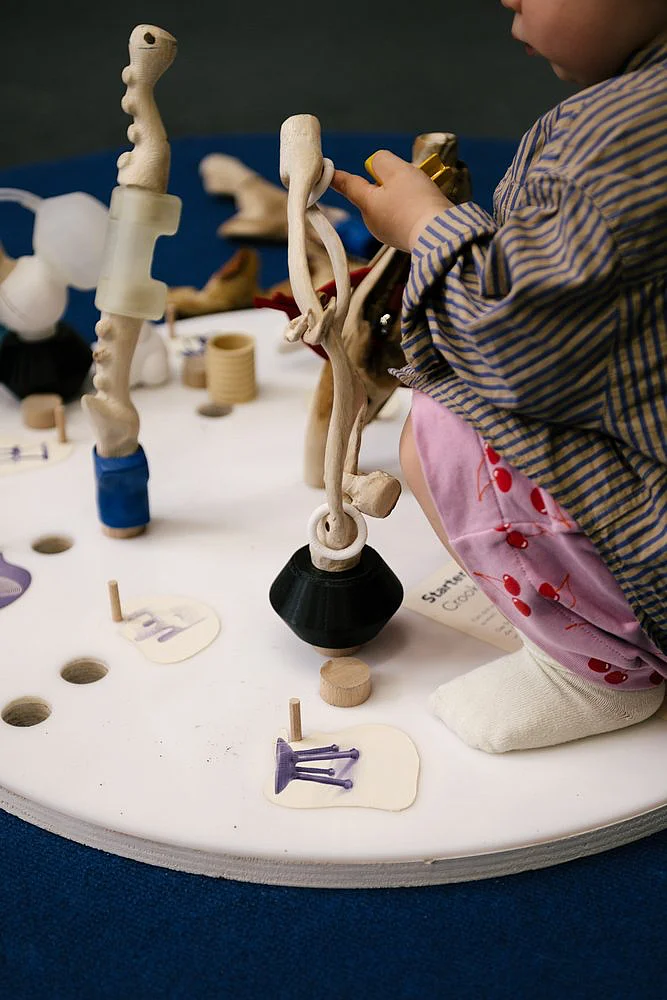
The "Crooked Playroom", showcased here, was the first in a series of projects within irreguLAB, a transdisciplinary and inter-faculty teaching lab for digital design and fabrication with irregular materials, funded by the Foundation for Innovation in University Teaching (StIL). In this project, we developed and implemented designs for children‘s furniture and toys, experimenting with logics and workflows that transform „worthless“ crooked wood into high-quality designs. The crooked oak pieces (storm damage wood from the local Webicht forest) was dried in an on-campus solar kiln (presented directly in front of this studio), scanned using 3D scanning, and inventoried in a shared database. We used this database ourselves as test users by matching and pairing our designs with its components. The term „non-standard seriality“ mentioned in the title hence refers less to tailoring towards user needs (as often seen in the discourse on mass customization) and more to designing with non-standardized materials, developing designs and workflows that incorporate this natural variability and even leverage it.
About the users: children are fascinating, but above all, they are small. By defining the (half-size) users, our scale of working, our material quantities, drying and processing time, etc., remained manageable (according to the logic (½)3=1/8). This allowed us to engage in experimental and iterative development through (digital-material) prototyping. Special emphasis was placed on learning skills in modeling (Rhino Sub-D, Fusion), programming (Grasshopper), and digital fabrication (CNC, Augmented Fabrication, Rapid Prototyping), as well as integrating them into „Design for Fabrication.“ These skills enable us to not obediently follow the as-found but, rather, to experimentally develop our own contemporary and innovative design language that can engage in a productive dialogue with the existing.
Lecturers: jun. Prof. Dr. Thomas Pearce, MA Mira Müller
SoSe 24 Fachkurs // ABUB
SoSe 24 Fachkurs // ABUB
In this specialized course, we focused on bending various materials – from PVC and metal pipes to wood lamination and sheet metal bending. We learned to understand and assess the unique characteristics of each material. A wide range of tools was used, both digital and analog: press brakes, clamps, Hololens for real-time visualization, CNC milling machines for mold making, NC bending machines for metal pipes, and 3D scanning for analysis.
The course was designed to be very practical and experimental. We tried out many techniques, tested limits, and bent materials to the extreme. In doing so, we collectively gathered and deepened our knowledge. In addition to the objects and investigations that were created, the students also offer workshops to make various bending techniques accessible to visitors.
Lecturers: BA Philipp Enzmann, MA Mira Müller
WiSe23 Projekt // Doubles. Fabricating the Mixed Real
WiSe23 Projekt // Doubles. Fabricating the Mixed Real
This project technologically, conceptually and above all creatively explores the idea of the "double”, diving deep into the world of doppelgängers, copies, fakes, reflections, twins, reuses, shadow images, skeuomorphisms, data decay and avatars. The aim is to test the emerging potentials of augmented and mixed reality (AR and XR) for designers: firstly for the design process, but also for the (digital and/or analog) manufacturing process and the use of products in the age of their technological reproducibility and variability.
The semester will kick off with lectures (e.g. by Paula Strunden) on the topic and an excursion to several "doubles" in and around Weimar. In a first task, you will immediately get hands-on by designing and producing "shifted doubles": existing objects and furniture from the excursion that will be reinvented, varied, or deconstructed using the “wrong” material and/or manufacturing method. In a second phase, the "Digital Doubles" are introduced: digital models that enter into dialogue with physical artifacts as optically superimposed manufacturing instructions, as parallel worlds to be manipulated, or as visualized extensions of a physical fragment.
"Doubles" is accompanied by two project-integrated workshops: "Low-Threshold Grasshopper for Designers" (Sofia Fernandez) and "Accessible Robotic Filming and Fabrication" (Michael Braun). In addition, it will be flanked during the first half of the semester by the skills module "Mixed Reality for Designers" (using the Rhino plugin Fologram, among others) and theoretically underpinned and reflected throughout the semester in the theory module "Computerized Materialization 2.0: Paradigms, Processes and Practices”.
Lecturers: Jun.-Prof. Dr. Thomas Pearce, Philipp Enzmann
WiSe23 Fachkurs // Mixed Reality für Designer*innen
WiSe23 Fachkurs // Nutzlose Wunsch-Maschinen - Das elektronische Fest
WiSe23 Fachkurs // Nutzlose Wunsch-Maschinen - Das elektronische Fest
A festival is a total work of art in which design, graphics, art, light, music, fashion and performance are combined in a unique way and which offers the opportunity to try out new experimental design ideas and concepts without constraint. Design does not have to be limited to the creation of things, but can also be the creation of a moment in which one forgets time and loses oneself in sound, light and movement.
The historic Bauhaus is known for its innovative approaches to art and design. The Lantern Festival, the Dragon Festival, the White Festival and the Metallic Festival were experimental and avant-garde in their use of materials, light, sound and movement, as well as absurd and humorous in relation to social developments of the time.
The aim of this course is to build, to realise one's own idea for an interactive party machine. This can be light sculptures, projections, costumes (electronic wearables), electronic musical instruments, inflatables, fog holograms or automata of all kinds.
The presentation becomes a party: an electronic celebration.
Lecturer: Dipl.-Des. Timm Burkhardt
WiSe23 Workshop // Dancing with Avatars: Shaping a Common Body in Virtual Reality
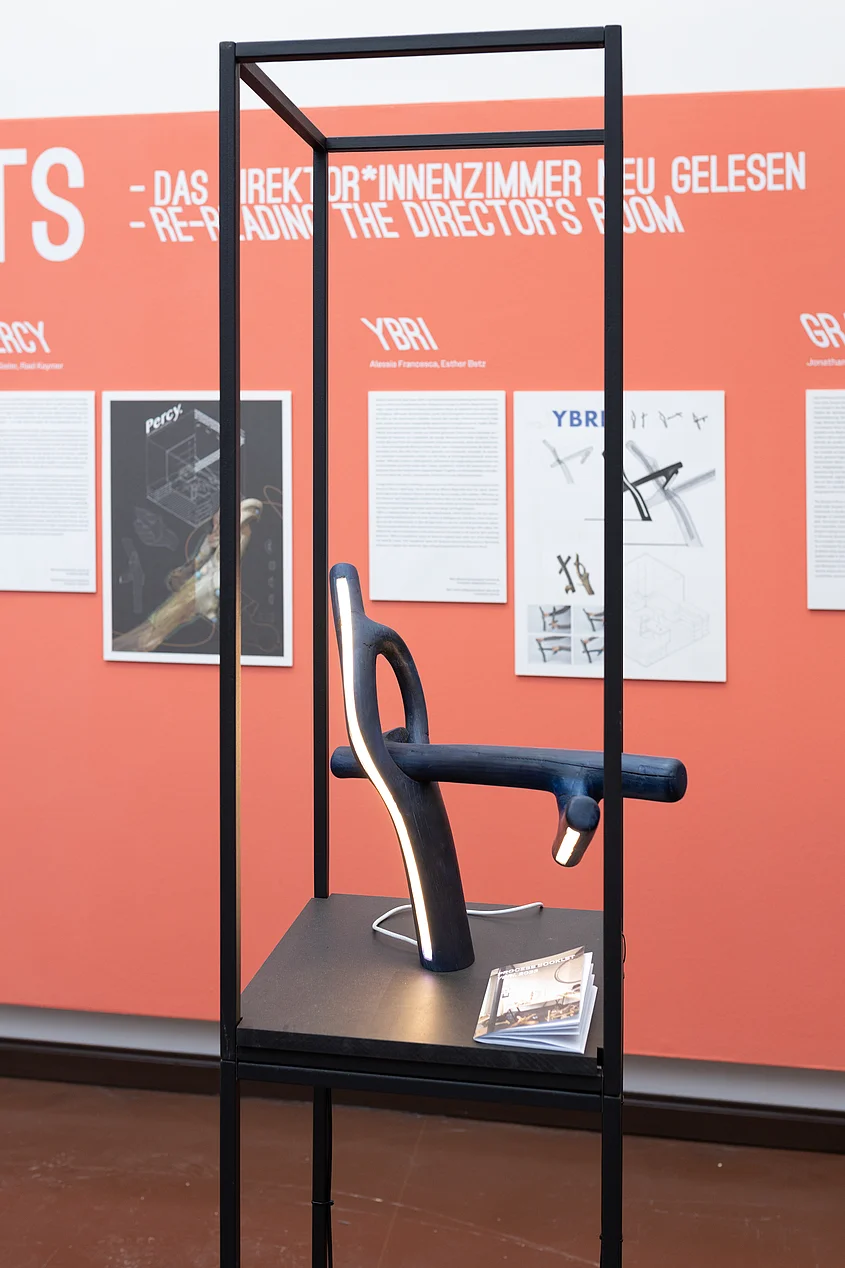
SoSe23 Projekt // Misfits
SoSe23 Projekt // Misfits
Misfit
noun
1. something that does not fit or fits badly
2. a person not suited in behaviour or attitude to a particular social environment
The project ´Misfits´ uses emergent technologies of capture and fabrication to revalue hardwood timber components normally deemed worthless by the timber industry: tree forks, inosculations, crooked, irregular and infested parts of trees. The project bypasses the industrialized processing and standardization of timber, instead regarding the idiosyncrasies of misfit timbers as design opportunities.
The idea of ´Misfits” isn’t just understood in a material, but also in a conceptual manner: students were asked to disobediently and speculatively challenge inherited categories such as ´furniture” and ´product”. The starting point for this was a collective, critical and contemporary re-invention of the Bauhaus’ Direktor*innenzimmer: how do we challenge 100 years of musealization? This formed the basis for the development of the students’ individual and group projects. Our mode of operation: prototyping; our ethos: provocation through precision.
The project was accompanied by a series of excursions: a guided tour by the local forester, a trip to the largest hardwood timber processing plant in Thuringia and, of course, a visit of the Direktor*innenzimmer. It was technically flanked by the skills module ‘A Mill an‘ Toys - Creative Problem solving for CNC machining’ and theoretically framed by the integrated seminar ‘Computerized Materialization’.
Lecturers: Jun.-Prof. Dr. Thomas Pearce, Philipp Enzmann
SoSe23 Fachkurs // A Mill an‘ Toys – Kreative Problemlösungen an der CNC-Fräse
SoSe23 Fachkurs // A Mill an‘ Toys – Kreative Problemlösungen an der CNC-Fräse
The specialist course "A Mill An' Toys" introduced the students to designing for the CNC milling machine in a playful way. For this purpose, design prints were made for which exemplary milling paths were then created. In the process, the students learned to produce their designs with the help of the Stepcraft M.700 CNC milling machine. The world of toys served as the design framework: from baby teething rings to sex toys, everything was allowed. In the course of the semester, the students initially approached this context by creating flat contours in order to later transfer the logic behind them to three-dimensional objects. In particular, the focus here was on multi-sided machining and the design of specialised holding devices for the development of these toys.
The learned knowledge about these processes was transferred to the project module at the same time in order to support the design processes accordingly.
Lecturer: Philipp Enzmann
SoSe23 Fachkurs // Nutzlose Wunsch-Maschinen - race it break it fix it²
SoSe23 Fachkurs // Nutzlose Wunsch-Maschinen - race it break it fix it²
In this course, simple prototypes of electrically powered vehicles for cargo and passenger transport were designed and built. The emphasis was placed on implementing individual ideas and programming the drive and control components.
To facilitate this, all participants received a kit consisting of a standard 8.5" hoverboard (2x400W motors, battery, electronics), two Arduino microcontrollers, gamepads and Arduino radio modules.
In the first part, everyone had to build a simple radio-controlled functional model capable of carrying a payload of 20 kg. In this part, the design was meant to be determined solely by functionality.
In the second part, a vehicle for passenger transport was constructed based on the insights gained. The focus was on implementing one's own ideas regarding the vehicle's characteristics, including design, driving dynamics and steering.
At the end of each part, a race with all the vehicles was held on campus, with a small award ceremony, champagne and trophies.
The course was conducted in collaboration with Daniel Scheidler from the Chair of Materials and Environment.
Lecturer: Dipl.-Des. Timm Burkhardt
WiSe22 Projekt // Prähistorisch ≈ Postdigital? Spekulative Praktiken und Werkzeuge für »Ongoingness«*
WiSe22 Projekt // Prähistorisch ≈ Postdigital? Spekulative Praktiken und Werkzeuge für »Ongoingness«*
Collaborating with the Thuringian Museum for Pre- and Ancient History (Museum für Ur- und Frühgeschichte Thüringens), the studio ‘Prehistoric ≈ Postdigital?’ explored the fertile tension between the newest of technologies and the oldest of material and ritual practices. In the test tube of our design laboratory, we mixed technological emergence and current desires with lively histories and narratives and probed and developed the results of this reaction as physical prototypes. The Museum’s spaces and collection became an initial catalyst for the development of our own speculative design practices.
Students used technologies like 3D-scanning, digital modelling and simulation, digital fabrication (CNC-machining & 3D-Printing) to rediscover and revive traditional ways of understanding and using materials as “alive”, many of which have been lost through industrialization. The goal was to learn from the past and, especially in the face of resource scarcity and climate emergency, develop future proof approaches to use resources in mindful, sustainable but also imaginative ways.
*Prehistoric: from the era before written accounts. There are no narrations, only finds – giving us all the more space for speculation.
*Post-digital: the digital is in the process of dissolving – it is everywhere, like the air we breathe; the digital as such is not very exciting – more exciting is what we do with it; the digital can be fabricated physically and the physical can be digitized, both nearly instantaneously – what is key is that we learn to navigate the in-between fluently and with ease and to use these constant translations playfully and speculatively.
*Ongoingness/Ongoing: a central concept in Donna Haraway’s more recent techno-feminist writing. It can be understood to mean many things:
- To continue, to follow, to connect, to pick up the threads…: as designers we have to engage with the pre-existing, the inherited (whether positive or negative), the accumulated data set, the slowly grown and the quickly decaying. This is not only an ethical obligation – it is also an invitation to tap into the pre-existing to spark our imagination and inventiveness. It is the opposite of the blank canvas, of the sad grey grid lines of an empty Rhino-file that stares back at us: it is a richly textured point cloud with millions of spatial and colour coordinates, precise and provocative.
- To survive, to continue to exist, to sustain: how do we, as designers, contribute to our survival, the ongoingness of the planet?
- To persist, to be tenacious: how do we keep going, how do we fail better, how do we think in iterations and prototypes?
- To continue, to unfinish: How can we create works that might never be “finished”, that might continue to be productively unfinished, that are active and stay active?
Lecturers: Jun.-Prof. Dr. Thomas Pearce, Dipl.-Des. Timm Burkhardt
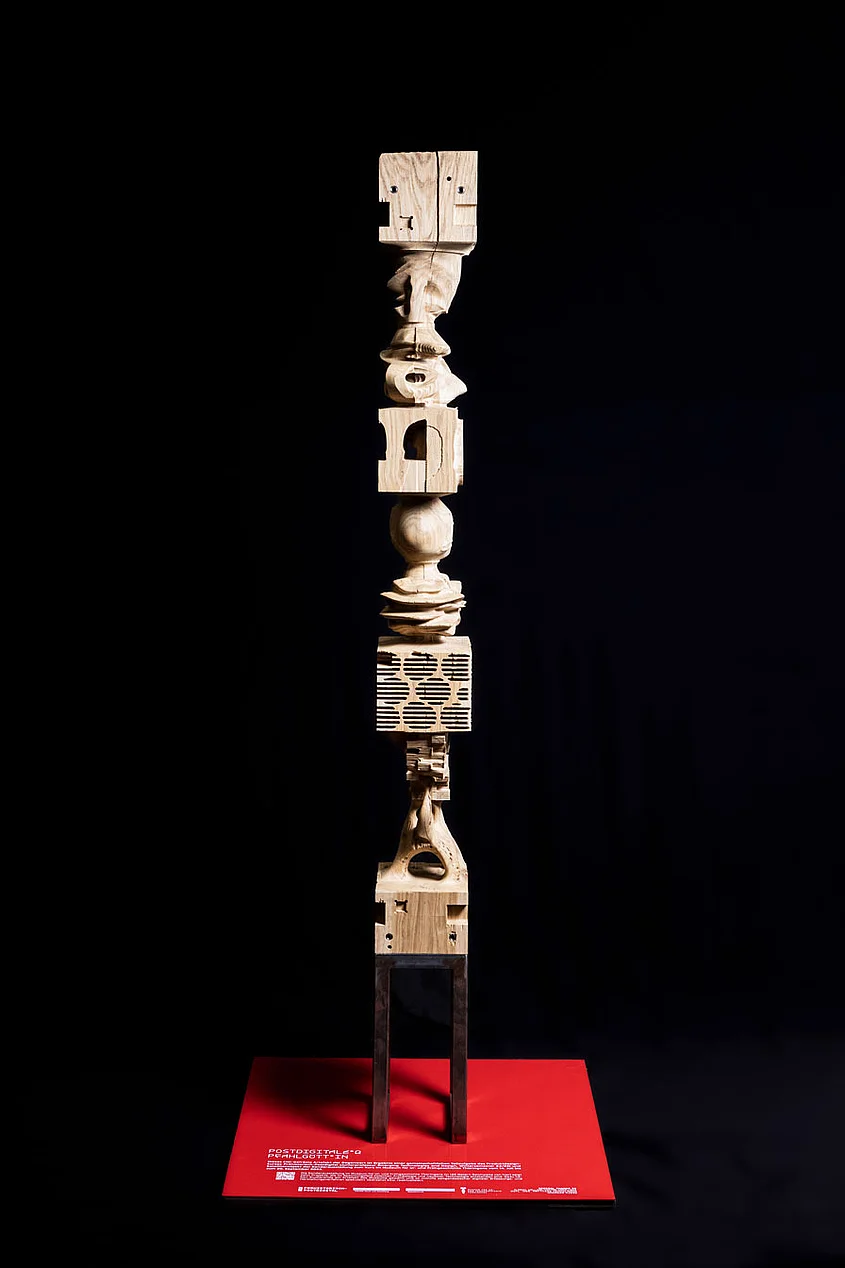
WiSe22 Workshop // Kollaborative CNC Pfahlgött*in
WiSe22 Workshop // Kollaborative CNC Pfahlgött*in
Over the course of two 3-day workshops, students worked on a collaborative, digitally fabricated sculpture made of a reclaimed oak beam. Based on a 3D-Scan of the beam, it was divided in 8 vertical sections, which were assigned to 8 groups of 2 students. These sections were 3d-modelled and simulated (using Rhino, Blender and Fusion 360) by the students, who learnt the ins-and outs (tools, tool libraries, toolpath strategies, …) of CNC-machining, The beam, which is machined from 4 sides is a learning piece for the development of the students’ skills as ‘digital craftspeople’ and fabrication-aware designers.
Lecturer: William Victor Camilleri
WiSe22 Fachkurs // Nutzlose Wunsch-Maschinen - Elegante Interaktionen
WiSe22 Fachkurs // Nutzlose Wunsch-Maschinen - Elegante Interaktionen
In the subject module Nutzlose Wunsch-Maschinen, participants learn about electronics, particularly the programming of microcontrollers and the utilization of sensors and actuators.
During the winter semester, we delved into the theme of Human-Machine Interaction. We acquired the skills to program smooth transitions and fluid movements for lighting and mechanics, as well as haptic feedback.
We pondered over the elegant and intuitive possibilities for interaction, replacing traditional switches and annoying, beeping piezoelectric elements. What kind of feedback could machines provide to humans that is more comprehensible than cryptic error messages and "Please wait" notifications?
In the course, all participants designed and programmed a small machine that responds to human input using Arduino microcontrollers, sensors, and actuators.
Lecturer: Dipl.-Des. Timm Burkhardt