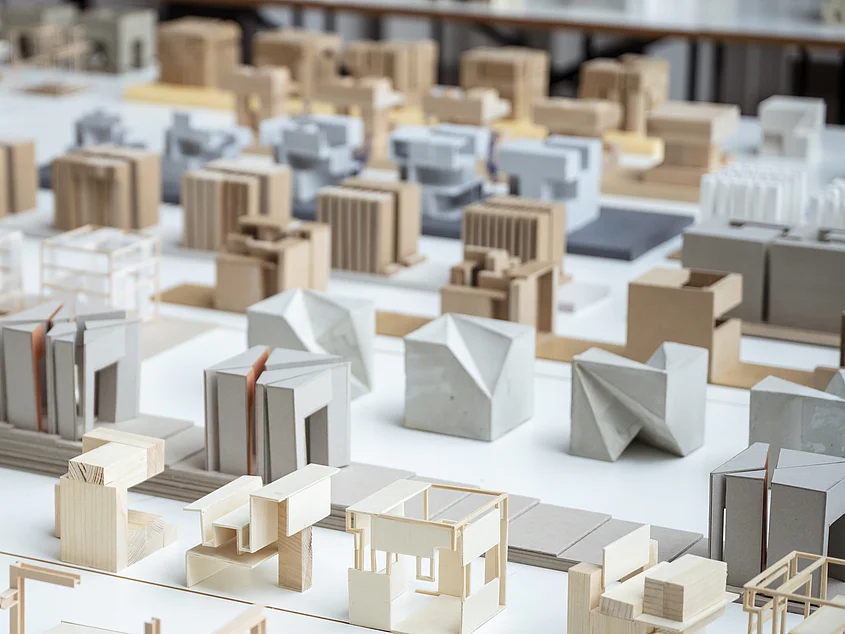
Our two Bachelor's degree courses in Architecture and Urbanism provide you with the basic tools you need to start your career.
The Bachelor of Architecture study course is divided into three successive years that build on each other. After a two-week introductory course in the first semester, all students follow a curriculum that focuses on a specific central theme each year. This is reflected in the content of the core modules:
The first year of study communicates basic design and presentation skills along with the fundamental principles of architectural design. Accompanying lectures provide a basic theoretical foundation for the following two years.
In the second year, design and construction and urban design are the main areas of focus.
In the third year of study, you will study abroad at a partner university. Your final semester project is also your final thesis. You can choose this freely according to your interests from the range offered by all professorships. You will work independently on a project, which can consist of a draft or the theoretical-scientific treatment of a topic.
The standard duration of studies for the undergraduate Bachelor of Architecture study programme is six semesters. After completion and defence of the Bachelor degree, the Faculty of Architecture awards the student the academic degree of »Bachelor of Science« (B. Sc.).
All prospective students must apply for a place in this procedure, even if they wish to transfer from another university to the Bauhaus-Universität Weimar. We will only check whether and which achievements can be credited after we have confirmed a study place.
To gain admission to the bachelor’s degree programme in Architecture, candidates must have a general university entrance qualification or equivalent certificate (e.g. high school diploma, A-levels, etc.). Candidates must also pass a two-part aptitude assessment test administered by the university to ensure that the candidate possesses specific academic skills required for the study of Architecture. In addition to considering the average grade of your university entrance qualification, the admissions board evaluates your creative ability, constructive comprehension, artistic skills and spatial cognition – in short, the admissions board assesses your personal, subject-specific qualification for study.
All interested applicants must apply for a spot in the program by participating in this process, even if they wish to transfer to the Bauhaus-Universität Weimar from another institution. Only after confirmation of admission will the university determine whether and which academic credits can be transferred.
We recommend that applicants complete an architecture-related internship of up to 12 weeks before applying. Such internships have a positive effect on the evaluation of the aptitude assessment test.
Candidates may only apply for enrolment in the winter semester.
Please consider that the B.Sc. Architecture is in German language. A proof of sufficient language proficiency for university study in Germany (DSH-2 or TestDaF TDN 4) will be required.
Please include the following with your application:
All documents (including your solution to the test) have to be handed in digitally via the application platform. Submissions by fax or e-mail are not accepted.
Application deadline
The application deadline for participation in the next aptitude assessment test is July 15 latest, which means all documents have to be handed in completely online via the application platform.
Compensation for disadvantages
Representative for the Needs of Students with Chronic Illnesses and Disabilities: advises students, for example, on personal issues associated with disability, such as lack of motivation, difficulties in social environment or compensation for disadvantages in their studies.
The Bauhaus-Universität Weimar takes into account the special needs of people with health impairments, mental health conditions, or chronic illnesses as early as the application stage for a degree program. These impairments include, for example, ADHD, mobility impairments, chronic physical illnesses (e.g., Crohn’s disease), dyslexia, mental health conditions, or visual, hearing, and speech impairments.
Prospective students with disabilities have the option to apply for accommodations for the admissions assessment process. Accommodations do not mean that applicants receive advantages over other prospective students, but rather they create conditions that offset the disadvantages faced by those with disabilities.
Further information can be found here on the website of the Representative for Chronically Ill and Disabled Students at Bauhaus-Universität Weimar. Questions regarding accommodations will be answered by the Architecture Academic Advising Office. To schedule an appointment, please contact studienberatung[at]archit.uni-weimar.de.
Applications for compensations for the aptitude assessment must be submitted by June 22 at the latest. Your disability must be documented by a medical certificate. You may suggest a specific type of accommodation for the aptitude assessment. The request for accommodation must be submitted in writing and mailed by June 22 at the latest to:
Bauhaus-Universität Weimar
Dean’s Office of the Faculty of Architecture and Urbanism
-Bachelor of Architecture Admissions Process-
99421 Weimar
GERMANY
In addition to the general university entrance qualification, the two-stage aptitude assessment process evaluates your subject-specific aptitude. The subject-specific requirements are met if you achieve a total score of 70 out of a possible 100 points. If you score between 55 and 69 points in the first stage, you will be invited to participate in the second stage.
Part 1
Candidates are only eligible for the aptitude assessment test if all the application documents are complete and submitted on time. Therefore, please apply early! In this first part, candidates are assessed as follows:
If you have scored 70 or more points in the first partm you will directly be admitted. A participation in the second part will not take place in those cases.
Part 2
The second stage of the admissions assessment process will take place on-site in Weimar. You must attend in person. If you successfully complete the first stage, invitations to the second stage will be sent out promptly via email. This will take place on Tuesday, July 28, 2026, on-site in Weimar.
The following will be evaluated:
In special or exceptional cases, a written test assignment may be provided, which must be completed within a specified timeframe and will be sent via email. This also applies to applicants who do not reside in Germany and are unable to travel due to visa issues. In such cases, please contact bewerbung_BSC[at]archit.uni-weimar.de. For questions please contact bewerbung_BSC[at]archit.uni-weimar.de
Details can be found in the Eignungsfeststellungsverfahrensordnung. (Aptitude Assessment Regulations, in German language)
Students may only enrol in the bachelor’s degree programme in Architecture after passing the aptitude assessment test. The assessment results are sent to the candidates fron the end of July onwards. The assessment is valid only for the academic year for which the candidate has applied for enrolment.
If you have passed the aptitude assessment test, please send the following documents to the Student Office:
All documents have to be handed in digitally via the application platform .
Enrolment deadline
The enrolment period ends on 30 September each year. After you have officially enrolled, the Student Office will send you a package of relevant information and study materials. For more information about enrolment, click here.
During your studies for the Bachelor of Science in Architecture, you will learn to draw up architectural designs, concepts and studies. Through practical work in the field and in the context of architectural offices you will gain an insight into the responsibilities of the architect for the environment and society and with respect to history and the client. As part of your studies, you will also learn how to apply your basic knowledge to other fields such as public relations, the social sciences and art.
If you are interested in continuing your education with a more in-depth qualification, your bachelor’s degree enables you to embark on a Master’s degree programme leading to a further or vocational qualification. According to the rules of the German Federal Chamber of Architects, graduates are entitled to enrol in the registry of architects and to bear the professional designation as an architect only after successfully completing a relevant Master’s degree and demonstrating sufficient practical experience (typically two years). An ideal means of obtaining this qualification is to continue your studies with our consecutive Master’s Degree in Architecture.
The study course is predominantly project-based with a strong emphasis on social and planning sciences and the architectural and spatial skills required by town planners. Alongside the planning project, the core module, a mix of parallel compulsory and elective modules communicate a fundamental background in the social sciences, design and planning policy. The study course has three main pillars: a strong basis in the social sciences, the architectural design of the built environment and an international orientation.
The course covers a breadth of topics required for the planning professions. The standard duration of this complex qualification is therefore eight semesters.
The core subject areas introduce students to the dimensions of social action required for practicing in the field and that are essential for relevant academic research:
_ town planning and socio-scientific urban research
_ theory, history and politics of the city and planning
_ urban design, housing and urban conservation
_ economics and technical infrastructure of spatial planning
All coursework is conducted in German. In the sixth semester, students spend a period abroad studying at a partner university or working with a practice partner. Students from abroad can spend this semester studying at another university in Germany.
In addition, before beginning the final thesis, students are required to complete 10 weeks of practical experience in Germany. This period gives students an opportunity to examine the German planning culture first-hand and students are expected to apply what they have learned in projects of their own. We recommend placements with planning authorities at an urban or regional level or comparable institutions as well as in public or non-public planning areas, for example in commercial planning offices, non-government organisations or research institutes.
After completion and defence of the final thesis the Faculty of Architecture awards students the qualification of »Bachelor of Science« (B. Sc.). This eight semesterqualification is recognised by the German Federal Chamber of Architects and entitles the holder, on completion of a necessary period in professional practice as a town planner, to officially enrol in the registry of architects.
Bewerbung zur Eignungsfeststellung
Wenn Sie Interesse an grundlegenden Fragestellungen und am Erwerb von Kenntnissen zur öffentlichen Steuerung der Stadtentwicklung, an der Entwicklung neuer Formate und sinnvoller, wie innovativer Instrumente der Stadt- und Raumplanung haben, dann erfüllen Sie beste Voraussetzungen für ein erfolgreiches Bachelor- Studium bei uns.
Voraussetzungen
Voraussetzung für den Bachelor-Studiengang Urbanistik ist neben der Allgemeinen Hochschulreife die erfolgreiche Teilnahme an der Eignungsfeststellungsprüfung. Die Teilnahme am Eignungsverfahren setzte eine Online-Bewerbung voraus.
So können Sie sich Bewerben:
Vorgehen:
1. Bitte füllen Sie das Interview und Online-Bewerbungsformular aus.
2. Bitte laden Sie dann die im Programm nötigen Unterlagen hoch:
Bitte beachten Sie, dass die Unterlagen ausschließlich digital über das Portal einzureichen sind. Eine Bewerbung per Telefax und E-Mail ist nicht zulässig.
Die Bewerbungsunterlagen werden nach dem „Absenden“ im Online Portal geprüft. Nach erfolgreicher Prüfung der Unterlagen wird die Einladung zum Eignungsgespräch über das Onlineportal versandt. Je nach Bewerbungseingang, kann die Einladung sehr kurzfristig erfolgen, daher ist eine rechtzeitige Bewerbung sinnvoll.
Für die Teilnahme am Test und dem Gespräch ist persönliches Erscheinen an der Fakultät Architektur und Urbanistik Voraussetzung.
Bewerbungsbeginn
ist der 01.04.2026
Die Teilnahme setzt eine persönliche Einladung voraus.
Bewerbungsschluss
ist der 15. Juli des Jahres
Ausstehende Leistungsnachweise sind kein Hinderungsgrund für die Bewerbung
Eignungsgespräche
Die Eignungsfeststellungsgespräche für den Bachelor Urbanistik im Institut für Europäische Urbanistik, voraussichtlich im Zeitraum vom 15. bis 17. Juli 2026, statt. Termin wird noch bekannt gegeben.
Immatrikulation
Die Immatrikulation im Studiengang Urbanistik kann erst erfolgen, wenn die Eignungsfeststellung erfolgreich absolviert wurde. Die Eignungsbescheide werden zeitnah nach dem Eignungsgespräch verschickt.
Die Immatrikulationsfrist endet am 30. September. Informationen zur Immatrikulation finden Sie hier.
Die Eignungsbescheide sind insgesamt für 2 akademische Jahre gültig: für das Studienjahr Ihrer Bewerbung und für das darauf folgende Studienjahr.
Studienbeginn
nur zum jeweiligen Wintersemester.
Nachteilsausgleich
Die Bauhaus-Universität Weimar berücksichtig die besonderen Bedürfnisse von Menschen mit gesundheitlichen Beeinträchtigungen, einer psychischen oder einer chronischen Erkrankung bereits bei der Bewerbung auf einen Studiengang. Zu diesen Beeinträchtigungen gehören z.B. AD(H)S, Bewegungsbeeinträchtigungen, chronische körperliche Erkrankungen (z.B. Morbus Crohn), Legasthenie, psychische Erkrankungen oder Seh-, Hör- und Sprechbeeinträchtigungen.
Beeinträchtigte Studieninteressierte haben die Möglichkeit, einen Nachteilsausgleich für das Eignungsfeststellungsverfahren zu beantragen. Ein Nachteilsausgleich bedeutet nicht, dass die Antragstellenden Vorteile gegenüber anderen Studieninteressierten erhalten, sondern er schafft Bedingungen, welche die Nachteile, die für Beeinträchtige bestehen, ausgleichen.
Wenn Sie einen Antrag auf einen Nachteilsausgleich stellen möchten, beachten Sie bitte Folgendes: Anträge auf einen Nachteilsausgleich für das Eignungsfeststellungsverfahren sind spätestens zum 22. Juni einzureichen. Ihre Beeinträchtigung ist glaubhaft zu machen, hierzu wird meist ein ärztliches Attest oder in begründeten Einzelfällen ein amtsärztliches Attest verlangt. Sie können eine bestimmte Form des Ausgleichs für das Eignungsfeststellungsverfahren vorschlagen. Den Antrag auf Nachteilsausgleich stellen Sie bitte schriftlich, die Entscheidung dazu wird Ihnen schriftlich mitgeteilt.
Weitere Informationen zum Nachteilsausgleich finden Sie auf der Webseite der Beauftragten für chronisch kranke und behinderte Studierende der Bauhaus-Universität: www.uni-weimar.de/de/universitaet/studium/beratungsmoeglichkeiten/studieren-mit-beeintraechtigung/ . Fragen zum Nachteilsausgleich beantwortet Ihnen die Fachstudienberatung oder die Beauftragte für chronisch kranke und behinderte Studierende.
Der Antrag auf Nachteilsausgleich ist bis spätestens 22. Juni per Post zu schicken an:
Bauhaus-Universität Weimar
Fakultät Fakultät Architektur und Urbanistik
Institut für Europäische Urbanistik
D-99421 Weimar (Germany)
As a study course with practical project-oriented and research-oriented components, the Bachelor of Science in Urban Planning degree course qualifies graduates to work in municipal and federal government authorities and other research institutions as experts for the spatial dimension of planning and development.
Public town planning has been instrumental in creating the conditions for an enormous increase in the standard and quality of life in many countries, especially in the second half of the 20th century, and today places new demands on the analysis and planning of spatial transformations. As a consequence the field of work both in professional practice as well as in research are changing continually.
Graduates of the Urban Planning course often go on to work as town planners in public administration, for example with municipal, regional or national planning authorities. They also work in private planning offices, in private companies, social organisations and policy consultancy agencies. A further field of work is in research, either in conjunction with an academic teaching position or in one of the many research institutes. International organisations are also increasingly seeking professional graduates with a background in Urban Studies.

Click the Play button to load and view external content from Vimeo.com.
Automatically load and view external content from Vimeo.com (You can change this setting at any time via our »Data protection policy«.)
|
Study programme |
Degree |
standard duration |
Application procedure |
Application deadline |
|---|---|---|---|---|
|
Bachelor Architecture |
Bachelor of Science (B. Sc.) |
6 |
aptitude assessment test |
only winter semester: 31 July 2022 |
|
Bachelor Urban Planning |
Bachelor of Science (B. Sc.) |
8 |
aptitude assessment test |
only winter semester: 15 July |

Click the Play button to load and view external content from Vimeo.com.
Automatically load and view external content from Vimeo.com (You can change this setting at any time via our »Data protection policy«.)

Click the Play button to load and view external content from Vimeo.com.
Automatically load and view external content from Vimeo.com (You can change this setting at any time via our »Data protection policy«.)
Changes from color to monochrome mode
contrast active
contrast not active
Changes the background color from white to black
Darkmode active
Darkmode not active
Elements in focus are visually enhanced by an black underlay, while the font is whitened
Feedback active
Feedback not active
Halts animations on the page
Animations active
Animations not active