

Projektbeschreibung
In recent years wireless sensor networks (WSN) have gained increasing interest in structural health monitoring due to the rapid advancements in wireless technologies and low-power electronics. The specialty of wireless systems is their ability to monitor structures and machines continuously without the need for associated installation costs of wiring. However, powering WSN using the traditional limited-life batteries, which need regular replacement, can lead to large maintenance costs, particularly for extensive network systems. Due to the continuous reduction in the power requirements of WSN, which is in many cases in the range of a few milliwatts (mW), self-powering the sensors alternatively using small-scale energy harvesters has gained growing research attention.
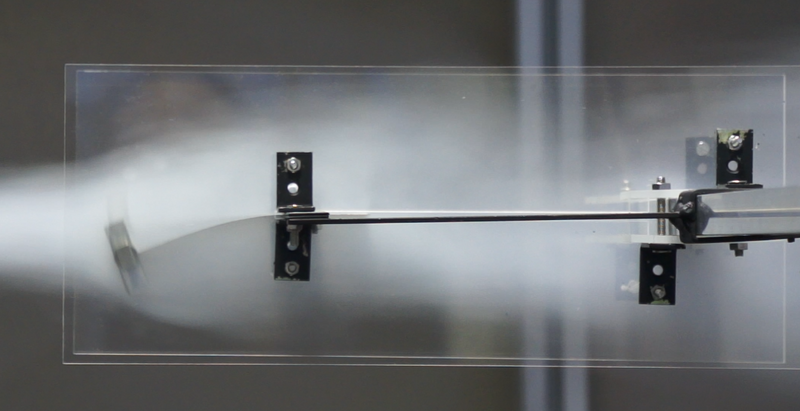
Wind energy offers a source of mechanical vibration for small-scale energy harvesting. Structural systems under wind loading may experience large amplitude limit cycle oscillations (LCO) due to the aerodynamic phenomena such as galloping and flutter. Flutter is a dynamic instability phenomenon of an elastic structure which is potentially destructive and caused by so-called self-excited aerodynamic forces. Such vibrations can be used as an efficient input source for small-scale energy harvesting. Under the vibration of an intelligent structural system, it is possible to convert the mechanical vibration into electrical power using an electromagnetic transducer. The energy harvesting mechanism from an aerodynamically unstable system like T-shaped cantilever beam is presented schematically in the Figure which shows the proposed configuration of the coils and magnets. At or above the critical flutter wind speed, the cantilever system starts vibrating in an unstable fashion, causes a relative movement between magnets and coils, and thus induces current flow through the circuit, c.f. Figure.
The project is concerned with a two-dimensional fully coupled fluid--structure interaction model for simulating aeroelastic instabilities to evaluate and optimize the performance of flutter-based electromagnetic energy harvesters. The flutter-type unstable vibration of T-shaped cantilever systems is investigated as a driving mechanism for small-scale energy conversion. Flow solver based on the Vortex Particle Method and structural solver based on a corotational finite element formulation is coupled in order to accurately account for the geometrically nonlinear effects of such very flexible elements. A reference harvester is simulated considering the damping effects arising from the electromagnetic transducer. The estimated flutter wind speed and the predicted energy outputs under different electrical resistances are found to agree reasonably well with reference wind tunnel experiments. The influence of physical parameters such as length, thickness, and cantilever tip height on the performance of the harvester are investigated up to an envelope volume of 42 cm3 The maximum power output is found to be 5.3 mW at 8 m/s. The optimized harvester shows a better performance under low wind speeds by producing 0.65 mW at 4 m/s where the reference harvester produced no power.
The interest still exists to study the performance of the flutter-based harvester at different inflow condition such as the low frequency pulsating wind flow. An experimental model is also prepared for further investigation on the system in the wind tunnel.
Projektdaten

Projektträger:
The project was sponsored by the Post Graduate Funding Program from the Free State of Thuringia 2014-2016.