
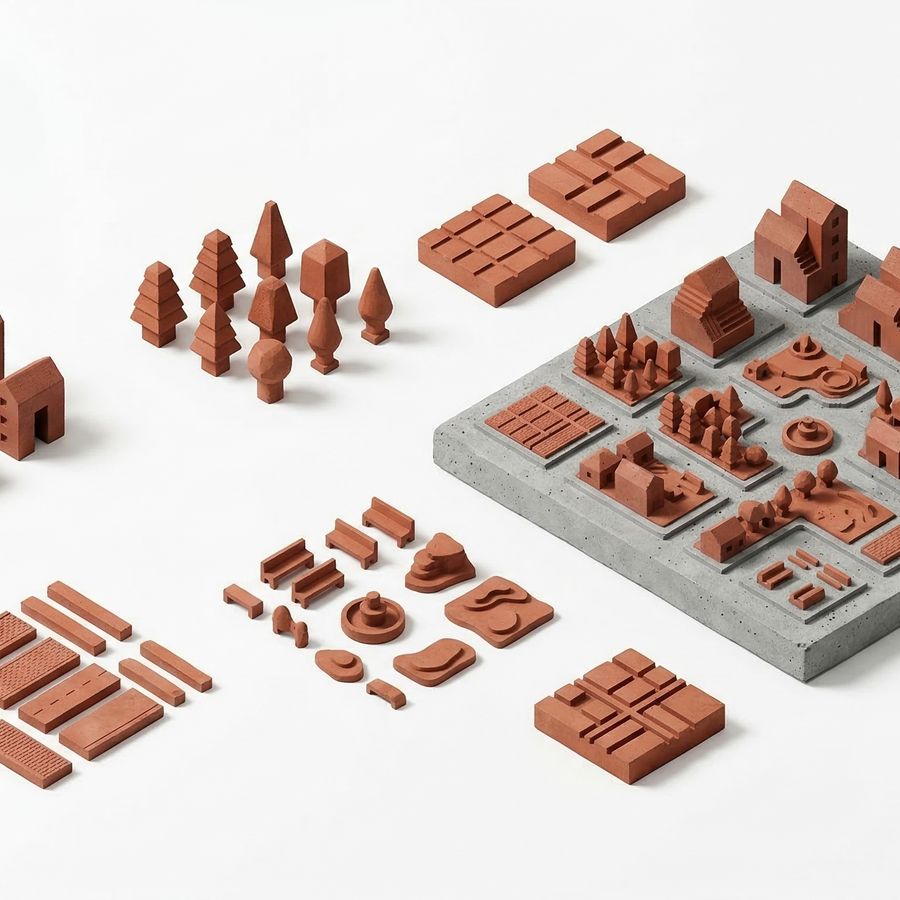
Thesis Topic - The AI Apprentice
Teaching urban design to AI models and testing whether they actually learned.
Dr.-Ing. Martin Bielik · Chair of Informatics in Architecture and Urbanism · Bauhaus-Universität Weimar
What if the best way to understand what urban design knowledge really is... is to try teaching it to someone who knows nothing?
Summary
Vision-language models can generate urban imagery on demand, but they have no persistent understanding of urban design. Whatever spatial intelligence they display comes entirely from the context you provide in that moment — the examples, rules, and references assembled as a prompt. Nobody has systematically figured out what that context should contain to make these models genuinely useful for spatial design tasks.
This thesis treats the problem as a teaching challenge: the student designs different "curricula" for AI models — curated sets of context including reference projects, design rules, and annotated examples — then tests whether the models learned anything, using a standardized design task evaluated by domain experts. The results are compared across context strategies, across models, and against human students given the same test. The core contribution is empirical: what makes AI context effective for spatial reasoning?
Description
1. Problem Statement
Vision-language models can produce photorealistic urban imagery and even generate site layouts on demand. But they have no persistent understanding of urban design. They do not know what makes a street section work, why a block structure supports mixed use, or how public space connects to pedestrian flow. Every session starts from zero. Whatever spatial intelligence they display comes entirely from the context you provide in that moment — the examples, rules, references, and instructions you assemble as a prompt. Right now, nobody has systematically figured out what that context should contain to make these models genuinely useful for urban design tasks.
This is a design problem disguised as an AI problem. The student takes on the role of a teacher — or a study program director — who must design a curriculum for an intern that forgets everything overnight. What examples of good urban design do you show? What rules and norms do you include? What do you leave out? How do you structure the brief so the intern produces useful work, not just plausible images? And critically: how do you test whether the intern actually learned something — and how does their performance compare to real students given the same test?
2. Expected Outcome
An interactive tool that allows the user to assemble different "didactic devices" — curated sets of context (reference projects, design rules, norms, annotated examples, spatial principles) — feed them to different vision-language models, run a standardized design test, and compare the results. The tool must support comparison across three dimensions: different context strategies (what you teach), different models (who you teach), and human students (the baseline).
The student delivers:
- A defined urban design skill to be taught (e.g. designing a mixed-use block, composing a street section, laying out a small neighborhood)
- A set of didactic devices — at least 3 distinct context strategies, deliberately designed and documented
- A test that evaluates the design output, validated by domain experts
- Comparative results: models vs. each other, context strategies vs. each other, and AI vs. human students on the same test
3. Presentation & Portfolio Value
Final presentation: Live demonstration of the tool — assembling a curriculum, running it on a model, comparing outputs side by side with human student work. Accompanied by a structured evaluation and expert review of the test design.
Career signal: This thesis demonstrates the ability to: design structured evaluation frameworks for AI tools; translate domain expertise into actionable AI context (a skill increasingly in demand); and critically assess AI capabilities against human performance — relevant for roles in spatial tech, AI product design, and computational design research.
4. Submission
Always required:
- Portfolio PDF (2 pages, A4) — visual summary: the teaching challenge, example didactic devices, side-by-side comparisons of AI vs. human outputs, and key findings from the experiment.
- 30-second video reel — a shareable teaser showing the tool in action: assembling a curriculum, running it on a model, comparing the output with human student work.
- 5-minute explainer video — walks through the problem, the didactic devices, the test design, the comparative results, and what was learned about teaching spatial reasoning to AI.
Working prototype: The interactive comparison tool, runnable by the reviewer. A reviewer should be able to select a didactic device, run it on a model, and compare the result against other strategies, other models, and human student outputs.
Specification document: Describes the design logic of the experiment: the urban design skill being taught and why it was chosen, each didactic device (what context it contains, why it is structured that way, what hypothesis it tests), and the test design (the task given, the evaluation criteria, how outputs are scored and compared). Not code documentation — the experimental design and rationale at a level where someone could replicate the study.
Validation report: Documents the full experiment: comparative results across context strategies, across models, and between AI and human students. Reports what worked, what failed, and what the results reveal about the relationship between context design and spatial reasoning performance. Includes the expert validation of the test itself (did domain experts agree the test measures the intended skill?). Method, data, and findings.
Written documentation: Research paper (~10 pages) covering problem, method, results, and discussion. The experimental findings are the core contribution of this thesis — the paper should be written as a standalone, shareable document at publishable quality.
5. Requirements
Baseline: Experience with AI-assisted coding workflows; prior web development experience (the thesis produces a web-based comparison tool — previous projects can be AI-generated); urban design knowledge (the student must understand the skill they are teaching); structured thinking about evaluation and testing.
Acquirable during the thesis: Systematic prompt/context engineering for VLMs; designing and running structured evaluation with human participants; working with multiple AI model APIs.
6. Solution Space (deliberately open)
The thesis is deliberately open in how the teaching experiment and comparison tool are designed. The didactic devices could range from curated image sets with no text, to structured rule books, to progressive sequences that build complexity incrementally. The target skill could focus on street-level design (cross-sections, frontages), block-scale composition (land use, density, access), or neighborhood-scale layout (connectivity, public space distribution). The comparison tool could be a web-based interface, a notebook workflow, or an API-driven pipeline with a visual front-end. The student is encouraged to explore what produces the most revealing comparisons — and to propose approaches not listed here.
7. Project Stages
- Define the skill — Select one specific urban design skill to teach. Justify why it is a good candidate: testable, requires spatial reasoning, currently poorly handled by generic AI.
- Design the didactic devices — Develop at least 3 distinct context strategies (e.g. examples-only, rules-only, annotated examples + rules, progressive complexity). Document what each contains and why.
- Design the test — Create a standardized task and evaluation criteria. Validate the test with 2–3 domain experts: does it actually measure the skill?
- Build the tool — Develop the interactive platform: input context → select model → run test → display and compare results.
- Run the experiment — Test across models and context strategies. Run the same test with a group of human students.
- Evaluate and document — Analyze comparative results. Write the thesis. Prepare the live demo.
8. Keywords
vision-language models, in-context learning, urban design education, prompt engineering, spatial reasoning, AI evaluation, didactic design, design curriculum, human-AI comparison
Before You Apply
Read the supervision terms and conditions — how I work, the timeline and deadlines, the consultation structure, and what is due when.
Dr.-Ing. Martin Bielik · InfAU · Bauhaus-Universität Weimar