Working Body, Breaking Body: Biomechanics, Prosthetics, Robots, ca. 1920
Part of the exhibition (December 1–8, 2025) in the context of the international conference “Planet Uncanny: Redistributing Subjectivities across Technology, Nature, and Society” (December 3–5, 2025).
The aftermath of the Russo-Japanese War, World War I, the Revolution, and the scientific breakthroughs of the early 20th century—ranging from physiology and psychology to electromagnetic theory—pushed artists, writers, and scientists to radically rethink the human body. The expansion of prosthetics for the war-wounded made hybrid bodies both a necessity and a metaphor. The reconstruction of the states went hand in hand with the remaking of human subjectivity—corporeal, cognitive, emotional. Hybrids of human and machine gave rise to complex emotions often associated with the feeling of the uncanny, as described by Jentsch and later interpreted by Freud.
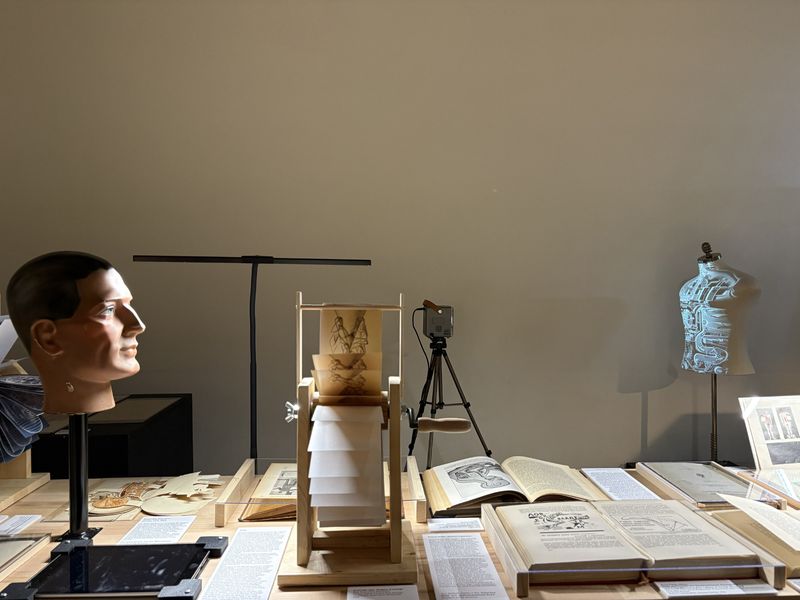
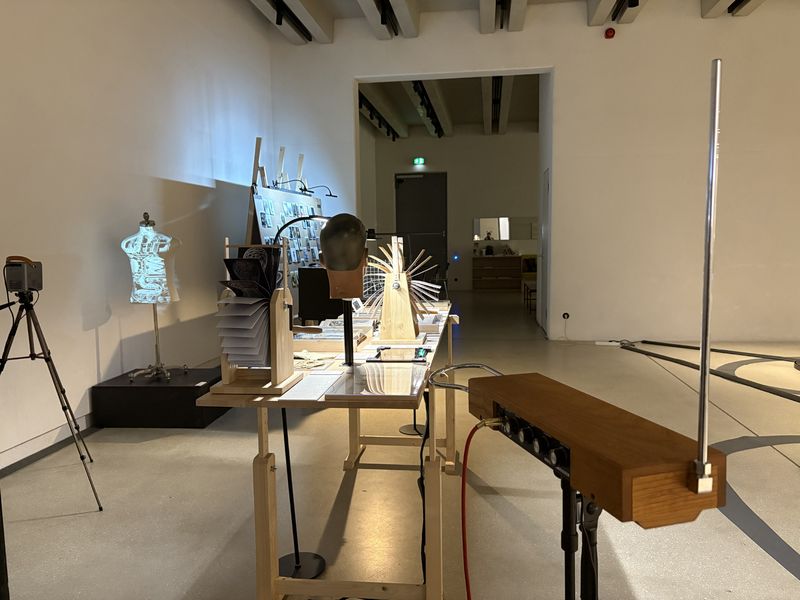
Movements could be recorded and algorithmized; voices disembodied and reproduced. The theremin and the terpsitone translated bodily motion into sound, while cyclograms transformed it into light. Artists and engineers alike envisioned future bodies permeated by electric currents, radiation, and cosmic trajectories. Urbanization, electrification, and new transport systems fostered a belief in the extension of the human body into space and time. In Constructivism, Dada, and Surrealism, these shifts manifested visually—often through fragmented, mechanized, or grotesquely hybrid forms.
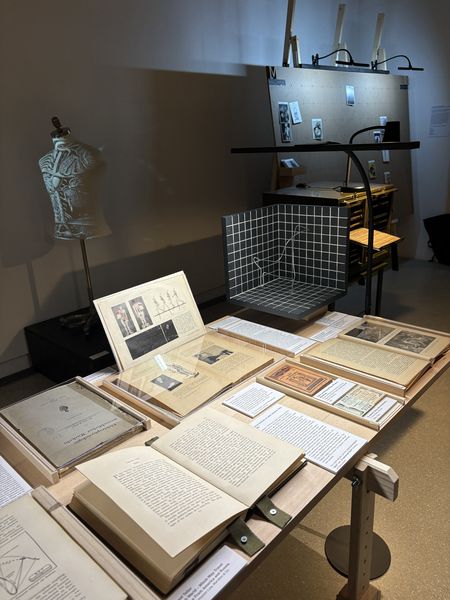
This exhibition explores how hybrid human-machine identities were imagined in art, theater, cinema, and literature of the 1900s–1920s. The installation—structured as an “archive, ” “laboratory table,” and “map” —presents visual documentation, performance scores, scientific experiments, and interpretive objects. It maps out modes of interaction between humans and machines—across labor, war, and love— and registers a spectrum of affective responses to autonomous machines and robotic bodies: anxiety, awe, desire, hope.
The project was developed with the participation of students from the workshop "From Archive to Exhibition: Curating the Uncanny Body” at Bauhaus-Universität Weimar (curated by Aleksandra Selivanova; participants: Renata Adnabaeva, Zeynep Zülal Bodur, Andrea Carolina Diaz Garavito, Aysenur Dilsad Eryilmaz, Lennart Keuneke, Melih Gürcan Kutsal, Daria Lashutina, Ambar Luna Quintanar, and Gina Wietschorke), as well as artists Anton Ketov (Belgrade), Evgeniia Rzheznikova (Frankfurt) and Sebastian Veloza (Weimar).