
»Planet Uncanny: Redistributing Subjectivities across Technology, Nature, and Society«
Review of the international transdisciplinary conference and exhibition at the Bauhaus Museum Weimar
Are AI assistants such as Siri or Alexa something like persons? Do language models such as ChatGPT have (self-)awareness? And can we still control the global dynamics of our time—from digitalization to the climate crisis—or have they long since taken on a life of their own?
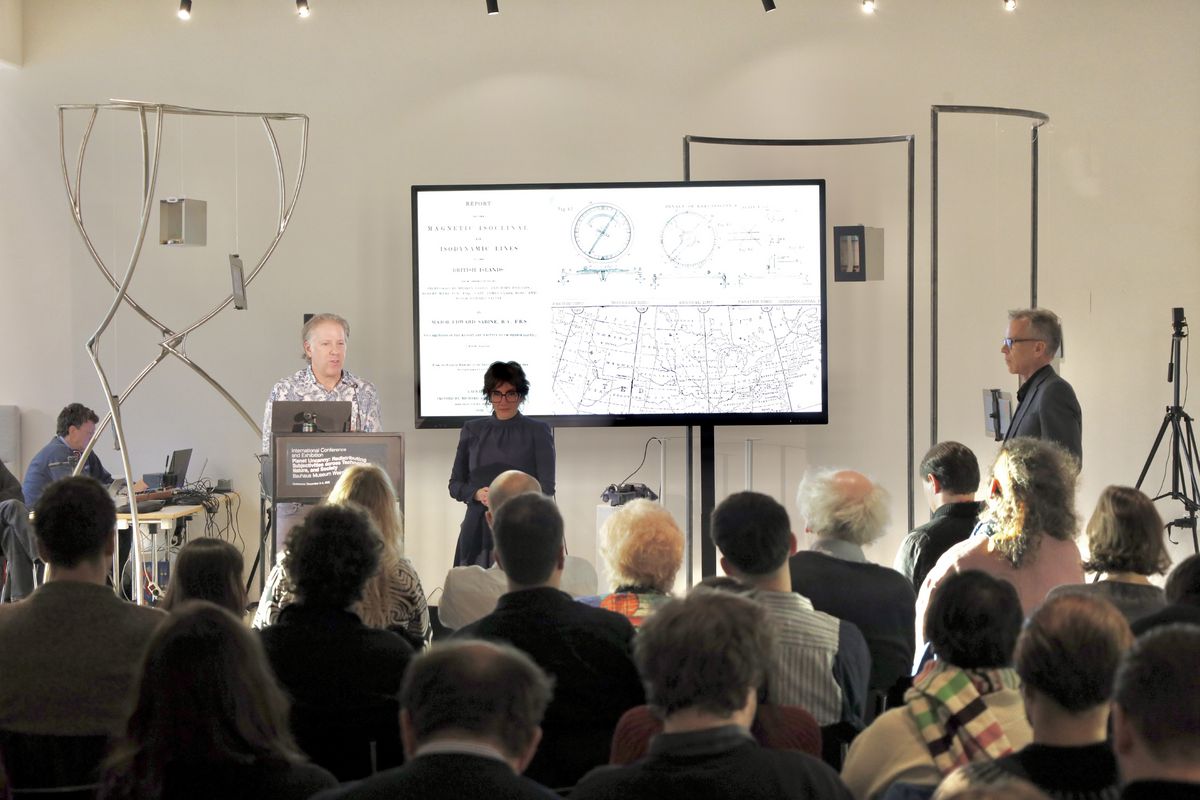
These questions were explored from Monday, December 1, to Monday, December 8, at the conference and exhibition "Planet Uncanny" in the DFG research project "Animism/Machinism" at the Bauhaus Museum Weimar. Through the close links between media studies, philosophy, and artistic practice, it opened up a space in which research, criticism, and social dialogue intertwined.
The title "Planet Uncanny" refers to the unease that accompanies many contemporary developments, explains Prof. Dr. Henning Schmidgen: chatbots in everyday life, polarization in discourse, the climate crisis. The location was also deliberately chosen: the Bauhaus Museum of the Klassik Stiftung Weimar—a public space that facilitates exchange across disciplinary boundaries.
A highlight of the event was the keynote speech by literary and media scholar Katherine Hayles, whose work has shaped the discourse since the 1990s. And: a spacious installation that ties in with Freud's motifs of the uncanny and combines art and science.
What remains after the conference and exhibition? "As a research group, we would like to see a reflection on the fact that our technological achievements challenge traditional notions of subjectivity and that ecological crises are shifting the boundary between culture and nature," say the project participants. Animistic perspectives can open up new ways of thinking about the relationship between humans, machines, and non-human life forms.
The research project "Animism/Machinism" (led by Schmidgen, Schönher, Brockmann, Selivanova) pursues the thesis that the Western world is increasingly taking on animistic traits.


