
ASSISTANTS, AVATARS, ATMOSPHERES. Perspectives on Animism in Media Studies and Media Art
Review of the transdisciplinary conference
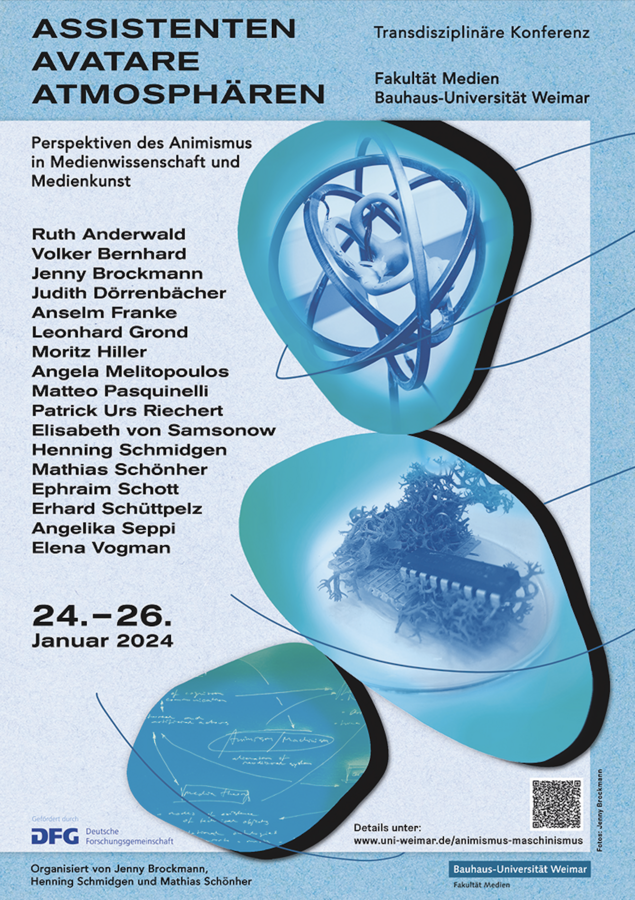
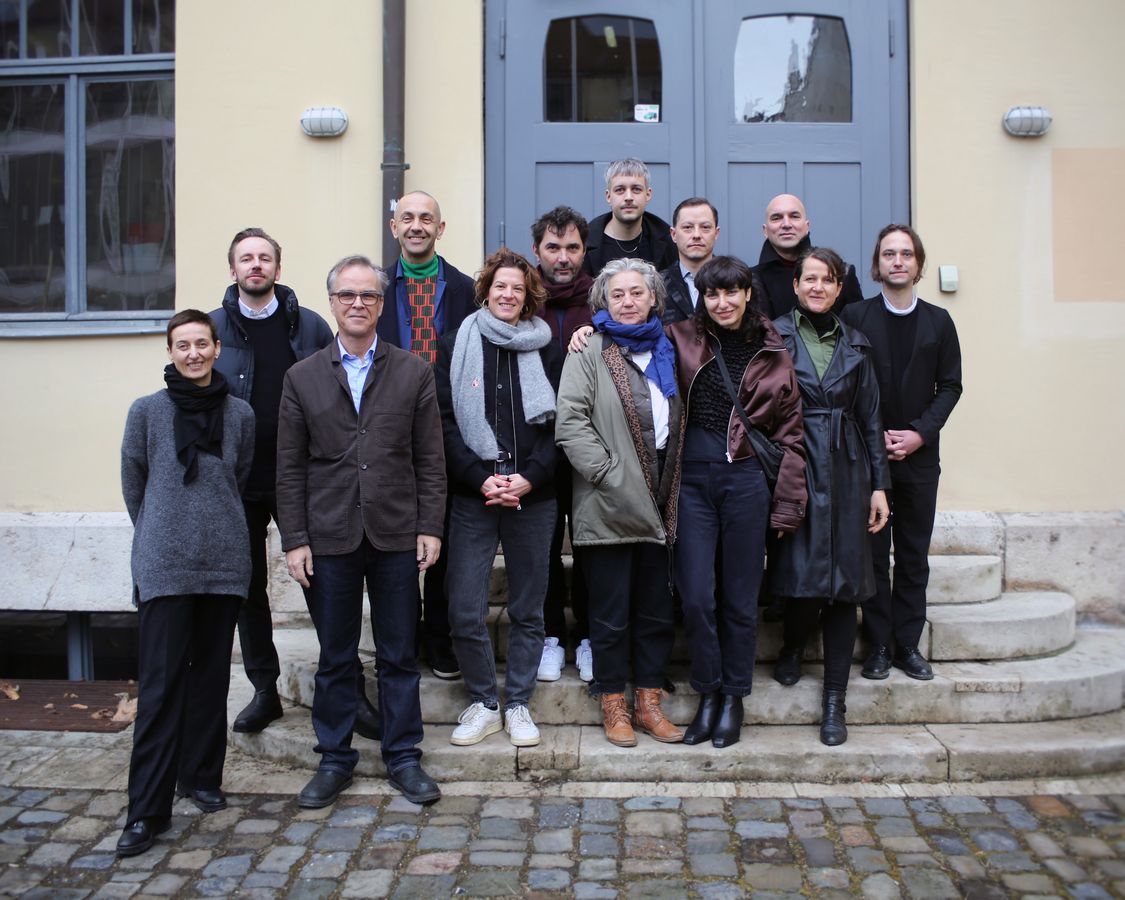
The transdisciplinary conference, titled "Assistants, Avatars, Atmospheres. Perspectives on Animism in Media Studies and Media Art," was held from January 24 to 26 at the Faculty of Media. The event was organized byHenning Schmidgen, who holds the professorship for Media Theory and History of Science, the artist Jenny Brockmann, and the philosopher Mathias Schönher. It served as a kick-off event for their research project, titled "Animism/Maschinism. Configurations of Critique between Science, Art and Technology.” The objective of the conference was twofold: firstly, to convene researchers from German-speaking countries who have demonstrated the relevance of animistic perspectives in recent years; and secondly, to firmly anchor the debate about these perspectives in media studies. The conference centered on the notion of animism in the context of contemporary advancements in media technology, with a particular emphasis on three prominent figures: the emerging role of new assistants, such as the widely discussed chatbots like ChatGPT; the avatars that accompany and interact with us in virtual worlds; and the technical-media atmospheres that smart cities and other developments based on the Internet of Things engender.
Following a welcome and introduction to the conference topic by Henning Schmidgen, Elisabeth von Samsonow (Professor of Philosophical and Historical Anthropology of Art at the Academy of Fine Arts Vienna) delivered a first lecture. She noted a depotenzation of the mind in the 20th century, observing that this depotenzation coincided with a rebirth of the mind from the thermostat. In the subsequent lecture, Mathias Schönher elaborated on the concept of animism in the philosophy of Gilles Deleuze and Félix Guattari, challenging the prevalent association of "animism" with "distributed agency."
In his lecture, Erhard Schüttpelz (Professor of Media Theory at the University of Siegen) critically examined animism as what he called "western soliloquy" and underlined the necessity of dealing with the problems of anthropomorphization and alterization in this context. On the second day of the conference, Angelika Seppi (visiting scholar representing the professorship for the History and Theory of Cultural Techniques) discussed the potential meanings of "animism today" in the context of the research conducted by Erhard Schüttpelz. She also referenced the work of the ethnologists Claude Lévi-Strauss and Philippe Descola.
The subsequent day of the conference was dedicated to the ongoing dialogue between media science and media art. The day's initial lecture was delivered by Anselm Franke(Professor of Curatorial Studies at the Zurich University of the Arts). Franke's lecture focused on the exhibition "Animism," which he conceived and realized at the Haus der Kulturen der Welt in Berlin in 2012. This exhibition made a substantial contribution to the reception of animistic perspectives in the German-speaking world. Subsequently, the artist Angela Melitopoulos presented her audio-visual research, titled "Assemblages," which was completed in 2010. This research focuses on Félix Guattari's concept of "machinic animism" and the subjectivation processes and critical potential of capitalism that this animism entails.
The third lecture, which preceded the subsequent laboratory visit, was delivered by design researcher Judith Dörrenbächer (postdoctoral researcher at the Chair of Ubiquitous Design at the University of Siegen). Dörrenbächer presented four distinct animistic practices and demonstrated their application in design processes. The "object personas" she mentioned were vividly illustrated during the visit to the virtual reality laboratory of the Chair of Virtual Reality and Visualization. Following an introductory presentation by Volker Bernhard (research associate at the Chair of Media Theory and History of Science) on animism in architecture and interiors, which spanned an arc from Goethe to Paul Klee to the interdisciplinary research project "MetaReal," the participants, equipped with virtual reality glasses, were able to navigate the renowned Gropius Room in the primary building of the Bauhaus University and interact with the furnishings under the guidance of Ephraim Schott (research assistant at the Chair for Virtual Reality and Visualization).
The subsequent two laboratory visits familiarized the participants with atmospheres generated by technical media. In the bauhaus.medien.bühnen lab, the participants collaborated with Jenny Brockmann on an interactive sculpture titled "Seat#12." Subsequently, Brockmann presented her discursive performance, "Atmospheric Algorhythms," which was set in a frequency sound environment influenced by WiFi signals.The second day of the conference concluded with the third laboratory visit. It led to the 7-channel sound installation “On Certain Groundlessness,” which Ruth Anderwald and Leonhard Grond (holders of the professorship for the doctoral program in artistic research at the University of Applied Arts Vienna) had set up in the hybrid learning studio. Through a polyphony that animated the space, it made tangible an atmosphere of social dizziness and provided the setting for the artist duo's performative lecture on “Voices of Dizziness.”
The third day of the conference commenced with a lecture by Patrick Urs Riechert (research assistant to the Chair of Media Philosophy at the Karlsruhe University of Arts and Design), and Elena Vogman (head of the research project "Madness, Media, Milieus" in the Department of Media Studies) titled "Machinic Extimacy.” Starting from the assumption of an outside at the heart of psychic interiority, which Jacques Lacan's concept of extimacy implies, Elena Vogman explained the concept of machinic subjectivity coined by Félix Guattari. Patrick Urs Riechert then presented concrete "scenes of extimacy" with reference to ChatGPT. In the subsequent lecture, Moritz Hiller (postdoctoral researcher at the Chair for the History and Theory of Cultural Techniques) presented his perspective on "Animism" as a strategic concept. Hiller's argument centered on the notion that techno-animism functions as a counter-movement to posthumanism, thereby enabling the perpetuation of a defunct conception of the human.
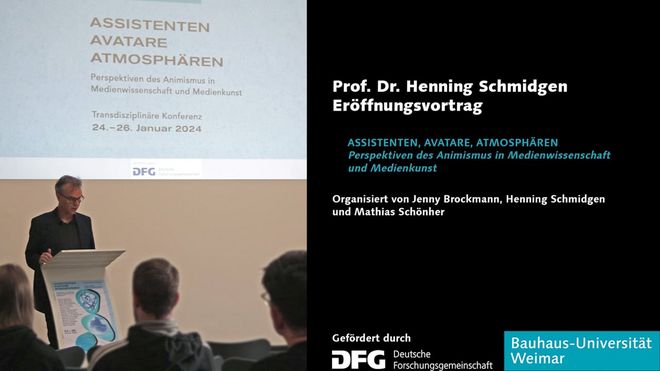
Matteo Pasquinelli (Professor of the Philosophy of Science at the University Ca' Foscari in Venice), presented a comprehensive analysis of the evolution of information technology, cybernetics, and artificial intelligence, highlighting the interplay among the three paradigms of "organism," "machine," and "language." The final contribution to the conference was delivered by Henning Schmidgen, who provided insights into Gilbert Simondon's philosophy of technology and interpreted his extension of the concept of the individual to technical objects as an expression of an animistic perspective.
Animismus Maschinismus. Konfigurationen der Kritik zwischen Wissenschaft, Kunst und Technik
Click the Play button to load and view external content from Vimeo.com.
Automatically load and view external content from Vimeo.com (You can change this setting at any time via our »Data protection policy«.)