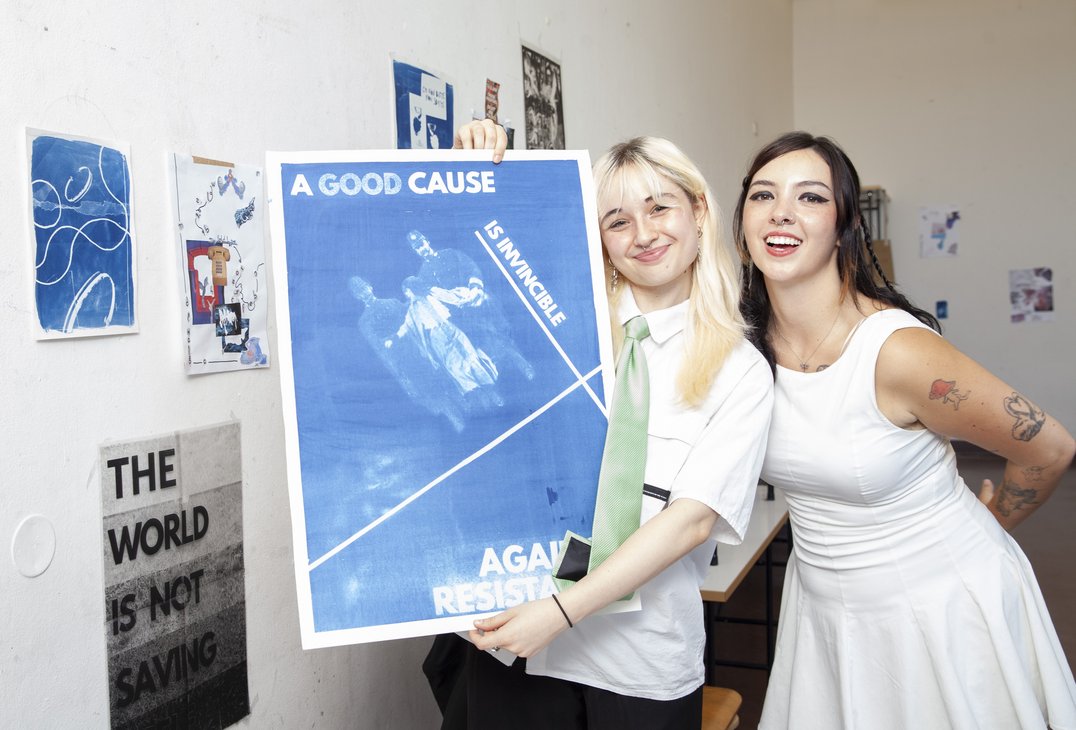
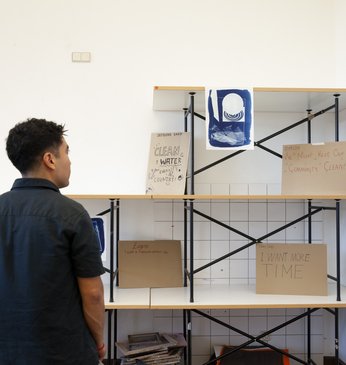
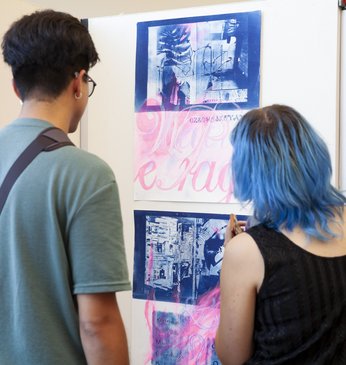
Posters have long served as powerful tools for communication, shaping dominant discourses and documenting sociopolitical transformations. Yet in today’s accelerated digital age—where information is consumed fleetingly and attention spans are fractured— how can "slow" mediums like posters retain their relevance and still make sense?
What matters are still worth creating tension or sparking dialogue for, in the age of algorithmic realm of knowledge and ephemeral content?
This course experiments with and reconstruct the process of poster-making, revisiting its communicative power beyond conventional roles as advertising medium for events, festivals, or political campaigns. It re-invests in the poster’s potential as a medium for personal and collective development and expression—particularly in a world dominated by algorithms, trends, and virtual spaces. Participants will examine how to articulate perceptions, emotions, and critical positions, operating outside the constraints of censorship, publishing policies, and consumer-driven strategies.
The course combines hybrid methodologies (analog and digital approaches, private and public realms, in studio and public space interventions) as the process of creation. Participants will translate personal and shared experiences into visual and linguistic elements.
This collaborative process fosters meaningful artistic production, enabling participants to engage with both their inner selves and the public sphere.
Course Components:
During the period of the course, we will depend on the interplay of the following three components as a framework for the production process:
Examine relevant socially and politically critical artistic movements such as Imaginary Bauhaus, and Situationists Internationale by addressing the role and reputation of Bauhaus, as a starting point of tensions between political and artistic standpoints and interpretations.
Explore the influence of current trends and discourses, from our time, on structuring the subjective agency of individuals, in the body of the practice, as engaging tool with sociopolitical issues, and negotiating with the public.
Using routes, sceneries and impressions from the city of Weimar, signs in the streets and mass communication objects as it represents the space of our shared experience during the course. Elaborating on visual and conceptual elements to examine and elaborate on the personal negotiations with public, influenced by the multi-perspectives of participants.
We will explore printing and assembling techniques as both tools of production and methods of artistic research, working through accessible, hands-on processes as an alternative to the print workshop.
Participants will examine relationships between self-statement, the perception of others, and context, while engaging with materiality, authorship, and translation.
The final project will take the form of an inter-connected body of subjective statements, presented in a shared exhibition space.
-Participants will contribute to its planning and realization as a collaborative practice.
-Guest contributors will join at key moments to expand the dialogue and process.
Update: 24.03.26