










The career path to a Tenure-Track Professorship at the Bauhaus-Universität Weimar
What does »Tenure Track« mean?
How can I apply?
By sending us your application for advertized tenure-track positions. Please also check the appointment requirements set out in the Thuringian Higher Education Act (Section 89). Further information on the appointment procedure can be found in the Appointment Regulations.
What is my role as a Tenure-Track professor?
As a W1 professor, you will carry out your research, artistic and teaching duties independently. In practical terms, this means:
- developing your academic or artistic profile
- teaching with a reduced teaching load
- supervising degree theses and doctoral research
- leading your professorial team
- carrying out duties relating to academic self-governancedevelloping
- develloping further skills towards a tenured professorship
As a junior professor, you are a member of the academic staff. This applies in particular to representation on university bodies (Thuringian Higher Education Act, Section 21).
You will hold the academic title of ‘Professor’, provided that your status as a junior professor is indicated in an appropriate manner. Upon termination of your employment, you may no longer use this academic title (Thuringian Higher Education Act, Section 98).
How does the Tenure-Track process work?
As a tenure-track professor, you will initially be appointed to a fixed-term W1 professorship. Following a successful interim evaluation, usually after three years, and a successful tenure evaluation, you will be appointed permanently to a W3 professorship. This generally takes place in the sixth year.
The interim and final evaluations are conducted according to criteria-based procedures established in the development objectives agreement. Both the procedures and the criteria are set out in the Bauhaus-Universität Weimar’s Tenure-Track Regulations.
If the interim or final evaluation does not confirm that you have successfully completed the probationary period, you will receive support during a transitional year while realigning your academic profile.
How does the university support me in achieving my personal development goals?
In addition to providing appropriate facilities, the Bauhaus-Universität Weimar supports you through annual feedback meetings with your dean to discuss your development goals, as well as the BauhausTrack qualification and development programme, which includes personal guidance, training opportunities and networking initiatives.
Which body is responsible for the interim and final evaluations?
Your faculty’s Graduation Committee is responsible for the interim evaluation, which is initiated by the Dean’s Office. You must prepare a self-assessment report on your development objectives agreement. The Graduation Committee will then obtain expert opinions and prepare a recommendation for the Faculty Council.
On the Faculty Council’s recommendation, the Praesidium (Executive Board) decides whether to extend the junior professorship (Section 4 of the Tenure-Track Statutes). For the final evaluation, a committee similar to an appointments committee is formed to assess your academic, teaching and personal suitability.
The committee obtains expert opinions, invites you to give a public lecture at the university and conducts an interview with you before preparing a recommendation for the Faculty Council. The Executive Board decides whether to convert the professorship into a permanent position based on the Faculty Council’s recommendation, the Senate’s opinion and, where applicable, additional expert opinions (Section 5 of the Tenure-Track Statutes).
What happens after a positive tenure evaluation?
Following the successful completion of the tenure evaluation, the President, together with the Chancellor and the Dean, will hold a meeting with you to discuss the future development and resourcing of the professorship. The Human Resources Department will initiate the formal appointment procedure. The appointment takes effect upon the President’s presentation of the certificate of appointment (see Section 5(11) of the Tenure-Track Statutes).
What happens if the evaluation is negative?
Can I change my professional development goals whilst I am a junior professor?
As a junior professor, can I take a leave of absence?
Yes, you may take a leave of absence for reasons related to the interests of the service or the public, or for important personal reasons, provided that the leave does not conflict with the interests of the service (see Section 67 et seq. of the Thuringian Civil Service Act).
Upon application, your employment relationship may be extended by the duration of the leave, up to a maximum of two years (see Section 97(4) of the Thuringian Higher Education Act). To do so, you must submit an informal application through official channels to the President. The start of the interim or tenure evaluation may also be postponed accordingly. It is advisable to apply for this postponement at the same time as you apply for the leave of absence.
How do periods of parental leave, leave of absence or periods of part-time work affect my tenure review?
How can I balance my junior professorship with my care responsibilities?
Many Tenure-Track professors also have care responsibilities. Please discuss with us what conditions are important to you to balance both: whether this involves parental leave and/or periods of part-time work, or even an additional extension of the tenure-track period – up to two years per child is possible (Section 6 of the Tenure-Track Statutes). If required, we can also advise on childcare options, support with day-to-day life and ensure you have a strong support network.
BauhausTrack Programme
Promoting skills development and professional growth

Individual Counselling and Coaching

Introductory meetings
We help you settle in quickly and build a strong network within the university. We also support you in developing the skills and accessing the resources you need to achieve your goal of becoming a professor.
The mid-term review provides an opportunity to reflect on how well the qualification programmes meet your needs and on your individual path to a professorship.
Verweisberatung
For specific questions or challenges relating to research, teaching or administration, we will connect you with the appropriate contact person.
Coaching
You also have the opportunity to address individual career-related questions and challenges through a short-term coaching programme.
Workshops

Together with your peers, you will discover your strengths as a research manager through a wide range of interdisciplinary programmes, broaden your repertoire of problem-solving strategies and thereby enhance your effectiveness.
A broad spectrum of in-house training programmes is available to you, organised by the relevant departments and central services. If you cannot find the right programme for you, please get in touch!
Here you will find an overview of all BauhausTrack workshops.
Mentoring
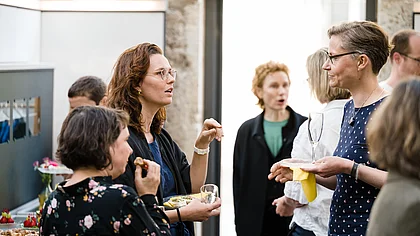
As junior professor, you also have the opportunity to seek collegial advice from experienced mentors and your peers during your qualification period:
Peer Mentoring
- within the university and across the inter-university online network
- comprises colleagues at the same stage in their careers
- who regularly discuss current topics
- who invite internal and external guests as required
- Dates and registration: please contact Katharina Reinholdt
Tandem Mentoring
- consists of a mentee and a mentor
- the focus here is on personal and strategic issues relating to career planning
- mentors can take part in the annual feedback meetings at the Dean’s Office
- mentors are matched on an individual basis, taking into account their personal preferences and development goals
- mentors are not involved in the committees or decision-making processes relating to the tenure procedure
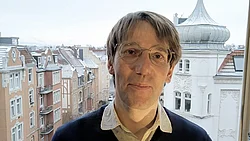
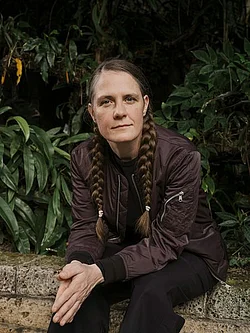
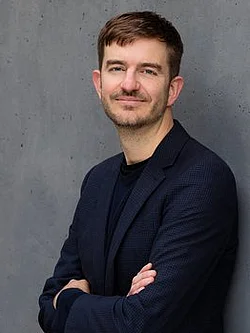
Mentors within the BauhausTrack

The Tenure Commission
The Tenure Commission advises the President's Office on the calls, the appointment, staff development and evaluation of tenure-track professorships. In this capacity, it issues recommendations on the sustainable and quality-assured implementation of the tenure-track career path, as well as on the further development of the relevant concepts. It meets at least once per semester (Section 9 of the Tenure-Track Statutes).
Members:
Chair: Prof. Peter Benz
Professor status group: Prof. Dr. Mark Jentsch; Prof. Dr. Rebekka Ladewig
Academic staff status group: Jacob Lammert
Student status group: Göram Leeder-Kamanda
In an advisory capacity: Dr. Katharina Reinholdt, Viola Baser M.A.