




Types of Doctoral Theses
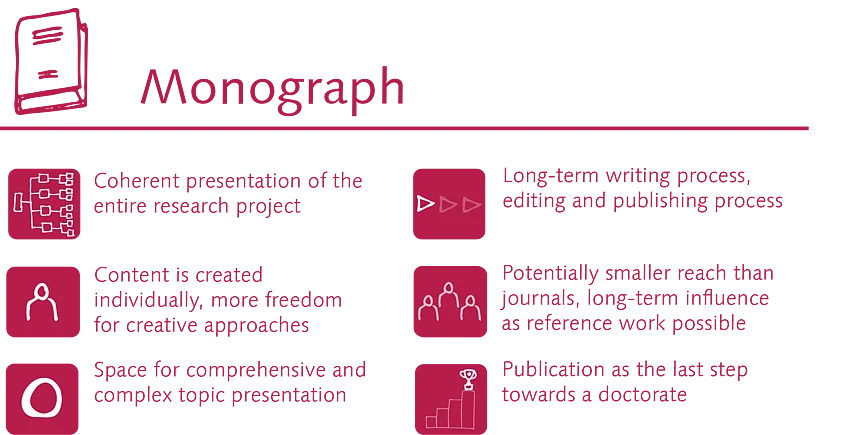
There are two main approaches to writing a doctoral thesis: either as a MONOGRAPH or as a CUMULATIVE THESIS. It is important to decide on one of these approaches as early as possible and to discuss your choice with your supervisor.
Monograph
Cumulative
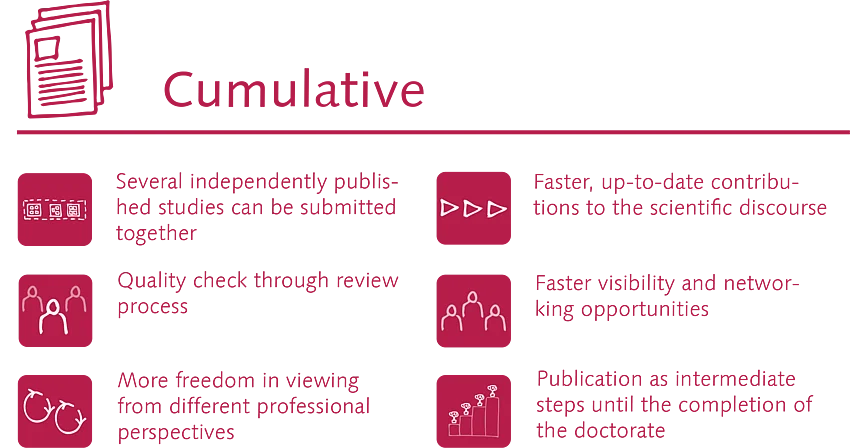
Option 2: The doctoral thesis is presented as a collection of papers or a portfolio, consisting of several independent academic papers that have been previously published in relevant academic journals. These papers represent partial results of the doctoral research and are contextualised in relation to one another within the thesis. Together, they form the cumulative doctoral thesis.
Currently, the cumulative PhD option is available only in the Faculties of Civil Engineering and the Environment, Art and Design (PhD), and Media.
You can find the relevant regulations in the respective doctoral guidelines.
Three ways of publication
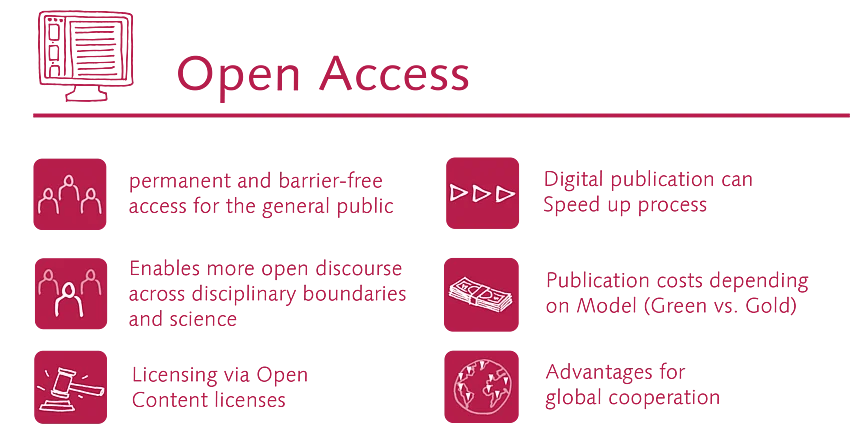
Open Access
Option 1: Open Access (OA) as a recognised way of academic publishing that makes academic insights freely available:
- We recommend that you publish your doctoral thesis electronically as an Open Access publication through the Digitale Bibliothek Thüringen. To do this, you will need to submit an electronic version of your dissertation as well as six printed copies in bound form to the university publication office.
- An increasing number of publishers also offer OA publication, so that the publisher's copy can also appear as an OA book. Here, funding and licensing must be clarified in advance. As with other publishing publications, three print copies must be submitted to the university press. As a rule, however, print versions are also integrated in OA publishing publications.
Ansprechperson
Dana Horch
Open Access Officer at Weimar University Library
Tel.: +49 (0) 36 43 / 58 28 05
E-Mail: dana.horch[at]uni-weimar.de or openaccess[at]ub.uni-weimar.de
Closed Access
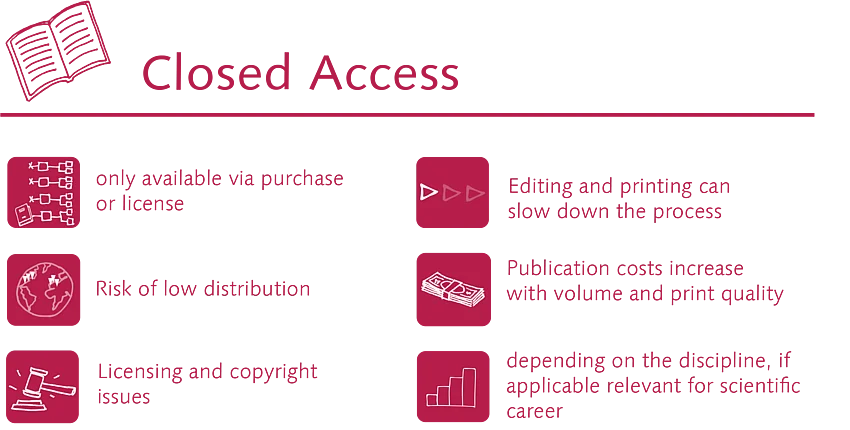
Option 2: The work is published by a publisher or in a journal with restricted access. Three copies from the publisher must be submitted to the University Publications Office.
→Further information from the University Publications Office
Contact persons
Heidi Körner
Tel.: +49 (0) 36 43 / 58 28 23
Claudia Haase
Tel.: +49 (0) 36 43 / 58 28 31
Katharina Anding
Tel.: +49 (0) 36 43 / 58 28 28
Email: hss[at]ub.uni-weimar.de
Self-Publishing
Option 3: After a successful thesis defence, the Bauhaus-Universität Weimar also offers the option to self-publish your thesis in the form of 20 printed and bound copies. The University Publication Office will also advise you on this.
Contact Persons
Heidi Körner
Tel.: +49 (0) 36 43 / 58 28 23
Claudia Haase
Tel.: +49 (0) 36 43 / 58 28 31
Katharina Anding
Tel.: +49 (0) 36 43 /58 28 28
E-Mail: hss[at]ub.uni-weimar.de
Publication Costs
Publication costs are incurred for all forms of publication. Bauhaus-Universität Weimar offers you various support services:
Furthermore, inform yourself about external funding opportunities, such as:
- VG-Wort (German)
- FAZIT-Stiftung (German)
- Deutscher Akademikerinnenbund (German)
Publications in professional journals
Presenting papers at specialized conferences and publishing in academic journals can enhance the international visibility of your research while you are still pursuing your PhD. Open Access (OA) publications allow for further dissemination, such as including them in your doctoral thesis, since they permit reuse under a Creative Commons license.
On the pages linked here you will find helpful tips to assist you in the strategic planning of your publications:
- Detailed information on OA publishing from the open access network
- find trustworthy journals with think.check.submit
- find quality-assured conferences with think.check.submit
- find quality-assured open access journals with B!SON
- find a suitable OA publication venue as well as funding opportunities for their own institution with oa.finder
- information about »Mirror Journals« (list)
Publication of Research Data
Publishing research findings is valuable for several reasons, not just when mandated by a funding body like the DFG. It facilitates the long-term archiving and utilisation of research data, ensures scientific integrity and transparency, fosters a culture of open knowledge, and can also improve your own reputation. (See forschungsdaten.info)
Your research data can be published in three different ways:
- Disciplinary and subject-specific repositories can be accessed through platforms like re3data.org.
- Institutional repositories such as the Thuringian Research Data Repository (REFODAT) at the Bauhaus University Weimar
- Generic, interdisciplinary repositories, such as Zenodo
→ Further information on the publication of research data
Contact person
Kevin Lang
University Library
Tel.: +49 (0) 36 43 / 58 28 50
E-Mail: kevin.lang[at]uni-weimar.de

Key Regulations and Guidelines
Regulations on Good Academic and Artistic Practice at the Bauhaus-Universität Weimar
The Regulations on Good Academic and Artistic Practice at Bauhaus-Universität Weimar provide guidelines for all members of the university community. These regulations serve as an ethical standard and establish the foundation for rules regarding academic professionalism and artistic freedom, which may differ across various disciplines.
Policy for research-related publications
The Affiliation Guidelines for Research-Related Publications (MdU 19/2025) at Bauhaus-Universität Weimar outline measures to enhance the visibility of institutional affiliation in various research-related publications. This includes materials such as publisher publications, preprints, postprints, journal articles, edited volumes, conference and congress proceedings, repository publications, patent specifications, data publications, and research contributions in audiovisual media and social networks.
These guidelines apply to all members and affiliates of the university, in accordance with Section 21 of the Thuringian Higher Education Act. They also extend to scholarship holders, provided that the published research is directly related to their activities at Bauhaus-Universität Weimar.
Policy and recommendations for the handling of research data
The »Policy on the Use of Research Data « as well as the »Handling and Management of Research Data« serve as a guide and resource for members and staff of the Bauhaus-Universität Weimar in the management of research data.
Policy on the use of generative artificial intelligence

The policy on the use of generative artificial intelligence highlights the opportunities and risks. It provides practical guidance on how to use it in a creative, considered and legally compliant manner.