Lehre

Im Folgenden bekommen Sie eine Übersicht über die angebotenen Lehrveranstaltungen für die Bachelorstudiengänge. Weitere Angaben zu den einzelnen Modulen finden Sie im Vorlesungsverzeichnis des laufenden Semesters im Serviceportal BISON.
Im Folgenden bekommen Sie eine Übersicht über die angebotenen Lehrveranstaltungen für die Masterstudiengänge. Weitere Angaben zu den einzelnen Modulen finden Sie im Vorlesungsverzeichnis des laufenden Semesters im Serviceportal BISON.
Baudynamik (WiSe)
Beschreibung:
- Einfache Schwingungsvorgänge, freie Schwingungen von EFHG-Systemen
- Erzwungene Schwingungen von EFHG-Systemen: harmonische Anregung, Impulsanregung, periodische Anregung, Frequenzgangfunktion, Impulsreaktionsfunktion, dynamische Vergrößerungsfunktion
- Methoden zur Berechnung der dynamischen Antwort im Zeitbereich: Duhamelintegral, Methode der zentralen Differenzen, Newmark
- Methoden- Freie und erzwungene Schwingungen von MFHG-Systemen, Modalanalyse, modale Superposition- Kontinuierliche Systeme
- Anwendungen: Maschineninduzierte Schwingungen, Windinduzierte Schwingungen, Erdbebenanregung, Personeninduzierte Schwingungen
Structural Dynamics (WiSe, EN)
Description:
- SDOF systems:
-free vibrations, harmonic, impulse and general excitation for undamped and damped systems,
-Impulse response function, frequency response function, base excitation,
-Time step analysis: Duhamel integral, central difference and Newmark methods; - MDOF systems: modal analysis, modal superposition, modal damping, Rayleigh damping, Frequency response functions
- Continuous systems
Experimental structural dynamics and Structural monitoring (SoSe, EN)
Description:
The students obtain deepened knowledge in structural dynamics, structural dynamic analysis, data processing, dynamic test equipment and its handling. They learn to analyse the dynamic behaviour of a structure utilizing both numerical and experimental state-of-the-art methods. Furthermore, the students have to develop strategies and concepts of investigation. The work in small groups enhances the social competence of the students.
Operational modal analysis, sensor types, sensor positioning, data analysis and assessment, assessment of structural changes, structural modelling, model updating
Finite Element Methods (FEM)
Finite Element Methods (WiSe, EN)
Description:
- Strong and weak form of equilibrium equations in structural mechanics
- Ritz and Galerkin principles, shape functions for 1D, 2D, 3D elements, stiffness matrix, numerical integration
- Characteristics of stiffness matrices, solution methods for linear equation systems, post-processing and error estimates, defects of displacement-based formulation
- Mixed finite element approaches
Nichtlineare FEM (WiSe)
Beschreibung:
- Einführung in die nicht-lineare Kontinuumsmechanik
- Geometrische Nichtlinearitäten
- Material Nichtlinearitäten
- Konsistente Linearisierung für Problemstellungen in der nicht-linearen Elastostatik
- FE-Formulierungen für geometrisch nicht-lineare Probleme und deren Lösung (Newton-Raphson, Line-Search, Arc- length)
- Detektierung von Bifurkationspunkten
- Kontaktformulierungen
Multiscale Analysis of Engineering Materials (SoSe, DE/EN)
Beschreibung:
Die Studierenden lernen experimentelle and analytische Methoden für die Charakterisierung von Baustoffen auf verschiedenen Ebenen kennen. Zunächst definieren und beschreiben die Studierenden die Mehrphasigkeit und Mehrskaligkeit ausgewählter Baustoffe. In Praktikumsversuchen, die unter fachlicher Anleitung durchgeführt werden, untersuchen sie die mikromechanischen Eigenschaften von ausgewählten Baustoffen und lernen dabei zum Beispiel die Methode der Nanoindentation und die dynamisch-mechanische Analyse kennen. Anschließend erfahren die Studierenden, wie diese experimentellen Daten in analytischen Ansätzen für die computer-basierte Abbildung der mechanischen Eigenschaften verwendet werden. Die Studierenden erlernen die Implementierung einfacher semi-analytischer Mehrskalenmodelle in MATLAB. Zudem lernen sie die thermodynamische Modellierung mittels GEMS kennen. Am Ende der Veranstaltung sind die Studierenden in der Lage, elastische Eigenschaften von Zementsteinen vorherzusagen.
Description:
The students learn experimental and analytical methods to characterize building materials at different levels. The students start to define and describe the multiphase and multiscale nature of selected building materials. The students then conduct selected micromechanical experiments in practical tests under expert guidance and learn, for example, about the method of nanoindentation and dynamic-mechanical analysis. Students then learn how these experimental data are used in analytical approaches for computer-based modelling of mechanical properties. Students learn how to implement simple semi-analytical multiscale models in MATLAB. They also learn about thermodynamic modelling using GEMS. At the end of the course, students will be able to predict the elastic properties of hardened cement pastes.
Kontakt:
Juniorprofessur Werkstoffmechanik
Stochastics for risk assessment / Mathematics for risk management (WiSe, EN)
Description:
- Introduction to probability theory with focus on situations characterised by low probabilities.
- Random events, discrete and continuous random variables and associated distributions.
- Descriptive statistics, parameter estimation. Risk Assessment by means of FORM and Monte Carlo Simulations.
- Introduction to reliability theory
- Extreme value distributions
- Stochastic modelling with software tools e.g. MATLAB, Octave, Excel, R.
- Reliability Analysis of Systems
- Catastrophic events + risk problems and Applications
Introduction to Optimization (SoSe, EN)
Description:
In engineering science, we are often faced with problems having potential for optimization. We learn how to formulate this in mathematical terms, and we will study techniques how to improve the situations, generally by involving numerical models. We will discuss classical optimization problems in the field of linear and nonlinear optimization, e.g. optimization of the use of resources, routing problems, calibration problems and structural optimization. In particular in structural optimization we learn techniques like dimensioning, shape and topology optimization. Optimized structures are discussed also in the context of additive manufacturing techniques.
Course Contents:
Definitions, Classification of Optimization Problems, Linear Problems, Simplex Method, Nonlinear Problems: Constrained and unconstrained continuous problems, descent methods and variants. (Robust) Structural Optimization (including Shape and Topology Optimization)
Optimization in Applications (SoSe, EN)
Description:
In engineering science, we are often faced with problems having potential for optimization. We learn how to formulate this in mathematical terms, and we will study techniques how to improve the situations, generally by involving numerical models. We will discuss classical optimization problems in the field of linear and nonlinear optimization, e.g. optimization of the use of resources, routing problems, calibration problems and structural optimization. In particular in structural optimization we learn techniques like dimensioning, shape and topology optimization. Optimized structures are discussed also in the context of additive manufacturing techniques.
Course Contents:
Optimization in Applications is generally a project assigned to the students including own programming and modelling. E.g. innovative optimization strategies are to be implemented in Matlab, Python or similar. Alternatively, engineering models could be subjected to optimization software.
Stochastic Simulation Techniques and Structural Reliability (SoSe, EN)
Description:
Soils, rocks and materials like concrete are in the natural state among the most variable of all engineering materials. Engineers need to deal with this variability and make decisions in situations of little data, i.e. under high uncertainties. The course aims in providing the students with techniques state of the art in risk assessment (structural reliability) and stochastic simulation.
The course topics comprise
- (a very brief review) of probability theory
- discrete and continuous random processes and fields
- estimation of statistical parameters
- stochastic simulation techniques (Monte Carlo Samplings)
- reliability-based design
- sensitivity analysis
- structural safety
- Risk assessment and stochastic modelling in practice

Sie möchten eine Abschlussarbeit (Master-, Bachelor- und Studienarbeit) im Institut für Strukturmechanik schreiben?
Unten steht eine Liste mit bereits definierten Themen. Außerdem können wir Ihnen bei der Bestimmung eines Themas in Ihrem Interessengebiet helfen. Nehmen Sie Kontakt mit uns auf.
Semantische Beschreibung von Material-, Prozess- und Prüfdaten zu Baustoffen (B. Sc. / M. Sc.)
Semantische Beschreibung von Material-, Prozess- und Prüfdaten zu Baustoffen (B. Sc. / M. Sc.)
Im Rahmen dieser Arbeit sollen Ansätze zur strukturierten, digitalen Beschreibung und Verknüpfung von Daten im Baustoffkontext untersucht und exemplarisch angewendet werden. Ziel ist es, ausgehend von Versuchs- und Prozessdokumentationen Wege zu einer interoperablen und nachnutzbaren Datenrepräsentation aufzuzeigen. Je nach fachlichem Hintergrund und Interessen können dabei semantische Methoden, Ontologien, Metadatenmodelle oder prototypische Datenstrukturen eine Rolle spielen.
Semantic Description of Material, Process, and Measurement Data on Construction Materials (B. Sc. / M. Sc.)
This thesis explores and exemplifies approaches for the structured digital description and integration of data in the context of construction materials. Starting from experimental and process documentation, the aim is to identify pathways toward interoperable and reusable data representations. Depending on the candidate’s background and interests, semantic methods, ontologies, metadata models, or prototypical data structures may be considered.
Contact:
Dr.-Ing. Fabian Ehle (fabian.ehle[at]uni-weimar.de)
Dr.-Ing. Ulrike Schirmer (ulrike.schirmer@uni-weimar.de)
Jun.-Prof. Dr.-Ing. Luise Göbel (luise.goebel[at]uni-weimar.de)
Mechanical Properties of Recycled Concrete Using Integrated Tomography Data and Finite Element Modeling (M.Sc.)

Motivation & Background:
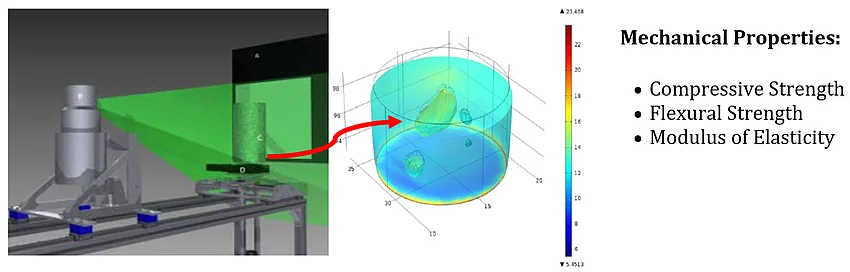
For decades, the structural integrity of concrete structures has been a critical concern in civil engineering. Recently, the use of recycled concrete and the incorporation of waste materials from wind turbine blades as replacements for aggregates or cement, have gained. The strength of recycled concrete is often difficult to predict due to the variability in the quality of the source materials, inconsistent structures and the presence of internal defects such as microcracks, voids, or weak interfacial zones. Therefore, accurately estimating the mechanical strength of such concrete is essential. Mechanical properties like compressive, flexural, and shear strength are of particular interest, especially when new concrete mixes with varying proportions are developed. The concrete that incorporating shredded or powdered recycled wind turbine blades, evaluating strength and defect distribution becomes even more critical. In this context, computed tomography (CT) offers a valuable non-destructive technique to generate 2D and 3D images of internal features. By integrating tomography data with finite element modeling (FEM), it becomes possible to simulate the behavior of concrete under load. This integrated approach provides new insights into the performance of recycled concrete and supports the development of more reliable, sustainable construction materials.
Objectives:
- Evaluate the capability of CT to detect defects in recycled concrete
- Develop FEM based on CT-derived geometries, considering the heterogeneous nature
- Analyze the influence of internal defects on mechanical properties and failure behavior
- Establish correlations between CT-derived features and mechanical performance to support non-destructive quality control methods
- Validate simulation results by comparing them with experimental test data
Selected literature:
- Khormani, Mahmood, et al. "Compressive strength determination of concrete specimens using X-ray computed tomography and finite element method." Construction and Building Materials 256 (2020): 119427.
- Liu, Tao, et al. "Mechanisms and applications of wind turbine blade waste in cementitious composites: A review." Materials & Design (2025): 113732.
- Godoi, W. C., et al. "Mechanical Strength Simulation of Concrete Samples Using COMSOL Multiphysics® Software with 3D Mesh Generated By Industrial Tomography System.
Supervisors:
Prof. Dr.-Ing. habil. Carsten Könke, and Dr.-Ing. A.M. Al-Mukhtar
Contact:
Prof. Dr.-Ing. habil. Carsten Könke (carsten.koenke[at]uni-weimar.de)
Biaxial Fracture in Fiber-Reinforced Concrete (M.Sc.)
Motivation & Background:
Concrete, as a composite material, exhibits unique failure criteria that become more complex when reinforced with fibers for strength enhancement. Fiber-reinforced concrete (FRC) significantly improves fracture toughness under biaxial stresses (compression), particularly when incorporating fibers such as steel, glass, or polypropylene. In addition, FRC eliminate the corrosion, and spalling problems. These modifications enhance the performance of FRC compared to plain concrete, making it a vital material in applications requiring increased durability and crack resistance. Understanding biaxial fracture behavior in FRC is crucial for optimizing its use in modern engineering designs. Hence, to better understanding the fracture resistance under biaxial stresses. The study is divided into two main parts; numerical analysis and experimental validation for comparative purposes. Both parts, or one of them, will be included depending on the verification process and the results obtained.
Objectives:
- Investigate crack propagation under biaxial loading in fiber-reinforced concrete (FRC) with the proposed fiber types
- Compare experimental findings with finite element (FE) simulation results for validation
- Examine mechanical properties of FRC under varying biaxial stress ratiosAnalyze the influence of different biaxial stress ratios on crack initiation and propagation
- Assess the effect of mechanical vibrations on the structural integrity of FRC
- Study the impact of fiber content on the performance of the concrete matrix as a whole
Selected literature:
- Tschegg, E. K., M. Elser, and S. E. Stanzl-Tschegg. "Biaxial fracture tests on concrete—Development and experience." Cement and Concrete Composites 17.1 (1995): 57-75.
- Liu, Bing, et al. "Mechanical properties and failure criteria of carbon fiber-reinforced coral concrete under biaxial compression." Construction and Building Materials 446 (2024): 138029.
- Al-Mukhtar, A. M. "Mixed-mode crack propagation in cruciform joint using Franc2D." Journal of Failure Analysis and Prevention 16 (2016): 326-332.
- Tarabin, Mohamed, et al. "Experimental and probabilistic analysis of the crack propagation in fiber reinforced concrete." Engineering Failure Analysis 151 (2023): 107388.
Supervisors:
Prof. Dr.-Ing. habil. Carsten Könke, and Dr.-Ing. A.M. Al-Mukhtar
Contact:
Prof. Dr.-Ing. habil. Carsten Könke (carsten.koenke[at]uni-weimar.de)
Biaxial Fracture in Concrete from Cracks to Failure (M.Sc.)
Motivation & Background:
Concrete is often subjected to multiaxial, particularly biaxial, stresses. As a result, its mechanical properties under such conditions differ significantly from those under uniaxial stresses. The effect of biaxial loads on solid structures is a critical concern due to the distinct crack behavior observed compared to uniaxial loading. Under biaxial loading, cracks change direction and propagation paths when subjected to perpendicular forces. The biaxial load ratio, which represents the relative magnitudes of the two directional loads, plays a crucial role in influencing crack propagation. Understanding this relationship is essential for accurate failure prediction. This research focuses on the numerical simulation and verification of crack behavior under biaxial loads. To enhance validation, experimental comparisons are recommended. The study is divided into two main parts; numerical analysis and experimental validation for comparative purposes. Both parts, or one of them, will be included depending on the verification process and the results obtained.
Objectives:
- Investigate crack propagation under biaxial loading.
- Compare non-commercial with commercial finite element (FE) software
- Compare 2D results with 3D results
- Examine the effect of different biaxial load ratios on crack development and final failure
- Compare numerical results with experimental data to verify the proposed model and conditions
Selected literature:
- Huang, Yi-Qun, Shao-Wei Hu, and Yue-Yang Sun. "The effect of inner friction on concrete fracture behavior under biaxial compression: A 3D mesostructure study." Materials 12.23 (2019): 3880.
- Tschegg, E. K., M. Elser, and S. E. Stanzl-Tschegg. "Biaxial fracture tests on concrete—Development and experience." Cement and Concrete Composites 17.1 (1995): 57-75.
- Al-Mukhtar, A. M. "Mixed-mode crack propagation in cruciform joint using Franc2D." Journal of Failure Analysis and Prevention 16 (2016): 326-332.
- Chandrabhan, Singh, and Gupta Pramod Kumar. "Biaxial behaviour of concrete and its failure mechanics under quasi-static and dynamic loading: A numerical study." Engineering Fracture Mechanics 300 (2024): 109931.
Supervisors:
Prof. Dr.-Ing. habil. Carsten Könke, and Dr.-Ing. A.M. Al-Mukhtar
Contact:
Prof. Dr.-Ing. habil. Carsten Könke (carsten.koenke[at]uni-weimar.de)
Sensitivity and uncertainty analyses of homogenization methods developed for the estimation of the compressive strength of cementitious materials
Goal:
Micromechanical multiscale models provide valuable possibilities to determine the central mechanical properties of multiphase and heterogeneous materials. The application has been extended to the estimation of the elastic properties as well as the compressive strength of cementitious materials. However, these models require several types of input parameters. It is therefore of vital interest to investigate if all of these parameters are important for a sufficient modeling result. To answer this question, several types of sensitivity and uncertainty analyses exist. A literature study should be conducted to provide an overview about the most relevant types of those analyses. Afterwards, sensitvity and uncertainty analyses should be implemented to investigate the importance of the model input parameters in micromechanical modeling.
Key aspects of the work:
- Thorough literature review about micromechanical models and their possible applications to cementitious materials
- Thorough literature review about types of sensitivity and uncertainty analyses
- Implementation of a semi-analytical model to estimate the compressive strength of cementitious materials according to the existing scientific literature (MATLAB, Maple)
- Sensitivity analysis of the model input parameters and determination of the most important parameters
- Estimation of uncertainties in the model input parameters
- Uncertainty analysis
Remarks:
The basic of the work constitutes a study of the international literature.
Contact:
Jun.-Prof. Dr.-Ing. Luise Göbel (luise.goebel[at]uni-weimar.de)
Dynamisch-mechanische Analyse zur Untersuchung der viskoelastischen Eigenschaften von klimafreundlichen Bindemittelleimen
Grundlegende Aspekte der Arbeit
Mit der Verbreitung von Leichtbaustrategien, additiven Technologien und innovativen Mischbauweisen steigen die Anforderungen an Baustoffe erheblich. Neben Fragen der Wirtschaftlichkeit betrifft dies insbesondere die Dauerhaftigkeit, Nachhaltigkeit, Anwendungs- und Nutzungseigenschaften, aber auch zunehmend funktionelle Eigenschaften. Innovative und anwendungsspezifisch entwickelte Bindemittelsysteme bilden die Grundlage für moderne Baustoffe, die diesen Anforderungen gerecht werden können.
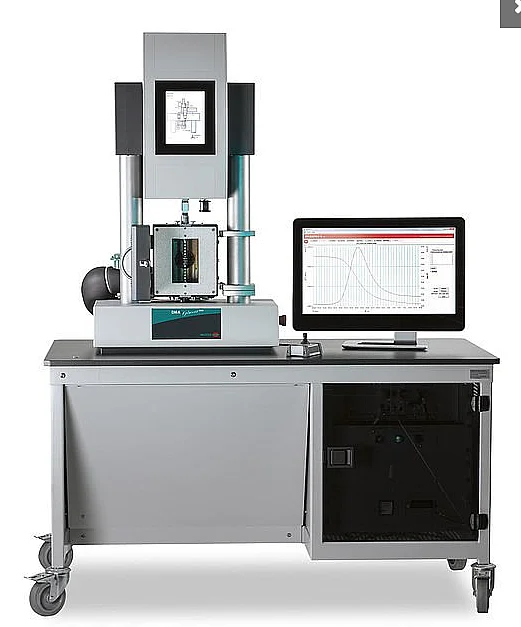
Im Rahmen eines vom TMWWDG-geförderten Projektes sollen die mechanischen Eigenschaften von funktionalisierten Bindemittelsystemen in Abhängigkeit von verschiedenen Umwelteinflüssen untersucht werden. Dafür stehen mit dynamisch-mechanischen Analysesystemen (DMA) innovative Untersuchungsmethoden bereit, die es erlauben, das mechanische Verhalten von kleinsten Prüfkörpern bei unterschiedlichen Temperaturen und Luftfeuchtigkeiten zu untersuchen. Die experimentellen Untersuchungen bilden die Grundlage für die computergestützte Beschreibung des Materialverhaltens auf Basis von Mehrskalenansätzen.
Arbeitsfelder
Auf Basis von vorgegebenen Rezepturen sollen umfassende experimentelle Untersuchungen zum viskoelastischen Materialverhalten von funktionalisierten Bindemittelsystemen durchgeführt werden. Die Versuche erfolgen selbstständig an Hochlast-DMA-Geräten. Ein besonderer Schwerpunkt liegt auf den Veränderungen der mechanischen Eigenschaften bei variablen Umgebungsbedingungen.
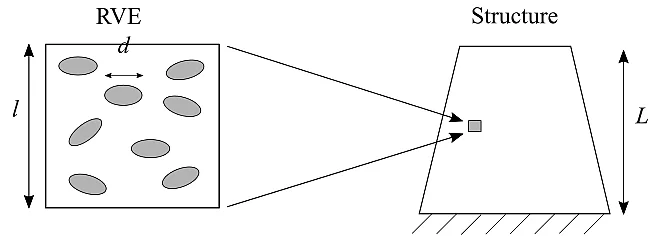
Neben den experimentellen Arbeiten bilden analytische Berechnungen einen Schwerpunkt der Arbeit. Mit Hilfe der experimentellen Daten soll untersucht werden, ob bestehende (mehrskalige) Modellansätze für die Vorhersage der mechanischen Eigenschaften von neuartigen Bindemittelsystemen verwendet werden können oder ob Anpassungen erforderlich sind.
Kontakt
Dr.-Ing. Luise Göbel (luise.goebel[at]uni-weimar.de)
Geeignet als: Bachelor- / Studien- / Masterarbeit
Entwicklung eines Versuchsaufbaus zur Bestimmung von Materialkennwerten durch dynamische Versuche (B.Sc.)
Während der letzten Jahre wurden am ISM in Zusammenarbeit mit der Materialforschungs- und Prüfanstalt (MFPA) Weimar zahlreiche Schwingungs- und Dämpfungsexperimente durchgeführt.
Im Fokus steht dabei die Ermittlung von Dämpfungskennwerten, wie der Material- und Fügestellendämpfung. Die durchgeführten Ausschwingversuche eignen sich zudem aber auch zur Identifikation von Werkstoffparametern, z.B. des E-Moduls.
Im Rahmen der geplanten Abschlussarbeit soll der bestehende Versuchsaufbau weiterentwickelt und professionalisiert werden, mit dem Ziel ein wirtschaftlich nutzbares experimentelles Setup zu konzipieren.
Neben Untersuchungen an unterschiedlichen Materialien und Werkstoffgeometrien sollen auch Experimente unter erhöhten Temperaturen und reduziertem Luftdruck einbezogen werden.
Die Abschlussarbeit soll neben einer Literaturrecherche eine Analyse bestehender Versuchsdaten beinhalten. Weiterhin soll ein generalisierter Versuchsaufbau entwickelt und die konstruktive Umsetzung geplant werden. Die einzelnen Arbeitsschritte können durch entsprechende experimentelle Tätigkeiten ergänzt werden.
Betreuung:
Modellbasierte Systementwicklung - eine Methode zur Entwicklung komplexer technischer Systeme (M.Sc.)
Die modellbasierte Systementwicklung (engl. Model Based Systems Engineering) ist eine anerkannte Methode zur Entwicklung komplexer technischer Systeme. Diese Methode basiert auf folgenden Grundsätzen:
Jedes technische System lässt sich in weitere Systeme (Teilsysteme) zerlegen und ist selber ein Teilsystem eines übergeordneten Systems
Der Entwicklungsprozess lässt sich in die aufeinanderfolgenden Abschnitte
Anforderungen – Funktionen – Konzepte – Prototypen einteilen.In jedem dieser Abschnitte werden spezifische Modelle eingesetzt, die in der Lage sind miteinander zu interagieren und damit das zu entwickelnde System abbilden.
Wissenschaftliche Fragen:
Welche Methoden zur Entwicklung zukünftiger komplexer Systeme gibt es im Bauwesen?
Welche Gemeinsamkeiten bzw. Unterschiede gibt es zwischen den Methoden im Bauwesen und der o.g. modellbasierten Systementwicklung?
Können Vorteile aus der modellbasierten Systementwicklung im Bauwesen genutzt werden?
Betreuung:
Moment-free Sensitivity Analysis of Engineering Models
To assess the influence of model parameters on the model's response, means of sensitivity analysis are applied.
Most of these methods are based on the analysis of the variance.
In this work, techniques shall be studied, which consider the complete distribution of a system's output during a Monte Carlo Simulation. Results are to be compared with variance-based methods.
The choice of the application (engineering model) is according to the students suggestion.
Contact: Prof. Tom Lahmer
Studien-, Bachelor- oder Masterarbeit an der MFPA Weimar im Bereich Kunststoff 3D-Druck und Werkstoff-Charakterisierung
Wir suchen…
engagierte Studenten aus dem Bereich Bauingenieurwesen oder ähnliches für experimentelle Arbeiten im Bereich Kunststoff-3D-Druck und experimenteller Charakterisierung.
Eigenmotivation und die Bereitschaft selbständig zu arbeiten wird vorausgesetzt.
Wir bieten…
spannende Themen im Bereich Kunststoff-3D-Druck, Werkstoffwissenschaft und Werkstoffprüfung sowie Sensorik. Kennenlernen und Einstieg gerne auch über HiWi-Stelle.
Interesse?
Info MFPA: Die Materialforschungs- und –prüfanstalt im Zentrum von Weimar ist eine außeruniversitäre Forschungseinrichtung und amtliche Materialprüfanstalt im Freistaat Thüringen. Forschungskompetenzen werden hierbei mit wirtschaftlichen Tätigkeiten bei der Prüfung, Überwachung und Zertifizierung von Werkstoffen, Bauteilen, Bauprodukten bis hin zu Bauwerken vereint. Weitere Info‘s hier www.mfpa.de.
Weitere Details / Kontakt: Andreas Kirchner, Dr.-Ing. Martin Ganß, Materialforschungs- und -prüfanstalt an der Bauhaus-Universität Weimar, Coudraystraße 9, 99423 Weimar, E-Mail: andreas.kirchner[at]mfpa.de, martin.ganss[at]mfpa.de